


Let Your Salespeople Sell. Let TRAQ Capture the Intelligence. Desktop & In-person.
by Adam Rubenstein | Conversation Intelligence | November 18, 2026
TRAQ \| PERSPECTIVE
TRAQ gives teams multiple ways to capture the conversations that matter—by bot, desktop, or mobile—without losing the intelligence inside them.
Summary
Salespeople do not sell in one place. They meet with buyers on Teams, Zoom, and Google Meet. They talk on cell phones. They visit customer offices, meet over lunch, and spend days having conversations at trade shows. Yet most sales technology sees only part of that activity. TRAQ helps close this conversation coverage gap with flexible capture options, including meeting bots, the TRAQ Desktop Recorder, the TRAQ Mobile App, and uploaded cell phone recordings, so important conversations can be captured and analyzed no matter how or where your people work.
The value is not simply in recording more conversations. It is in turning those conversations into insights and actionable intelligence that help salespeople follow up better, managers coach more effectively, and leaders understand what buyers, competitors, and the market are really telling them. The more complete the sales narrative, the better equipped the organization is to improve sales performance and efficiency.
“Nothing cripples a sale like incomplete information.”
For as long as I have been building and managing sales teams, I have watched salespeople face the same frustrating choice.
Pay close attention to the prospect. Or take good notes.
Listen for the concern behind the question. Or type fast enough to capture the words.
Stay focused on the conversation. Or worry about what must be entered into the CRM when the call ends.
That is a bad choice. And in most organizations, it creates an intelligence gap that gets wider with every conversation.
Salespeople love selling. They do not love documenting their sales. It is a bore and a chore. Yet the notes, commitments, concerns, objections, next steps, and subtle signals from a buyer are often the very things that determine whether an opportunity moves forward or dies quietly in the pipeline.
The problem is not that salespeople do not care. The problem is that they are trying to do two difficult things at once.
They are trying to sell. And they are trying to become a stenographer.
We believe it does not have to be this way.
TRAQ was designed to help salespeople do what they do best: engage with buyers, ask better questions, listen to learn, and move the conversation forward. At the same time, TRAQ helps capture the intelligence that is usually lost when the meeting ends.
The Right Capture Method Depends on the Conversation
TRAQ gives sales teams the flexibility to use a meeting bot, a quiet Desktop Recorder, in-person meeting capture or recorded phone call.
There is no single way that every salesperson, customer, or organization wants to capture a conversation.
For some virtual meetings, a TRAQ bot is the right choice. It can join scheduled calls and help ensure that important conversations are captured consistently.
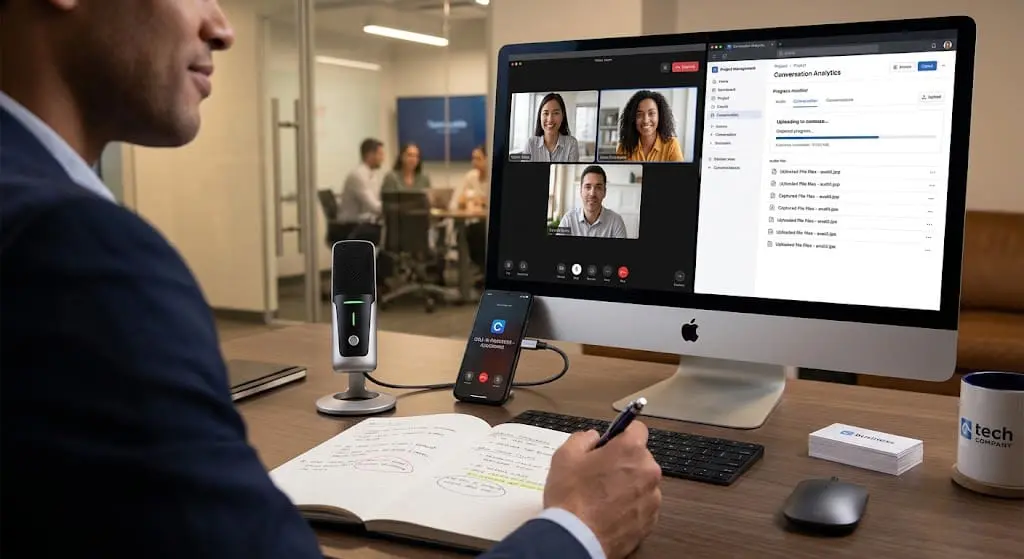
For other conversations, a salesperson may prefer a more discreet approach. TRAQ’s Desktop Recorder runs quietly on the salesperson’s computer. It does not appear as another participant in Zoom, Teams, or Google Meet. It acts as the salesperson’s personal assistant in the background, allowing them to focus on the buyer while TRAQ captures the conversation, takes notes, identifies follow-up items, and surfaces valuable insights.
Sales also happens in person. TRAQ’s mobile app helps teams capture important face-to-face conversations, whether they occur at a customer’s office, on a job site, at a conference, or over lunch.
And when a sales conversation happens by phone, sales teams can bring those recorded calls into TRAQ as well. The result is the same: a conversation that might otherwise remain isolated in a phone system or on a device becomes searchable, organized, and available for follow-up, coaching, and analysis.
The point is not that one approach is always better than another.
The point is that sales teams need the flexibility to capture the conversations that matter in the way that works best for the salesperson, the buyer, and the situation.
Whether the conversation is captured by bot, desktop, mobile, or uploaded phone recording, TRAQ helps turn it from raw data into insights and actionable intelligence.
The Desktop Recorder Is a Quiet Sales Assistant
When a bot is not the right fit, TRAQ’s Desktop Recorder gives salespeople a natural, non-disruptive alternative.
A meeting bot can be a very useful tool. It can automate capture, create consistency, and make sure conversations are not missed.
But there are times when a salesperson wants a different experience.
The buyer may prefer a more natural meeting environment. The salesperson may not want another participant showing up in the call. The meeting may be more personal, more sensitive, or simply better served by keeping the visible participants limited to the people who are actually having the conversation.
That is where TRAQ’s Desktop Recorder comes in.
It runs quietly on the salesperson’s desktop. It does not join the meeting. It does not enter a waiting room. It does not appear as an unfamiliar name in the participant list.
Instead, it works as the salesperson’s assistant.
The salesperson stays focused on the buyer. TRAQ helps capture the conversation and turn it into useful notes, follow-up tasks, buyer insights, and coaching intelligence.
No added participant in the meeting. Just a quiet assistant helping the salesperson do their job better.
That distinction matters because sales conversations are built on trust.
The buyer should be focused on the salesperson, the problem they are trying to solve, and the decisions ahead. The salesperson should be focused on the buyer. The last thing either person needs is technology competing for attention.
The Desktop Recorder does not ask the salesperson to change how they sell. It supports the way good salespeople already want to work.
Great Sales Conversations Require Full Attention
When salespeople can focus on the buyer instead of their keyboard, they hear more of what matters.
Think about a typical sales call.
A buyer says their current process is creating delays. They mention that the executive team is concerned about risk. They suggest that implementation may be difficult. They reference a competitor. They say they want to move quickly, but they have not yet identified who else needs to be involved.
Every one of those comments may matter.
But not all of them matter in the same way.
The best salespeople understand this. They do not simply listen for words. They listen for meaning. They recognize when a buyer is giving them an opening to ask a better question. They hear the difference between interest and commitment. They know when to slow down. They know when to challenge an assumption. They know when to ask, “Can you tell me more about that?”
Successful sales is the business of nuance and subtlety.
Unfortunately, nuance is easy to miss when the salesperson is looking down at a keyboard.
A salesperson who is trying to capture every detail is often not fully present. They may miss a change in tone. They may move too quickly past a concern. They may fail to ask the question that could have uncovered the real issue.
Then the call ends. The salesperson has a page of hurried notes, a calendar full of other meetings, and the familiar pressure to update the CRM before the details fade.
That is where important information disappears.
TRAQ helps remove that burden.
Whether the team chooses bot capture or the Desktop Recorder, TRAQ helps salespeople spend more time focused on the buyer and less time trying to document every word. After the conversation, they have a useful record of what was discussed and a clearer understanding of what needs to happen next.
The goal is not simply to record the meeting.
The goal is to improve the meeting.
A Transcript Is Raw Data. Intelligence Changes the Value of the Conversation.
TRAQ turns what was said into insights and actionable intelligence that guide what happens next.
There is a major difference between capturing a conversation and understanding it.
A transcript is raw data. It tells you what was said.
Notes are helpful. They help someone remember what happened.
But sales intelligence is something more valuable. It helps a salesperson and a sales leader understand what matters, why it matters, and what should happen next.
Did the salesperson uncover a real business problem?
Did the buyer share a concern about pricing, timing, implementation, competition, or risk?
Was the buyer engaged, skeptical, frustrated, or ready to move forward?
Did the salesperson ask enough questions before presenting a solution?
Did they follow the company’s sales methodology?
Was there a meaningful next step, with a clear owner and date?
These are not note-taking questions. They are performance questions.
TRAQ takes the information found within the conversation and turns it into insights and actionable intelligence. It can help identify buyer sentiment, follow-up tasks, important commitments, coaching opportunities, key objections, and the behaviors that may influence the outcome of a deal.
That changes the nature and value of the conversation.
Instead of ending with a raw recording or a block of text, the salesperson can leave with a clearer picture of what the buyer needs and what must happen next. Instead of relying on incomplete CRM notes, the manager has evidence to guide coaching and pipeline discussions. Instead of guessing what is happening in the field, the organization can begin to see the sales narrative.
Not everything in a conversation is important. But everything important is found within the conversation.
That is why TRAQ exists.
The Follow-Up Starts Before the Salesperson Leaves the Meeting
The details, commitments, and buyer concerns should not disappear between one call and the next.
Too often, the work that happens after a sales call is treated as an afterthought.
The salesperson leaves one meeting and immediately joins another. A few notes get entered into the CRM. Some of the important details are captured. Some are not. A follow-up email is sent later, perhaps after the salesperson has had time to reconstruct the conversation from memory.
The prospect is left waiting.
The sales manager sees activity, but not necessarily the truth. There may be notes in the CRM, but notes do not always tell the full story. They rarely capture the buyer’s tone, the real objection, the weakness in the discovery process, or the opportunity the salesperson failed to explore.
This is the black hole of the CRM.
Information goes in. Important context often disappears.
TRAQ helps close that gap.
By turning a conversation into organized notes, follow-up items, buyer insight, and coaching intelligence, TRAQ helps the salesperson make the next interaction stronger. It helps ensure that the customer’s concerns are not forgotten. It helps the salesperson prepare for the next meeting with more than a vague recollection of what happened.
And it gives the manager something much more useful than a status update.
It gives them the conversation behind the status update.
Sales Does Not Happen Only on Zoom
TRAQ captures the intelligence from important customer conversations, whether they happen virtually or face-to-face.
Virtual meetings are important. But they are not the whole story.
In many industries, the most important conversations happen in person.
They happen in a customer’s office. They happen on a job site. They happen in a conference room, at a trade show, over lunch, or during a walk-through. They happen wherever people build trust and make decisions.
These conversations often contain the most valuable intelligence. They are also the least likely to be documented well.
A salesperson may leave a customer visit with a few bullet points and a general feeling that the meeting went well. But what did the customer really say? What did they hesitate on? What issue did they raise that needs to be addressed? What did the salesperson promise to do? What did the sales manager need to know?
Without a useful way to capture the conversation, the answers may never see the light of day.
TRAQ’s mobile app extends the same philosophy beyond the desktop.
It helps salespeople capture important in-person conversations and turn them into useful information. The salesperson can stay engaged with the customer. TRAQ can help preserve the intelligence from the meeting so it can be used for follow-up, preparation, coaching, and better decision-making.
The conversation does not have to disappear just because it happened away from a computer.
If it was an important sales conversation, it should not be lost when the meeting ends.
From Personal Assistant to Organizational Intelligence
One conversation helps a salesperson. Hundreds of conversations reveal the sales narrative.
Each method of capture begins with a simple benefit for the individual salesperson.
A bot can help make sure scheduled meetings are captured consistently. The Desktop Recorder can help a salesperson stay fully present without adding another visible participant. The mobile app can help preserve the intelligence from a face-to-face meeting.
Together, they give the salesperson more flexibility and less administrative work.
But the value becomes even greater when a sales organization begins to see what is happening across all of its conversations.
With 10, 50, or 100 salespeople, reviewing every conversation is an impossible task. No sales leader has the time to listen to every call, attend every meeting, or manually review every piece of customer feedback.
In an ideal world, a manager would understand exactly what each salesperson was doing well, where they were struggling, what buyers were saying, and which opportunities needed attention.
Unfortunately, that type of detailed review is not possible through manual effort alone.
Until now.
TRAQ helps sales leaders move beyond anecdote and incomplete information.
Instead of asking a salesperson, “How did the call go?” and receiving the usual optimistic answer, the manager can look at the evidence in the conversation. Instead of treating every pipeline review as a collection of opinions, the organization can begin to identify patterns.
Where are deals stalling?
Which objections are coming up most often?
Are buyers concerned about price, implementation, timing, or something else?
Are salespeople asking enough discovery questions before they begin presenting?
Which coaching behaviors would have the greatest impact?
What are the top performers doing differently?
More data leads to more insights. And more insights and actionable intelligence yield better sales results.
This is how TRAQ helps organizations close the intelligence gap.
Coaching Should Begin With the Truth
The best coaching comes from what actually happened in the conversation, not what someone remembers afterward.
Most sales managers want to coach their teams. The challenge is finding the time and having the information needed to coach well.
Too often, coaching is based on a salesperson’s own summary of the call, a few CRM notes, or a manager’s memory of a single interaction. That creates a problem.
The salesperson may not remember the call accurately. The notes may leave out the most important moment. The manager may be coaching the wrong behavior because they do not have the full context.
TRAQ gives managers a better foundation.
It helps them review real conversations and identify real opportunities to improve. Coaching can focus on the questions the salesperson did not ask, the objection they did not explore, the moment they spoke too soon, or the follow-up they failed to establish.
This is not about blaming salespeople.
Salespeople are notoriously optimistic. It is a job requirement. Otherwise, they would be defeated by the frequent “no’s” they hear.
But optimism is not a substitute for visibility.
A good sales manager needs to know what is really happening, not just what everyone hopes is happening.
TRAQ gives managers the opportunity to coach from evidence. And when coaching is based on the truth of the conversation, it becomes more useful, more specific, and more likely to lead to improvement.
The Sales Narrative Is Already There
TRAQ helps organizations connect the signals hidden across individual customer conversations.
Every sales organization has a sales narrative.
It is the story buyers are telling about the company, the product, the market, the competition, the pricing, and the problems they are trying to solve.
It is also the story salespeople are telling through their questions, their presentations, their follow-up, and their ability to move opportunities forward.
The problem is that this narrative is usually scattered across hundreds of conversations.
A customer shares a concern with one salesperson. Another buyer mentions a competitor. A third explains why implementation is causing hesitation. Each comment may be placed in a separate CRM record, if it is recorded at all. Nobody connects the dots.
Three separate warning signs look like three separate events.
But together, they may reveal a much larger issue.
That is the difference between one strike and three strikes.
TRAQ helps organizations bring those conversations together. It helps turn individual meetings into a broader view of what is happening in the business. Leaders can see patterns, understand where action is needed, and make better decisions before it is too late.
The intelligence was always there.
It was simply trapped inside the conversations.
Better Technology Should Feel Like a Better Way to Work
TRAQ reduces the burden on salespeople instead of forcing every team into the same workflow.
Salespeople already have enough applications.
Every time a company introduces another technology platform, there is often a collective groan. Salespeople ask themselves, “What more do they want from me?”
That is a fair question.
The answer should not be another system that creates more work. Nor should it be a rigid process that assumes every sales conversation happens the same way.
TRAQ was designed to fit into the way teams already work.
Use a bot when automated virtual capture is the right fit. Use the Desktop Recorder when the salesperson wants a quiet assistant that does not join the meeting. Use the mobile app when the important conversation happens face-to-face.
Each option has a place. Each helps salespeople retain more of the intelligence from the conversations they are already having.
The platform is there to reduce the burden, not add to it.
A salesperson should not have to choose between a natural conversation and a useful record of that conversation.
A sales leader should not have to choose between managing from incomplete information and spending every waking hour reviewing calls.
And an organization should not have to accept that its most valuable customer intelligence will remain hidden in the conversations its people have every day.
Let Salespeople Sell
Whether the conversation is captured by bot, desktop, or mobile, TRAQ helps turn it into intelligence that improves performance.
The future of sales is not about forcing every salesperson into one workflow.
It is about giving good salespeople the support they need to be better listeners, better prepared, better coaches, and better managers.
TRAQ gives teams flexibility.
Use a bot when automated virtual capture is the right fit. Use the Desktop Recorder when the salesperson wants a quiet assistant that does not join the meeting. Use the mobile app when the important conversation happens face-to-face.
No matter how the conversation is captured, TRAQ helps turn raw data into insights and actionable intelligence.
That means better follow-up. Better coaching. Better visibility. And a clearer sales narrative.
Let your salespeople focus on the buyer.
Let TRAQ capture the intelligence.
And let the conversations that happen every day become one of your organization’s greatest sources of insights and actionable intelligence.
Meeting notes help you remember the conversation. TRAQ helps your team get better because of it.
Learn How TRAQ Transforms Sales Teams
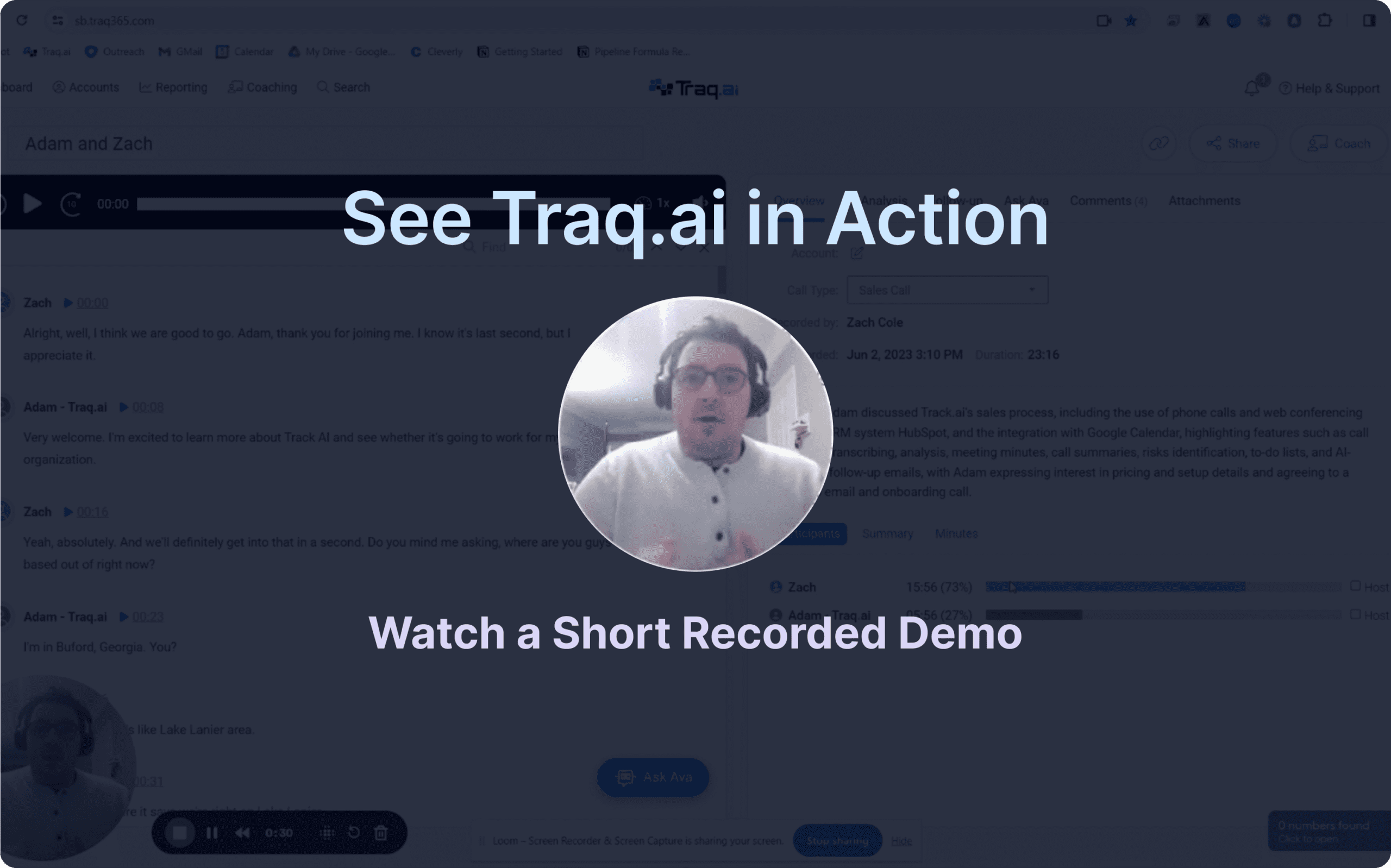
See TRAQ in action in this 5-min intro
Keep Learning

Conversation Intelligence vs Call Recording:
What Actually Moves Revenue
Some of Your Most Important Sales Conversations Never Make It Into Your Tech Stack