
Conversation Intelligence vs Call Recording:
What Actually Moves Revenue
Quick Summary.
Your team is recording every sales call. And those recordings are doing absolutely nothing for your revenue.
I’ve built and managed sales teams across multiple companies. The pattern is always the same: someone sets up call recording, feels good about it, and then three months later those recordings are sitting in a folder that nobody opens. Meanwhile, reps are burning 8 to 12 hours every week on manual admin work, deals are slipping through the cracks, and managers are making coaching decisions based on gut feeling instead of data.
Recording calls isn’t a strategy. It’s just storage with extra steps.
The recording is not the insight.
Here’s the honest truth about call recording: it only has value if someone goes back and listens. And in a team of 50 to 70 reps generating roughly 7,500 calls a month, that’s not happening. Not even close.
What you actually have is an archive. A very large, very expensive archive that tells you nothing about why deals are closing or why they’re not.
The assumption behind basic call recording is that visibility equals value. It doesn’t. A security camera records everything, but it doesn’t tell you what to do differently tomorrow.
Most ops teams don’t realize they have this problem until they’re sitting in a pipeline review trying to explain why Q2 looked nothing like Q1. The calls that could have answered that question were recorded. Nobody listened to them.
What intelligence actually means.
After every call, instead of an audio file sitting in a folder, you get structured data. Buyer objections. Deal risks. Action items. Patterns across hundreds of conversations that show you exactly what your best reps do differently from everyone else.
Nobody can remember every word and detail from a sales conversation. But a conversation intelligence platform can. As your rep engages the buyer, every question, need, objection, and concern is captured and accurately transcribed automatically, immediately after every call, without the rep lifting a finger.
That structured data isn’t locked inside one platform either. It can feed your internal AI tools, your dashboards, your enablement workflows. The conversation becomes an input, not an artifact.
Three things separate real conversation intelligence from a glorified recording tool:
- Automated scoring. Every call gets evaluated automatically. Did the rep uncover the real business problem? Did they handle the objection or dodge it? You know the answer without listening to a single minute of audio.
- Signal extraction. The system pulls out what matters: what the buyer pushed back on, where the deal might be at risk, what follow-up was promised. No manual note-taking. No deals going quiet because someone forgot to send the recap.
- Structured output your whole stack can use. This is the piece most ops teams don’t think about until they’re knee-deep in a tool evaluation. If the output is just a transcript, you haven’t solved the problem. You’ve just moved it. Structured data means every platform your team already uses can act on what happened in that conversation.
What happens to a call after it ends.
This is where the difference between recording and intelligence becomes impossible to ignore.
-
-
- Under basic call recording: The call ends. The rep closes their laptop and moves to the next meeting. Later, maybe, they log some notes manually. The recording gets auto-saved to a folder organized by date. A manager gets an alert that the call happened. Nobody listens to it. The deal either moves forward or it doesn’t, and nobody knows exactly why.
- Under conversation intelligence: The call ends. Within minutes, the system has already analyzed the entire conversation. The rep gets a summary of what was discussed, what they committed to, and what the buyer flagged as a concern. The manager gets an automatic score and a flag if something in the conversation suggests the deal is at risk. The structured data from that call joins every other call in the system, quietly building a picture of what’s working and what isn’t across the entire team.
-
Same call. Completely different outcome.
What 7,500 ignored calls actually costs you.
A mid-sized sales org, 50 to 70 reps, runs roughly 7,500 calls every month. Every one of those calls has information in it. What’s blocking the deal. What the buyer actually cares about. What objection keeps coming up that nobody has a good answer for.
If those calls are just being recorded, that information disappears the moment the call ends. Multiply that across a month, a quarter, a year, and you start to understand why so many sales teams keep making the same mistakes. Nobody told them they were making them, because the data that would have shown it was sitting in an audio file nobody opened.
Teams that shift from recording to intelligence see a different outcome. Based on TRAQ’s internal customer data, organizations see a 22% to 28% improvement in win and close rates within the first 90 days of consistent use. Not after a year of implementation. Within the first quarter.
Note: The 22%–28% figure reflects results observed during the first 90 days of consistent platform use across TRAQ customers. It is a directional performance result, not a universal guarantee. Outcomes vary based on adoption, management involvement, call volume, and the team’s starting sales process.
The coaching problem nobody talks about.
Here’s what I’ve seen happen in almost every sales org that relies on call recording for coaching.
A manager picks one or two calls a week to review, usually the ones from reps they’re already worried about. They listen, take notes, and schedule a coaching session. By the time that session happens, the call is days old. The rep barely remembers the specifics. The feedback lands as general advice instead of a precise correction. And next week, the same pattern repeats on a different call.
That’s not coaching. That’s a very slow, very expensive feedback loop that doesn’t change behavior fast enough to matter.
Conversation intelligence changes the entire model.
-
-
- Coaching becomes immediate. When a system analyzes every call automatically, the coaching moment doesn’t have to wait for a manager to find time to listen. The insight surfaces right away, when the context is still fresh and the rep can actually connect the feedback to what just happened.
- Coaching becomes specific. Instead of telling a rep they need to “handle objections better,” you can show them the exact moment in Tuesday’s call where the buyer raised a pricing concern and the rep pivoted to features instead of value. Specific feedback changes behavior. General feedback gets forgotten.
- Coaching scales across the whole team. This is the part that most recording-based approaches simply cannot do. When you have structured data from thousands of calls, you can identify patterns that no manager could spot manually. Which talk tracks are consistently losing deals. Which discovery questions lead to longer sales cycles. Which reps are handling competitive objections well and which ones aren’t. You can build a coaching library from real calls, share winning examples across the team, and let reps learn from each other at scale.
- Reps can coach themselves. With access to their own call data and scoring, reps don’t have to wait for a manager to tell them where they’re falling short. They can see it. They can access resources tied to those specific gaps and work on them independently. That shift from reactive coaching to self-guided improvement is one of the most underrated benefits of real conversation intelligence.
- Performance tracking becomes objective. One of the most uncomfortable parts of sales management is the subjectivity of performance conversations. With conversation intelligence, both the manager and the rep are looking at the same data. Progress is visible. Improvement is measurable. And the conversation shifts from opinion to evidence.
-
The teams that close more deals aren’t necessarily the ones with the best reps. They’re the ones that know what good looks like, can replicate it quickly, and close the gap between their average performers and their top performers faster than anyone else.
4 key mistakes ops teams make when evaluating tools in this category.
- Treating transcription as intelligence. A transcript is better than nothing. It is not conversation intelligence. If the main output of a platform is a searchable text version of your calls, you still don’t have the insight layer that drives coaching and performance improvement.
- Evaluating features without evaluating workflows. The demo will always look clean. The question is what happens to the data after the call ends. Where does it go? What can act on it? If the answer requires a manual step somewhere, that step will eventually stop happening.
- Ignoring adoption. The most sophisticated conversation intelligence platform in the world doesn’t help if reps treat it as surveillance. The tools that actually move revenue are the ones that give reps something valuable back. Summaries they would have had to write themselves. Coaching that helps them close more deals. Data that makes their job easier, not just their manager’s job easier.
- Focusing on recording quality instead of output quality. Audio clarity matters. What the system does with that audio matters more. Evaluate platforms on the quality and usability of what they produce, not just how well they capture.
A note on security and compliance.
Moving from basic recording to a conversation intelligence platform means your call data is doing more. That also means the question of who can access it, and how it’s protected, matters more.
TRAQ protects recorded calls with role-based access controls and multi-factor authentication, so access is limited to the right users and teams. Privacy controls include private conversation settings, configurable retention and deletion practices, and optional PII redaction. Customer data is never used to train generalized or external AI models without the customer’s written consent.
TRAQ’s security program is mapped to SOC 2, NIST, HIPAA, and GDPR requirements, and the platform supports compliance through its Data Processing Agreement and Standard Contractual Clauses. Following cancellation, customer data is retained for up to 90 days before deletion, unless a different arrangement is agreed upon.
The gap isn't technology. It's visibility.
I co-founded TRAQ because this problem kept showing up everywhere I looked. Sales leaders flying blind. Managers guessing at what their teams needed. Reps spending their best hours on admin instead of selling.
The conversations are already happening. 7,500 of them a month. The information is already there. The only question is whether your organization is capturing it in a way that actually improves what happens on the next call.
If it’s not, you don’t have a recording problem. You have a visibility problem.
Want to see what’s actually inside your sales conversations? Start your free trial and find out what your team’s calls have been telling you all along.
Learn How TRAQ Transforms Sales Teams
See TRAQ in action in this 5-min intro

Keep Learning
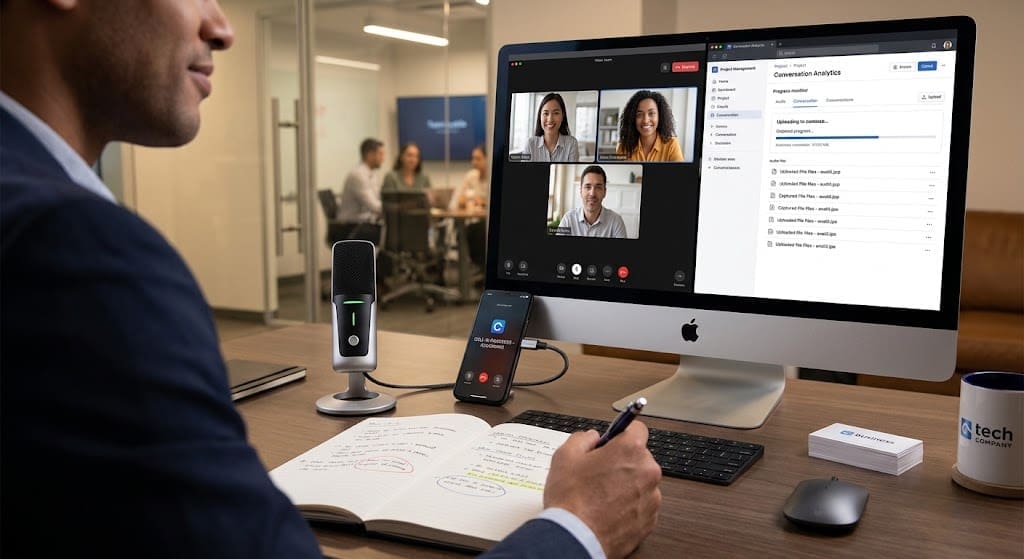
Some of Your Most Important Sales Conversations Never Make It Into Your Tech Stack

Your Conversations Shouldn’t Live in an Application