






Some of Your Most Important Sales Conversations Never Make It Into Your Tech Stack
Sales does not happen in one place. Your sales intelligence should not either. TRAQ’s Desktop Recorder and Mobile App capture conversations no matter how or where they occur.
Quick Summary.
Salespeople do not sell in one place. They meet with buyers on Teams, Zoom, and Google Meet. They talk on cell phones. They visit customer offices, meet over lunch, and spend days having conversations at trade shows. Yet most sales technology sees only part of that activity. TRAQ helps close this conversation coverage gap with flexible capture options, including meeting bots, the TRAQ Desktop Recorder, the TRAQ Mobile App, and uploaded cell phone recordings, so important conversations can be captured and analyzed no matter how or where your people work.
The value is not simply in recording more conversations. It is in turning those conversations into insights and actionable intelligence that help salespeople follow up better, managers coach more effectively, and leaders understand what buyers, competitors, and the market are really telling them. The more complete the sales narrative, the better equipped the organization is to improve sales performance and efficiency.
“Nothing cripples a sale like incomplete information.”
For as long as I have been building and managing sales teams, one frustration has remained remarkably consistent. Sales leaders want to know what is really happening with their customers, their prospects, their opportunities, and their salespeople. Yet much of the information they need never makes it into the systems they rely on to run the business.
We have CRMs. We have email. We have sales engagement platforms. We have meeting recorders. We have dashboards filled with data.
And yet, some of the most important information in the sales process is still trapped inside conversations.
The problem is bigger than poor note-taking. It is bigger than salespeople forgetting to update the CRM. In many organizations, entire conversations simply never enter the technology stack in the first place.
A meeting on Zoom may be captured. But what about the phone call that happens 30 minutes later? What about the conversation at the customer’s office? What about lunch with the decision-maker? What about the discussion in the hallway after the formal meeting ends? What about the 20 conversations your salespeople have at an industry trade show?
Those conversations may contain the objection that kills the deal, the competitor that keeps showing up, the product feature buyers keep requesting, the reason customers are hesitating, or the insight that changes your sales strategy.
If the organization cannot see the conversation, it cannot learn from it.
That is the conversation coverage gap.
And we believe it does not have to be this way.
Sales Does Not Happen in One Place.
Think about a normal day for a salesperson.
They may start the morning with a Microsoft Teams meeting from their laptop. A prospect calls their cell phone later that morning. They meet another customer for lunch. In the afternoon, they join a Zoom presentation with several stakeholders. The next day, they fly to an industry conference where they spend eight hours talking to prospects, customers, partners, and competitors.
Which one of those conversations is the sales conversation? All of them. Sales has never been confined to a conference room, and it certainly is not confined to Zoom, Teams, or Google Meet.
Yet much of the conversation intelligence market has been built around scheduled web conferences. That makes sense. Web meetings are relatively easy to identify and capture. A bot can join the meeting, record the discussion, and create a transcript.
That is useful, but web meetings are only one part of the sales narrative.
If your conversation intelligence platform sees the scheduled web conference but misses the cell phone call, the customer visit, the lunch meeting, and the trade show discussion, you may have excellent intelligence about only a portion of what is actually happening.
You do not have the full sales narrative. You have a few chapters.
The Right Capture Method Depends on the Conversation
I do not believe there is one “right” way to record every sales conversation.
Sometimes a meeting bot makes perfect sense. It can automatically join a scheduled meeting and make sure the conversation is captured consistently. For many teams and many situations, that is exactly what they want.
Other times, the salesperson wants a different experience. That is why TRAQ gives teams several ways to capture conversations. The goal is not to force the salesperson into a specific workflow. The goal is to make sure that important conversations do not disappear simply because of where or how they happened.
Use a meeting bot when a meeting bot makes sense. Use the TRAQ Desktop Recorder when the conversation happens on your computer and you do not want a bot joining the meeting. Use the TRAQ Mobile App when the conversation happens face-to-face. Bring recorded cell phone conversations into TRAQ when the discussion happens over the phone.
No matter how you work. No matter where you work. The conversation can become part of the intelligence your organization uses to improve sales performance and efficiency. That flexibility matters because selling is not standardized, and people are not standardized either. Technology should adapt to the way people sell rather than forcing every salesperson and every buyer to adapt to the technology.
The TRAQ Desktop Recorder Is a Quiet Sales Assistant

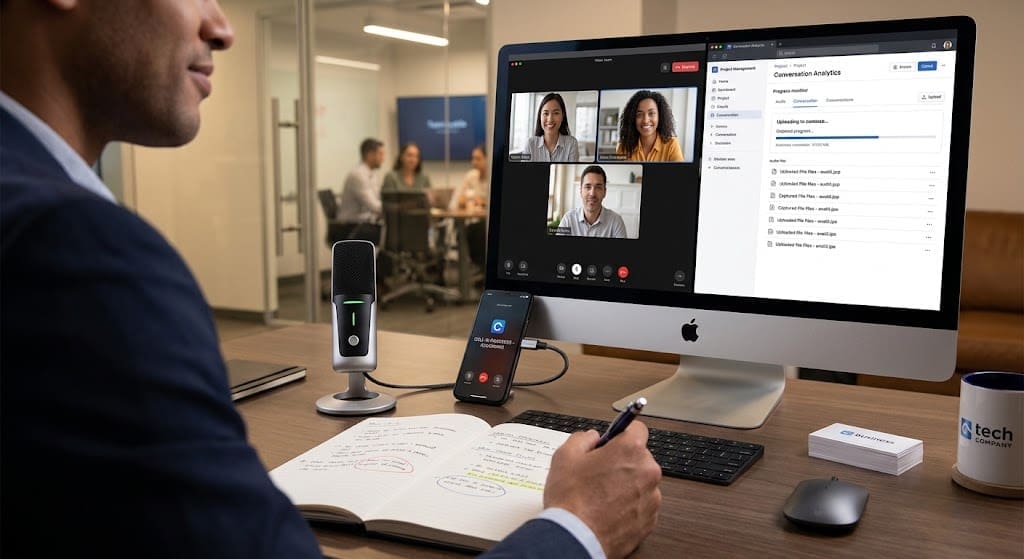
When a bot is not the right fit, the Desktop Recorder captures the conversation without joining the meeting.
Meeting bots can be very useful. We support them because there are plenty of situations where automated meeting capture is the right approach.
But there are also times when another participant showing up in the meeting is unnecessary or unwanted. Perhaps the buyer prefers a more natural meeting environment. Perhaps the salesperson does not want a recording bot entering the waiting room. Perhaps the conversation is sensitive. Perhaps there are only two people in the meeting and adding “TRAQ Notetaker” as a third participant simply feels awkward.
The TRAQ Desktop Recorder provides another option. It runs on the salesperson’s computer and can capture the conversation without joining Microsoft Teams, Zoom, or Google Meet as another participant. It does not enter the waiting room. It does not appear in the participant list. It simply works quietly in the background.
I like to think of it as a personal sales assistant. The salesperson can focus on the buyer, listen for what the buyer means rather than racing to type what the buyer says, and ask the next logical question instead of worrying about documenting the previous answer.
TRAQ can capture the conversation and then help turn what happened into useful notes, follow-up tasks, buyer insights, coaching information, and whatever other intelligence matters to that organization.
No extra meeting participant and no change to the basic way the salesperson works, just a quiet assistant helping preserve the intelligence from the conversation.
Great Sales Conversations Require Full Attention.
Salespeople should be listening to learn, not listening while trying to become stenographers.
Salespeople face a bad choice far too often: pay close attention to the prospect or take good notes, listen for the concern behind the question or type fast enough to capture the words, stay focused on the conversation or worry about what needs to be entered into the CRM when the call ends.
The problem is not that salespeople do not care about documentation. The problem is that they are being asked to do two difficult things at the same time. They are trying to sell, and they are trying to become a stenographer.
Successful sales is the business of nuance and subtlety. A buyer may say they are concerned about implementation, but their tone suggests the real concern is risk. They may say price is the issue when the real problem is that the economic buyer has not been convinced. They may casually mention a competitor that is actually much further along in the deal than the salesperson realizes.
The best salespeople listen for those signals. They hear the change in tone, notice hesitation, and recognize when a buyer gives them an opening to ask, “Can you tell me more about that?”
Those moments are easy to miss when the salesperson is looking down at a keyboard. Technology should help the salesperson become more present, not less present. The goal is not simply to record the meeting. The goal is to improve what happens because the meeting was captured.
Sales Happens in the Physical World Too.
Customer offices, lunches, conferences, trade shows, and job sites contain some of the richest sales intelligence in the business.
For all the technology we use in sales today, selling remains a very human activity. People meet. They shake hands, sit across the table from each other, walk factories, tour facilities, meet for coffee, eat lunch, stand in trade show booths, and have conversations in hallways after the “official” meeting has ended.
And in many businesses, those face-to-face discussions are some of the most important conversations in the sales process. They are also some of the least visible.
A salesperson may leave a customer meeting with a few handwritten notes and a general feeling that things went well. Perhaps they dictate a note into their phone later. Perhaps they enter a few sentences into the CRM that evening.
Or perhaps they do what salespeople frequently do. They move on to the next meeting, and important details begin to fade.
What exactly did the customer say about the competitor? Who did they say would be involved in the final decision? What concern did they raise about implementation? What did the salesperson promise to send? What was the buyer excited about? What question went unanswered?
Much of that intelligence may never see the light of day. The TRAQ Mobile App changes what is possible.
It allows the salesperson to capture face-to-face conversations so the intelligence from those discussions can become part of the same system that analyzes their virtual meetings.
The conversation does not have to disappear simply because it happened away from a computer.
Trade Shows May Be One of Your Biggest Intelligence Gaps.
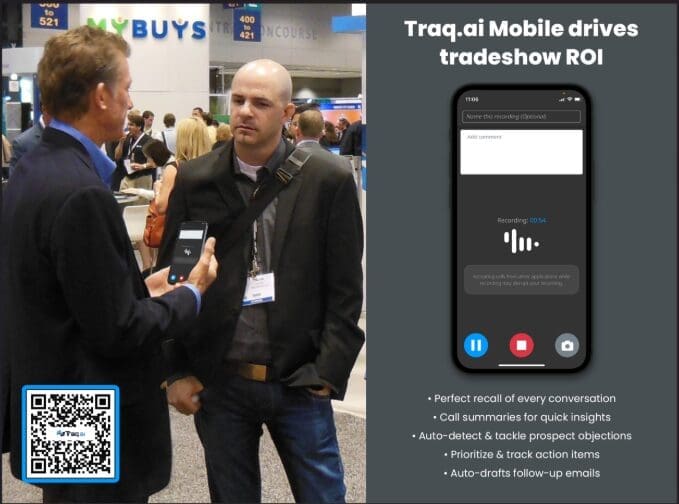
Companies spend heavily to create hundreds of valuable conversations and then allow much of the intelligence to walk out the convention-center door.
Trade shows are one of my favorite examples because they make the problem so obvious. Companies spend enormous amounts of money attending conferences. There are booths, sponsorships, travel, hotels, dinners, marketing materials, giveaways, and the opportunity cost of taking salespeople out of the field for several days.
The goal is conversation, and your team may have 100, 200, or 500 conversations during a large industry event.
Think about the intelligence buried inside those discussions. Prospects tell you what problems they are trying to solve. Existing customers tell you what they like and do not like. Buyers mention competitors. Partners talk about what is changing in the market. People ask for new capabilities. Pricing concerns come up. New use cases emerge. Patterns begin to develop.
Then the trade show ends and everyone heads to the airport. Some business cards get scanned. Some notes get typed into the CRM. Your salespeople try to remember which prospect said what, and an enormous amount of the intelligence you paid to acquire travels home inside people’s heads.
That seems crazy to me. Imagine instead being able to analyze those conversations together.
What competitor was mentioned most often? What problems came up repeatedly? What new product requests did we hear? Which prospects showed the greatest interest? What objections should our sales team be prepared to address? What did the market tell us over those three days?
Now the trade show becomes more than a collection of leads. It becomes a source of market intelligence.
Your Cell Phone Is Part of the Sales Tech Stack Too.
An important conversation does not become less important because it happened over a cell phone.
Not every sales call is scheduled. A prospect may call while the salesperson is between meetings. An existing customer may call with a problem. A decision-maker may return a voicemail while the salesperson is driving to the airport. A buyer may call after discussing the proposal internally and share the one concern holding up the decision.
Those conversations matter, and with cell phone call recording now becoming increasingly available, recorded cell phone conversations can also be uploaded into TRAQ and analyzed alongside other customer interactions.
That closes another part of the conversation coverage gap. The customer should not become invisible simply because they called a mobile number instead of clicking a Zoom link.
Whether the conversation happens through a web conference, on the salesperson’s computer, over a cell phone, or face-to-face, it can become part of the same body of sales intelligence.
That is a very different way of thinking about conversation intelligence. It is not meeting intelligence. It is conversation intelligence.
Capturing the Conversation Is Only the Beginning.
A recording tells you what happened. Intelligence helps you understand what to do about it.
I do not believe the real value of conversation intelligence is recording. Recording is the starting point. A transcript is raw data. It tells you what was said. Notes help someone remember what happened. Both are useful.
But they are not the final destination. The real value comes from understanding what is inside the conversation.
Did the salesperson uncover a real business problem? What objections did the buyer raise? Was a competitor mentioned? Is price really the issue? How does the buyer feel about moving forward? Who else needs to participate in the decision? Was the salesperson following the company’s sales methodology? Was there a meaningful next step? Did the salesperson make commitments that need to be completed?
These are not note-taking questions. They are business questions.
TRAQ can analyze conversations and turn what was said into insights and actionable intelligence. That might include buyer sentiment, next steps, commitments, competitive intelligence, coaching opportunities, product feedback, sales methodology adherence, CRM information, or dozens of other things.
Which brings me to one of the most important parts of the entire conversation-intelligence discussion: the intelligence that matters to one company may not be the intelligence that matters to another.
What Does Your Organization Want to Know?
The best conversation intelligence is built around the questions that matter to your business.
Not every organization sells the same way. A software company may want to know which integrations prospects request most often. An insurance organization may care about coverage discussions, cross-selling opportunities, compliance, and customer sentiment. A manufacturer may care about competitor products, pricing pressure, delivery concerns, or technical requirements.
A sales leader may want to know whether their people are asking good discovery questions. A product leader may care about feature requests. A marketing leader may want to understand how buyers describe their problems in their own words. An executive may want to understand why the company is winning and losing deals.
This is why I believe conversation intelligence needs to be customizable. The goal is not simply to apply the same generic analysis to every conversation at every company.
The question should be: What does your organization need to know?
Once that question is answered, conversations become an incredibly rich data source. Not everything in a conversation is important, but everything important is found within the conversation.
One Conversation Helps a Salesperson. Hundreds Reveal the Sales Narrative.
The real power emerges when individual conversations become organizational intelligence.
A single conversation can help one salesperson. It can help them remember what the buyer said, prepare better follow-up, identify commitments, and understand what needs to happen next.
But something much more interesting happens when you begin analyzing hundreds or thousands of conversations across the organization: patterns emerge. With 10, 50, or 100 salespeople, it is impossible for a sales leader to listen to every call, sit in every meeting, attend every lunch, and hear every conversation at a trade show.
In an ideal world, a manager would know exactly what was happening. They would know where deals were stalling, which objections were becoming more common, which competitors were gaining traction, which members of the team were struggling with discovery, and what their top performers were doing differently. They would understand what buyers liked, what they disliked, and what was changing in the market.
Unfortunately, that type of visibility is impossible through manual effort.
Until now.
When conversations are captured across the places sales actually happens, the organization can begin to connect the dots.
A prospect tells one salesperson that implementation looks difficult. Another prospect tells another salesperson the same thing. A third buyer raises the issue again during an in-person meeting. Three isolated comments may look like three unrelated events, but together they may reveal a problem. That is the difference between one strike and three strikes.
The sales narrative was always there. It was simply scattered across conversations.
Better Visibility Creates Better Coaching.
You cannot coach against conversations you cannot see.
Managers want to help their salespeople improve. The difficulty is knowing where the help is needed.
Too often, coaching begins with a salesperson’s recollection of what happened. The manager asks, “How did the meeting go?”
Salespeople are notoriously optimistic. It is almost a job requirement. Otherwise they would be defeated by the frequent “no’s” they hear. So the answer is often, “It went pretty well.” Maybe it did. Maybe it did not. Good coaching should begin with evidence.
Did the salesperson ask enough questions? Did they listen? Did they explore the objection or move past it too quickly? Did they understand the buyer’s real business problem? Did they create a strong next step? What are the best performers doing that others could learn from?
The more conversations an organization can capture, the more complete the coaching picture becomes.
And that matters because the conversation that reveals where a salesperson needs help may not be the Zoom meeting. It may be the phone call, the lunch, the customer visit, or the trade show conversation.
If you only coach against the conversations your technology happens to see, you may be coaching against only part of the salesperson’s performance.
More Conversation Coverage Creates Better Business Intelligence.
What begins as a productivity tool for the salesperson can become an intelligence platform for the organization.
There is an obvious benefit to the individual salesperson: less note-taking, better follow-up, better preparation, more time focused on the customer, and less administrative work. Those things matter, but the larger opportunity is organizational.
Once more conversations become visible, leaders can begin asking questions that were difficult or impossible to answer before.
What are customers saying about our pricing? Why are we losing to a particular competitor? What objections are increasing? Which features are buyers requesting? Which messages are resonating? What concerns are showing up early in deals that ultimately stall? What do our highest-performing salespeople consistently do differently?
Those answers can influence far more than sales coaching. They can influence sales strategy, product strategy, pricing, marketing, training, competitive positioning, hiring, and management.
This is why I often talk about insights and actionable intelligence. Data by itself does not improve sales performance. More useful data leads to better insights. Better insights create better decisions. Better decisions create better actions, and better actions improve performance.
Let Your Salespeople Sell. Let TRAQ Capture the Intelligence.
No matter how you work or where you work, the conversations that matter should become part of the sales narrative.
Salespeople already have enough technology. They do not need another platform that makes selling more complicated. They need technology that supports the way they already work.
Sometimes that means using a bot. Sometimes it means using the TRAQ Desktop Recorder so there is no bot joining the meeting. Sometimes it means using the TRAQ Mobile App while sitting across the table from a customer. Sometimes it means bringing a recorded cell phone call into TRAQ after the conversation ends.
The capture method may change, but the goal does not. If the conversation matters to your business, the intelligence inside it should not be lost.
Sales happens on Zoom. It happens on Teams. It happens on Google Meet. It happens over cell phones. It happens in offices, conference rooms, restaurants, job sites, cars, hotel lobbies, and trade show booths. Your sales intelligence should be able to go there too.
No matter how you work. No matter where you work. TRAQ helps capture the conversations that matter and turn them into insights and actionable intelligence. The more complete the sales narrative becomes, the better equipped your salespeople are to sell, your managers are to coach, and your leaders are to make better decisions.
More conversations create more data. More data creates more insights. And more insights and actionable intelligence drive better sales performance and greater efficiency.
That is why TRAQ exists.
About the Author
Adam Rubenstein is the CEO of TRAQ, a conversation intelligence platform for sales and customer-facing teams. He works with sales leaders to turn real conversations into structured insights, repeatable coaching, and measurable improvement, helping teams execute consistently and scale what works. Connect with Adam on LinkedIn or learn more at TRAQ.
Learn How TRAQ Transforms Sales Teams
See TRAQ in action in this 5-min intro

Keep Learning

Conversation Intelligence vs Call Recording:
What Actually Moves Revenue
Some of Your Most Important Sales Conversations Never Make It Into Your Tech Stack