



Are You Training Reps on How to Sell, or on How Your Best Reps Actually Sell?
Quick Summary
Sales training without reinforcement is just an expensive event. Here’s what you need to know:
-
-
- The forgetting curve is real. Reps forget 84% of training content within 90 days unless something keeps the learning alive in their daily workflow.
- Your best coaching material is already being recorded. The calls your top reps take every day contain more relevant training content than any outside workshop curriculum.
- Behavior change needs proof. Teams using TRAQ to coach from real call data report a 28% improvement in win rates within 90 to 120 days, giving enablement managers a trend line instead of a budget defense.
-
The two-day workshop went well. Reps were engaged, the facilitator was sharp, and everyone left with a binder full of frameworks. Morale was up for the next three weeks. But six weeks later, everyone reverted to their past behaviors.
This is not a training problem. It is a reinforcement problem, and it is costing you the ROI conversation with your VP of Sales.
Generic training works as a foundation. It gives reps a shared language and a starting point. But it cannot teach your reps how your best sellers handle the specific objection your buyers raise in the second call, or how they move a stalled deal forward using language that actually resonates in your market. That knowledge lives in your calls, not in a workshop curriculum.
The Forgetting Curve Is Not a Theory. It Is Your Call Data.
Faster than most enablement budgets assume. The research on this is consistent and brutal.
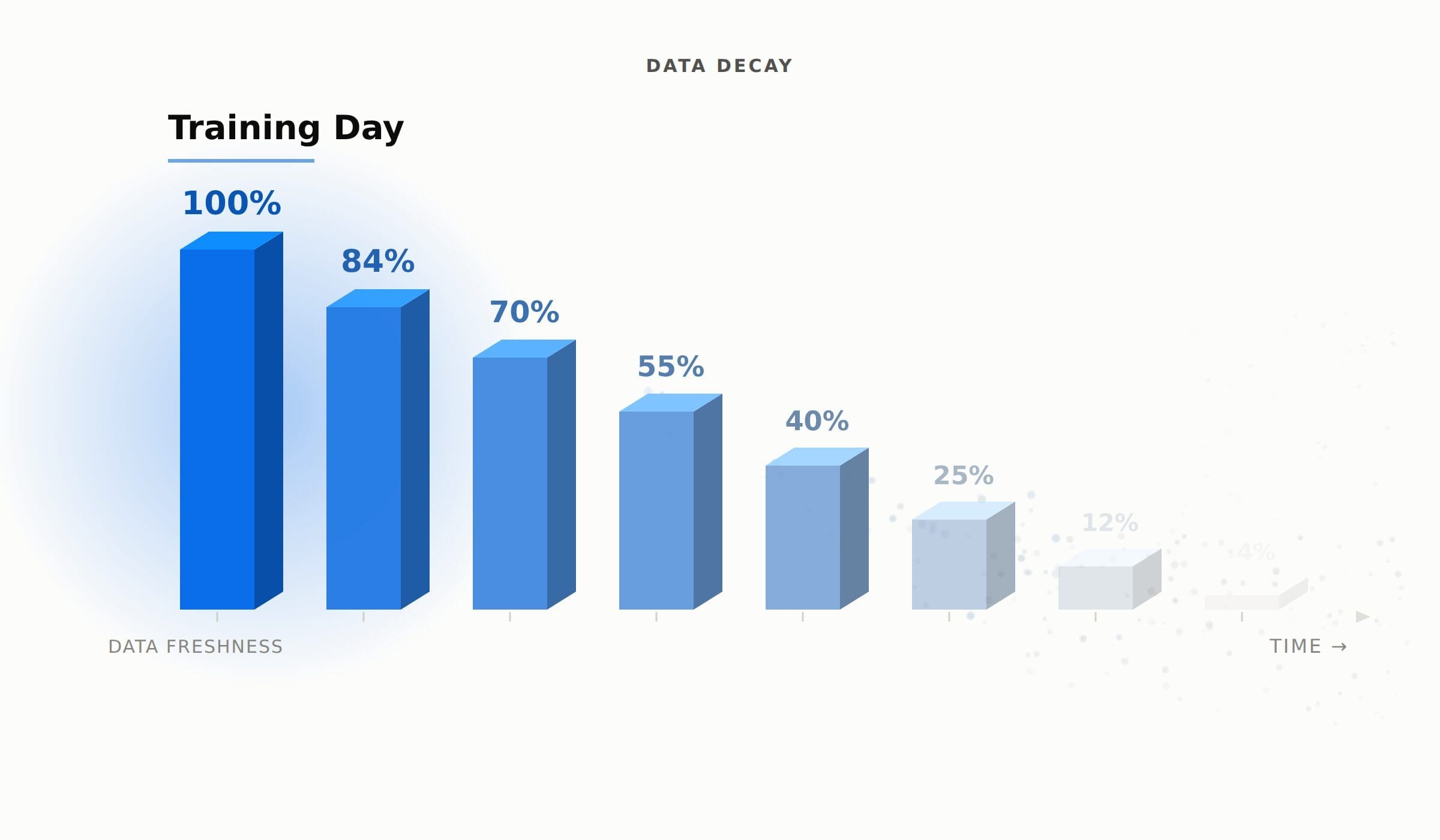
Reps forget roughly 70% of what they learned within 24 hours of a training session. Half of it is gone within about five weeks. By the 90-day mark, 84% of sales training content is forgotten entirely when there is no reinforcement behind it. One widely cited study from ES Research put it even more bluntly: about 90% of sales training produces no lasting change in behavior at all.
The same curve shows up in call data. Teams often show a real lift in the target behaviors for the first week or two after a training event. Then, call by call, reps drift back to whatever they were doing before. Not because they rejected the training, but because nothing in their daily workflow was reminding them to apply it.
The workshop was an event. Selling is a habit. Habits win unless something keeps the new behavior in front of the rep, in context, on real calls.
What Generic Training Gets Right, and Where It Stops Working.
The problem is not the methodology. The problem is the gap between learning a framework in a classroom and applying it consistently in a live conversation with a skeptical buyer.
A rep can leave a Challenger training knowing exactly what a reframe is supposed to sound like. Then they get on a call, a buyer pushes back, and they default to whatever felt natural before the training.
That gap does not close with more classroom time. It closes with repetition, feedback, and examples that feel real because they are real.
The Reinforcement Problem, Done Manually.
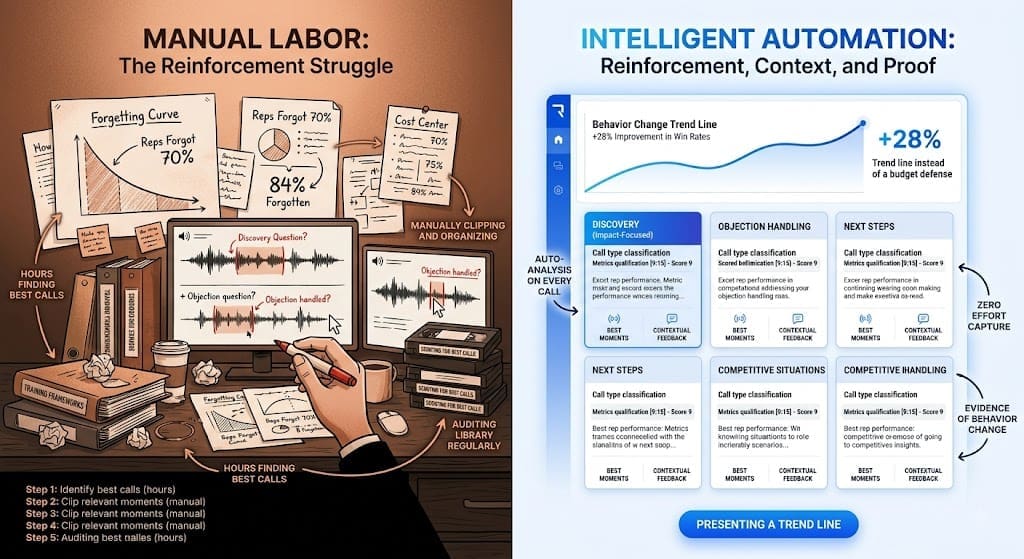
If you wanted to build a reinforcement system from scratch without purpose-built technology, here is what that actually requires:
Step 1: Identify your best calls. Go through your call recording library and find 15 to 20 calls from top performers that represent different stages and scenarios. This alone takes several hours if your library is not tagged or searchable.
Step 2: Clip the relevant moments. For each call, find the specific moments where the rep executes the methodology correctly. The discovery question that surfaces business impact. The objection response that keeps the deal alive. The close that gets a real commitment. Clip each one manually.
Step 3: Organize by scenario. Sort your clips by use case: discovery, objection handling, next steps, competitive situations. Build a folder structure your reps can actually navigate.
Step 4: Map clips to your methodology. Tag each clip to the relevant framework stage so a rep training on MEDDPICC can find examples of metrics qualification happening in a real call, not a role play.
Step 5: Keep it current. Your market changes. Your buyers change. The clips you pulled six months ago may no longer reflect how your best reps are winning today. Someone has to audit and refresh the library regularly.
Step 6: Track who is using it. If you cannot show your VP of Sales that reps are engaging with the library and improving, the whole system is invisible as an investment.
This is a part-time job that most enablement managers are doing on top of everything else they own.
How TRAQ's Coaching Library Solves This Workflow.
Every call is analyzed, classified by call type, and scored against your evaluation framework, with every scored behavior tied to a timestamp. So when an enablement manager wants strong examples of impact-focused discovery or a well-handled pricing objection, they are not scrubbing through recordings hoping to stumble on one. TRAQ has already identified those moments across the entire call library. Finding your best examples becomes a matter of reviewing what the platform has surfaced, not hunting for it.
From there, building the library is capture and context. The manager takes a surfaced moment, adds the framing a rep needs to learn from it, what happened, why it worked, what to listen for, and files it by scenario and methodology stage. A rep working on metrics qualification can go straight to real examples of metrics qualification, in your product, with your buyers.
Step five solves itself. Because TRAQ never stops analyzing calls, the freshest examples of what is winning right now keep surfacing automatically. The library does not go stale in a folder, because the pipeline that feeds it runs on every new conversation.
On step six, TRAQ gives enablement something stronger than click counts: evidence of behavior change. Because every rep’s calls are scored continuously, you can see whether the behaviors the library teaches are actually showing up in live conversations, rep by rep, week by week. Usage tells you a rep opened a resource. Call scores tell you it worked. That is the number a VP of Sales actually cares about.
Building Onboarding From What Actually Works in Your Market.
When onboarding is grounded in real calls, two things happen. New reps ramp faster because they are learning from situations they will actually face, not hypothetical scenarios built for a general audience. And the methodology your team invested in gets reinforced in context, which is the only place it sticks.
TRAQ’s coaching library lets enablement managers build training resources directly from real call moments. Instead of telling a new rep what a great discovery question sounds like, you show them one from your top performer, in a real conversation, with a real buyer who sounds exactly like the prospects they are about to call.
That is the difference between a rep who understands MEDDPICC and a rep who uses it.
The average ramp time for a new sales hire is around nine months, and it stretches even longer in complex and technical sales. Most of that time is not spent learning the product. It is spent learning the conversations. What buyers in this market actually ask, which objections are real and which are reflexes, and what a winnable deal sounds like at each stage.
That is exactly the knowledge a coaching library built from real calls transfers on day one. A new rep at a TRAQ client does not spend their first month guessing what good sounds like. They hear the team’s best discovery calls, the objection responses that actually work with these buyers, and the closes that get real commitments, before they ever dial.
Then, once they start taking calls, their own conversations are scored against the same framework. The manager sees exactly where the new rep is on track and where they need help, from the very first week instead of the first quarter.
The pattern we see with clients is that new reps stop needing to learn by losing. Instead of burning their first thirty prospects figuring out the conversation, they start closer to the team’s standard and get specific feedback on every call from the start. Compressing even a month or two out of a nine-month ramp is worth tens of thousands of dollars per hire in recovered productivity, and it compounds with every seat you fill.
Proving It Is Working.
When a VP of Sales asks whether the training investment is paying off, “reps said the workshop was great” is not an answer. Neither is “we built a coaching library.” The answer has to connect training activity to pipeline behavior.
TRAQ tracks rep behavior across calls over time. You can see whether reps are actually applying what they learned, where they are still reverting to old habits, and which coaching interventions are moving the needle. That data is what turns an enablement program from a cost center into a measurable driver of rep performance.
TRAQ gives enablement the one thing most training programs cannot produce: a before-and-after picture built from actual selling behavior.
Because every call is scored against a consistent framework, you can baseline the team before a training initiative and then watch the specific target behaviors over the weeks that follow. If the workshop was about discovery, you can see whether discovery scores actually moved, for which reps, and whether the change held at 30, 60, and 90 days or faded on the forgetting curve like most training does.
That is the difference between reporting that training happened and reporting that training worked.
The same data breaks down by rep and by behavior, so you can show where coaching interventions landed and where reps are reverting. A team-level view shows the distribution: is the middle of the team closing the gap to the top performers, or is the average being carried by the same two people it always was?
Because scored behaviors connect to outcomes, you can tie the behavior change to the numbers the VP of Sales already watches. Across our client base, teams that coach consistently from this data report a 28% improvement in win rates within the first 90 to 120 days. That is a very different ROI conversation than a post-workshop satisfaction survey.
For the enablement manager, this reframes the whole role. You are no longer defending a budget line. You are presenting a trend line.

Where Workshops Fit In This Model.
A well-run workshop still has a place. It aligns the team, builds energy, and introduces frameworks in a way that is hard to replicate asynchronously. The shift is in treating the workshop as the start of the process, not the deliverable.
The workshop introduces the methodology. TRAQ reinforces it through real calls, flags where reps are not applying it, and gives managers the data to coach with precision instead of intuition. Reps get self-guided resources they can access when they need them, not six weeks after a training event when the moment is already gone.
Every call TRAQ analyzes is evaluated against the framework your team is being trained on, stage by stage. The platform does not just tell you a call went well or badly. It tells you which parts of the methodology showed up and which got skipped. The rep asked strong situation questions but never quantified impact. The objection was answered but never acknowledged first. The call ended with “I’ll send some information” instead of a committed next step. Each of those gaps is flagged as a specific, timestamped moment in a real conversation.
For the manager, those flags roll up into a coaching report per rep: here is where this rep consistently executes the methodology, and here is the stage where they consistently drop it. That changes the 1:1 from a generic review into a precise conversation. Instead of “work on your discovery,” the manager can say “in three of your last five calls, the buyer mentioned a business problem and you moved on without asking what it costs them. Let’s listen to one of those moments together.” Then the rep can go to the coaching library and hear a teammate handling that same moment well.
That loop, flag the gap, coach the moment, show the example, repeat on the next call, is the reinforcement system the workshop never had. It is why the methodology stops fading at week six and starts compounding instead.
The Budget You Spent on That Workshop Does Not Have to Fade.
Your best training content is already being recorded every day on your own calls.
The question is whether you have a system that finds it, organizes it, and keeps it working, or whether it disappears into a folder no one opens.
See how TRAQ turns your call library into a coaching system that actually sticks.
Learn How TRAQ Transforms Sales Teams
See TRAQ in action in this 5-min intro

Keep Learning

Conversation Intelligence vs Call Recording:
What Actually Moves Revenue
Some of Your Most Important Sales Conversations Never Make It Into Your Tech Stack