








The CRM Was Never the Truth. It Was the Best We Had.
Quick Summary:
Every sales leader has opened a CRM after a big call and found three bullet points where a 90-minute conversation used to be. It’s not a rep problem. It’s a design problem. CRMs were built to store what people report, not what buyers actually say. For years, that was the best we had. Forecasts were built on filtered memories, coaching was based on gut feel, and pipeline reviews were more interrogation than analysis. Conversation intelligence changes the foundation entirely. Instead of asking reps to translate reality into notes, it captures reality directly from the conversation itself, and that changes everything from forecast accuracy to how fast a new hire can ramp.
- Accurate pipeline data: No more forecasts built on filtered memories and Friday afternoon updates
- Real coaching material: Managers coach from actual calls, not secondhand accounts
- Macro trend visibility: Spot team-wide patterns like rising pricing objections or competitor mentions before they show up in your close rate
- Compounding results: Clients see a 28% lift in win rates and reps recover 5-7 hours per week
- Faster onboarding: New hires learn from a library of real winning calls on day one, instead of waiting weeks to shadow live calls
Curious, I opened our CRM to review the notes. There were three bullet points. One of them said: “Pricing too high.”
I looked at him and said, “You just had a 90-minute conversation with the CMO of one of the largest companies in the US, and the totality of your recollection is two innocuous bullets and that the price was too high? What are we supposed to do with that?”
He wasn’t a bad salesperson. He was a good one. That’s what made the moment stick with me. If a senior executive coming off the best call of his quarter could only surface three bullet points, the problem wasn’t the rep. The problem was the system we were asking him to feed.
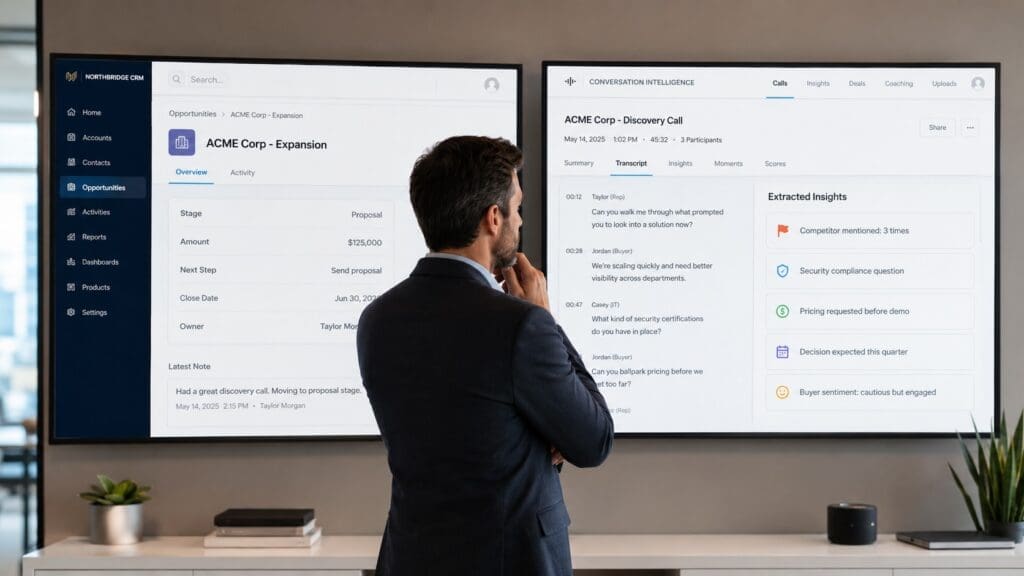
Every sales leader has a version of this story. It’s the quiet problem at the center of modern sales: reps hate updating the CRM, and when they do, the data is subjective, late, or incomplete.
Industry analysts have warned about CRM data decay for years. Contacts change jobs, deals shift, and notes go stale. But decay isn’t the real issue. The real issue is that the data was never fully accurate in the first place.
Platforms like Salesforce and HubSpot are only as good as human memory. Reps filter reality. Sometimes they do it to make a deal look healthier than it is. Sometimes they’re just recalling a call from three days ago while juggling twelve others. Multiply that across an entire team and you get sales pipeline leakage that no dashboard can explain. Deals that looked solid until they suddenly weren’t.
So why do traditional CRMs fail to provide accurate sales forecasts? Because every number you commit to the board is built on those filtered notes. When a rep marks a deal at 75% because the call “felt good,” that guess flows straight into your revenue projection. It’s why so many quarters end in a scramble: the pipeline said one thing and reality said another. And the damage doesn’t stop at a missed number. Hiring plans, marketing spend, and investor confidence all ride on pipeline reliability. When the underlying data is soft, every decision built on top of it is soft too.
The limitations of manual sales activity tracking aren’t a training problem or a discipline problem. They’re a design problem. And that design is finally being replaced.
A Quick History of “Must-Have”
Every era of business has its non-negotiable tool. Decades ago, when you started a company, the first move was buying an 800 number. Then it was the yellow pages ad. Then it became standing up a website. And for the past 15 years, it was launching a CRM.
 It’s worth remembering why the CRM earned that status. Before it, customer knowledge lived in three places: a rep’s head, a rep’s notebook, and a rep’s rolodex. When the rep left, all three walked out the door with them. The CRM changed that. For the first time, a company owned its own customer history. Pipeline stages, contact records, and deal notes lived in one system that survived turnover. That was genuinely transformative, and I don’t want to minimize it.
But every one of these tools felt permanent at the time, and none of them were. The 800 number and the yellow pages ad didn’t disappear because they stopped working. They were replaced by something that captured reality more directly. The CRM is now facing the same moment.
Look at what the modern sales tech stack has become. The CRM sits alongside the contact database, the outbound outreach tools, the data enrichment services, the scheduling apps, and a dozen other point solutions. Each one does its job well. None of them holds the truth. The contact database tells you who the buyer is. The enrichment tool tells you where they work and what they might care about. The outreach platform tells you what you sent them and whether they opened it. But not one of these tools can tell you what the buyer actually said when you finally got them on a call.
And even that is only half the job. Capturing the words is the starting point. The real value is in the analysis. What did the buyer mean? What does it signal about where the deal is headed? What obstacles are standing in the way? What will it take to win the business? And what can this call teach the rest of the team? A recording answers none of those questions on its own. The analysis does. That’s the difference between having the truth and being able to use it.
That’s the job being taken over by conversation intelligence. The CRM is being unbundled into this broader stack, and the piece inheriting its most important role, holding the truth, is the one built on the conversations themselves.
From System of Record to System of Reality
Now for the nuance, because “delete your CRM” makes a great headline and terrible advice.
Here’s the distinction that matters. A CRM is a system of record: a ledger of what people say happened. Conversation intelligence is a system of reality: a record of what actually happened.
The difference goes well beyond call recording. A recorder captures raw audio and leaves you with hours of playback that nobody has time for. Modern conversation intelligence extracts the unstructured data buried inside every call, including objections, competitor mentions, pricing pushback, buying signals, and commitments made. Then it turns those elements into structured, objective updates that flow into the CRM automatically.
That’s the real comparison when people ask about conversation intelligence vs CRM. It’s not either/or. It’s the difference between a filing cabinet and a witness. One stores what someone wrote down later. The other was in the room.
This is also why revenue intelligence platform analytics have become a board-level topic. Real-time sales data capture doesn’t just make life easier for reps. It changes what leadership can see. AI-driven sales forecasting accuracy improves for a simple reason: the forecast is finally built on the conversations themselves, not on a rep’s interpretation of them.
How does conversation intelligence improve sales pipeline visibility? By replacing the summary with the source. When every deal in the pipeline is backed by what the buyer actually said, a pipeline review stops being an interrogation and starts being an analysis.
The Three Gaps Conversation Intelligence Closes
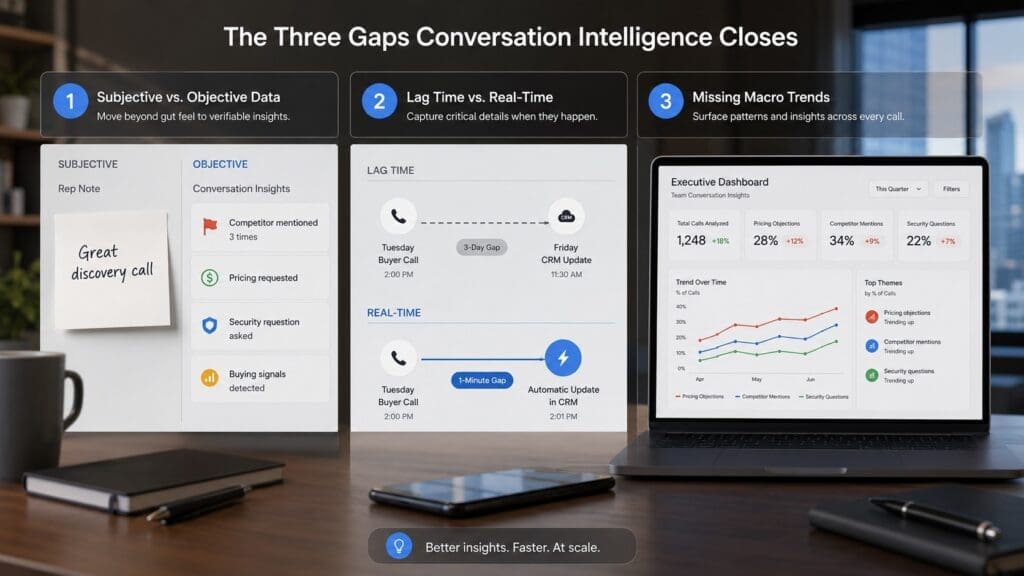
Gap 1: Subjective vs. Objective Data
A rep logs: “Had a great discovery call.” Conversation intelligence logs: “Buyer mentioned a competitor three times, asked about enterprise security compliance, and requested pricing before the demo.”
One of these tells you how the rep felt. The other tells you what the buyer did. We are more concerned with the buyer’s journey.
Think back to that Ford call. Somewhere in those 90 minutes, a CMO explained exactly why the pricing felt too high. What he was comparing it to. What budget he was working within. What would have changed his mind. All of it was said out loud. None of it made the CRM. Buying signals in discovery calls are the most valuable data in the entire sales cycle, and for years, most of them evaporated the moment the call ended.
Gap 2: Lag Time vs. Real-Time
Reps update deals on Friday afternoon. Buyers make decisions on Tuesday morning. That gap is where deals die quietly.
Automated sales call notes sync buying signals to the pipeline the moment a Zoom or Teams call ends. Not at the end of the week, and not filtered through what the rep remembers. Automated CRM data entry isn’t a convenience feature. It’s the difference between managing the pipeline you have and managing the pipeline you had five days ago.
Gap 3: Missing Macro Trends
Even a perfectly updated CRM can only tell you about individual deals. It can’t tell a VP of Sales that pricing objections spiked across the whole team this month, or that a specific competitor started showing up in twice as many calls after their product launch.
Imagine learning that pricing pushback rose 22% team-wide in a single month, before it showed up in your close rate. That’s the kind of early warning a ledger simply cannot produce, but competitor mention analytics and team-wide conversation patterns can. For regulated industries, the same capability powers sales team compliance tracking: knowing what was actually said, on every call, without relying on self-reporting.
The Coaching Opportunity Hiding Inside This Shift
There’s a second story here that gets less attention, and I think it may matter even more over time.
For decades, sales coaching has been built on ride-alongs, role plays, and whatever the manager happened to overhear. A sales manager with eight reps might catch a handful of live calls a month. That means coaching decisions were based on a tiny, random sample of each rep’s actual work.
Conversation intelligence changes the math. When every call is captured and analyzed, a manager can see how each rep handles objections, how much they talk versus listen, and where deals stall in their conversations. Even better, you can study what your best rep does differently and teach it to everyone else. The playbook stops being a document someone wrote two years ago. It becomes a living thing, built from the calls that are actually winning.
This matters most for ramping new hires. Instead of shadowing calls for six weeks, a new rep can study a library of your team’s best conversations on day one. In my experience, that’s where the ROI shows up first, before the forecasting benefits even kick in.
But new hires aren’t the only ones with room to grow. Your experienced reps may have the most to gain, because their habits are the most set. A veteran who has been selling the same way for ten years rarely gets real feedback anymore. Nobody rides along with them, and nobody questions their approach as long as the numbers hold up. Conversation intelligence gives them what great athletes have always had: game film. They can review their own calls, spot the exact moment a deal turned, and compare how they handle a pricing objection to how the rep down the hall handles the same one. Self-awareness is the hardest thing to coach, and a recording of your own call delivers it better than any performance review.
Here’s the part most leaders miss. The biggest revenue gains don’t come from fixing your weakest rep. They come from moving your solid B players closer to your A players. Those reps already carry most of the pipeline, so even a small lift in their win rate moves the whole number. That kind of targeted improvement is nearly impossible when coaching is based on memory and gut feel. It becomes routine when every rep’s calls are on film.
What Kind of Return Should You Expect?
Every sales leader eventually asks the same question: what does this actually deliver? Fair question. Here’s what the results look like in practice, with the obvious caveat that every team starts from a different baseline, so your mileage may vary.
Win Rates
The clearest impact shows up in win rates. Our clients see a 28% improvement in win rates within the first 90 to 120 days. That number surprises people until they think about where it comes from. Reps stop walking into calls blind, because they’ve studied what worked in similar deals. Managers stop coaching from memory, because they can see exactly where deals stall. And the objections that used to kill deals quietly get spotted and addressed while there’s still time to act. None of those changes is dramatic on its own. Stacked together, they move the win rate in a way almost nothing else can.
Time Savings
The second return is time, and it arrives even faster than the win rate lift. Our clients tell us their reps get back about 5 to 7 hours each week. That’s the time that used to go to writing call notes, updating CRM fields, and reconstructing conversations from memory. Give a rep an extra workday’s worth of hours every week and something has to improve. More calls, better preparation, faster follow-up, or all three. Multiply that across a team of ten and you’ve effectively added a rep and a half without hiring anyone.
The Compounding Return
The third return is harder to put a number on, but it may be the largest over time. Every recorded conversation makes your library smarter. Your onboarding gets faster because new hires learn from a growing archive of winning calls. Your playbook gets sharper because it’s rebuilt from what’s working right now, not last year. Your forecasts get more reliable because they’re grounded in evidence. The win rate lift and the time savings show up in a quarter. The compounding advantage shows up in a year, and by then it’s very hard for a competitor to catch up.
The Honest Take: It’s an Integration, Not a Funeral
Now for the nuance, because “delete your CRM” makes a great headline and terrible advice.
 The CRM isn’t going away. It remains the operational backbone. It’s where pipeline stages, contracts, and customer history live. What’s changing is its role. The CRM is losing its claim to being the source of truth and settling into what it always did best: being the system of record.
The future looks like conversation intelligence feeding the CRM automatically. Salesforce conversation intelligence integrations and AI tools for HubSpot automation are maturing fast. The endgame is what some are calling zero-entry CRM tools: a world where reps never type a deal note again because the conversation itself populates the record.
That’s the actual promise here. Not replacing the CRM, but freeing it from its worst dependency, which is human data entry. When the manual work disappears, reps get their hours back to do the thing they were hired to do, which is sell. And leaders get something they’ve never truly had: a pipeline built on reality.
What Sales Leaders Should Do About It
The question isn’t whether this shift is coming. It’s whether you’ll be early or late. Here’s the practical path, and it’s the one I wish I’d had the day I opened our CRM and found three bullet points.” This adds urgency, though it’s a bit longer.
- Start by capturing everything. You can’t analyze conversations you didn’t record. Make recording the default for every sales call, with proper consent, and treat the recordings as a company asset just like the CRM data they’ll soon replace.
- Decide what truth you need. Every business has its own signals that matter. For some it’s competitor mentions. For others it’s compliance language, pricing objections, or specific buying questions. Define the elements of your winning strategy before you pick tools, not after. Some platforms make it possible to develop your own unique customized analyses.
- Connect it to the CRM, don’t run it beside the CRM. The value multiplies when conversation data flows into your existing records automatically. A standalone library of call recordings is a filing cabinet with extra steps.
- Review trends monthly at the leadership level. The macro signals, like rising objections or shifting competitor mentions, belong in your leadership meetings next to the revenue numbers. That’s where conversation data stops being a rep tool and becomes a strategy tool.
Teams that do this now will build a compounding advantage. Every recorded conversation makes the picture sharper. The teams that wait will be making decisions from summaries while their competitors make decisions from reality.
The Pattern Repeats
Nobody mourns the yellow pages ad. Nobody misses transcribing voicemails from the 800 number. Tools that mattered get replaced by tools that capture the truth more directly, and the businesses that adopt early get a head start that compounds.
The shift has already begun. The CRM will keep its seat at the table. But the source of truth isn’t a database anymore.
It’s the conversation.
Frequently Asked Questions
Why do traditional CRMs fail to provide accurate sales forecasts?
Because CRM data depends on manual entry, forecasts inherit every human flaw in the process: selective memory, delayed updates, and optimistic interpretation. A forecast is only as reliable as its inputs, and secondhand summaries of sales calls are unreliable inputs by design.
How does conversation intelligence improve sales pipeline visibility?
Conversation intelligence captures what buyers actually say, including objections, competitor mentions, and buying signals, and syncs that data to the pipeline in real time. Leaders see deal health based on evidence from the conversations themselves rather than a rep's summary written days later.
Is conversation intelligence the same as call recording?
No. Recording captures audio. Conversation intelligence analyzes it, pulling out the objections, buying signals, and commitments buried in each call and turning them into structured data your team can act on. The recording is the raw material. The intelligence is what makes it useful.
Does conversation intelligence replace the CRM?
No. The CRM remains the system of record for pipeline, contacts, and history. Conversation intelligence becomes the system of reality that feeds it, automating data entry and grounding every record in what was actually said.
How does conversation intelligence improve sales training?
It replaces guesswork with game film. Managers can coach from actual calls instead of secondhand accounts, pinpoint where each rep struggles, and build training around what the team's best performers actually do on winning calls.
How does conversation intelligence help with onboarding new sales reps?
New hires can study a library of the team's best real conversations from day one instead of waiting weeks to shadow live calls. They hear how top reps handle objections, pricing questions, and competitor comparisons, which shortens ramp time significantly.
How does conversation intelligence make a sales team more efficient?
It eliminates manual note-taking and CRM data entry, giving reps hours back each week to sell. It also means managers spend coaching time on the moments that matter instead of sitting through full calls to find them.
How does conversation intelligence improve deal visibility?
Every deal is backed by evidence from the conversations themselves: the objections raised, the competitors mentioned, and the commitments made. Leaders can inspect any deal's health directly instead of relying on a rep's summary or a gut-feel probability.
Is conversation intelligence only for large sales teams?
No. Small teams often see value faster because every conversation represents a larger share of the pipeline. A five-person team that learns from every call can outperform a much larger team that learns from none of them.
Learn How TRAQ Transforms Sales Teams
See TRAQ in action in this 5-min intro

Keep Learning

Conversation Intelligence vs Call Recording:
What Actually Moves Revenue
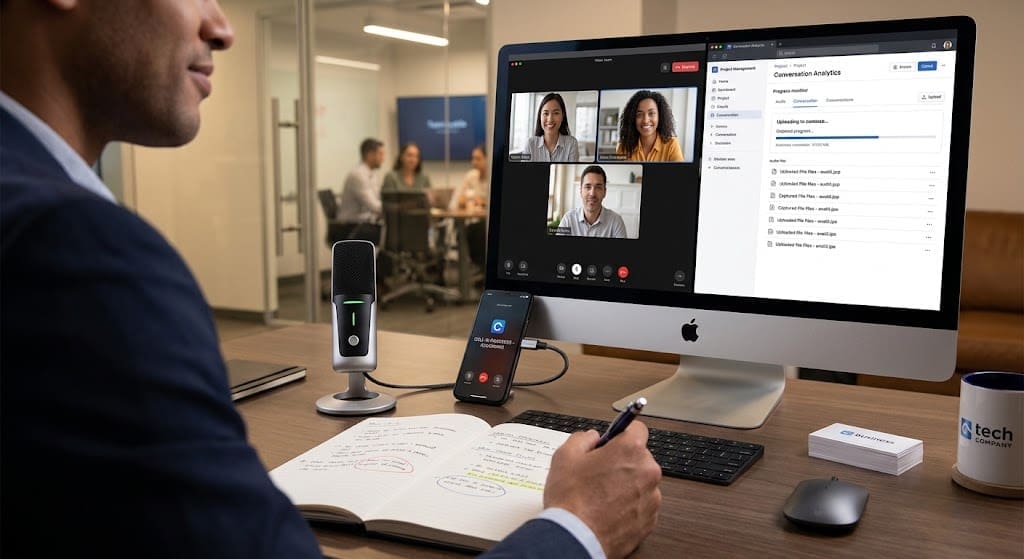
Some of Your Most Important Sales Conversations Never Make It Into Your Tech Stack