






How to Improve Sales Forecast Accuracy: Stop Guessing, Start Listening to Your Customer Conversations
Quick Summary
Most sales forecasts fail not because of bad math, but because of bad inputs. Reps report what they believe about deals, not what buyers actually said. The gap between those two things is where forecast accuracy dies.
The fix isn’t a smarter formula. It’s better data, and that data is already sitting inside your sales conversations.
This post breaks down why forecasts miss, how to spot at-risk deals before they slip, and how AI-powered conversation intelligence gives sales leaders an objective, evidence-based view of every deal in the pipeline. From fixing pipeline reviews to coaching reps on the behaviors that make deals forecastable, the path to a forecast you can stand behind starts with listening to what your buyers are actually saying.
Nothing cripples a sale like incomplete information. The same is true of a sales forecast.
Every sales leader has lived this story. You build the number carefully. Your reps swear their deals are solid. Then the quarter ends, half of those "sure things" slip, and you’re standing in front of your CEO explaining the gap.
Here’s what I’ve learned over decades of building and running sales teams: the problem is almost never your forecasting model. The problem is your inputs. Most teams forecast based on what reps believe about their deals, not on what buyers actually said. And those two things are often very different.
In this post I’ll walk through how to improve sales forecast accuracy by shifting your forecast from opinions to evidence. Specifically, the evidence sitting inside your sales conversations. We’ll cover why forecasts fail, how to identify deals at risk before they slip, and how conversation intelligence software turns your customer conversations into the most reliable forecasting data you have.

The Real Reason Forecasts Fail: Bad Inputs, Not Bad Math
Sales forecasting has never lacked for math. Weighted pipelines, stage probabilities, historical win rates. The formulas are fine. The data feeding them is the problem.
Think about where your forecast actually comes from. A rep updates a field in the CRM. That update reflects the rep’s read on the deal, and the rep’s read is shaped by optimism, pressure to show a healthy pipeline, and plain old human memory. Salespeople are notoriously optimistic; it’s a job requirement. Otherwise they’d be defeated by the frequent “no”s they hear. But that same optimism clouds reality and leads straight to inaccurate forecasts.
Three failure modes show up on nearly every team:
- Happy ears. Reps hear what they want to hear. A polite “this looks interesting” becomes a 75% close probability in the CRM.
- Stale stages. A deal sits in “Negotiation” for six weeks because nobody moved it back when the buyer went quiet. The forecast still counts it.
- Sandbagging and inflating. Some reps hide strong deals so they can beat their number later. Others inflate weak ones to survive the next pipeline review. Either way, your forecast absorbs the distortion.
This is why so many leaders ask how to forecast sales without relying on rep updates. It’s not that reps are dishonest. It’s that self-reported data is a shaky foundation for a number your company plans headcount and spending around. Pipeline visibility software helps, but only if you feed it something more objective than opinions.
So what’s more objective? The conversations themselves.
Your Customer Conversations Are the Best Forecasting Data You Have
Sales conversations are the beating heart of the sale. Not everything in a conversation is important, but everything important is found within the conversation. Did the buyer talk about budget, or dodge the question? Did they name a decision date? Did a competitor come up? Did they commit to a concrete next step, or end with a vague “let’s circle back”?
Those signals predict outcomes far better than a stage field in your CRM. The challenge has always been scale. A sales manager can’t sit in on every call. And when reps summarize their calls, the summary passes through the same optimistic filter that distorts the CRM in the first place. The rest of the conversation lives in the hazy memory of the salesperson for a short time, and then it’s forgotten.
It falls into the black hole of the CRM, never to see the light of day.
We believe it doesn’t have to be this way.
This is exactly the problem sales conversation intelligence was built to solve. Conversation intelligence software records, transcribes, and analyzes every sales call automatically. Instead of a rep’s two-line summary, you get the full picture: what the customer said, what they asked, what they hesitated on, and what commitments were made.
And modern call recording and analysis software goes well beyond transcription. AI conversation intelligence for sales mines each conversation for insights and actionable intelligence: buying signals, objections, competitor mentions, and buyer sentiment across the whole relationship, not just one call. Over time, this customer conversation analytics layer becomes a factual record of every deal in your pipeline.
That changes forecasting at its root. A sales forecast based on customer conversations doesn’t ask”what does the rep think?” It asks “what did the buyer actually say and do?” That’s a much harder question to fudge, and a much better predictor of what closes. More conversation data leads to more insights. And more insights and actionable intelligence yield a forecast you can actually trust.
How to Spot Deals at Risk Before They Slip
Ask any experienced sales leader “why are sales deals stalling?” and you’ll hear the same patterns.
The trouble is that these patterns are easy to see in hindsight and nearly impossible to catch in real time across dozens or hundreds of active deals. Here are a few of the warning signs that matter most:
- You’re single-threaded. Every conversation involves the same one contact. No economic buyer, no other stakeholders. When your champion goes on vacation or changes jobs, the deal goes with them.
- Timelines stay vague. The buyer says “sometime next quarter, probably” and never gets more specific. Deals with no agreed decision date slip at a dramatically higher rate than deals with one.
- Next steps disappear. Early calls ended with clear commitments: “send the proposal, we’ll review it Tuesday.” Recent calls end with nothing scheduled. Momentum is a leading indicator, and it just vanished.
- Response times stretch. Emails that used to get answered same-day now take a week. The buyer isn’t saying no; they’re just saying less.
- The decision-maker never shows. You’ve had four calls and the person who signs the contract hasn’t joined one. That’s not a late-stage deal, no matter what the CRM says.
Here’s how this plays out in the real world. Your rep is on a call with a technology leader at Company Z, who mentions the problem “wouldn’t be happening if we were using the competitor’s solution.” The comment gets documented in one contact record. That same week, your account manager hears from the project lead that “costs are too high.” That note lands in a different record. Then your sales executive learns from a third contact that the project is going out for bid. That’s three strikes against the deal, but because each warning landed in a separate silo, nobody connects the dots. The account is at risk, and the organization doesn’t know it. It may never know it until it’s too late.

Any manager can spot these signals in a deal they’re personally watching. No manager can spot them across an entire pipeline. With 10, 50, or 100 salespeople, reviewing every conversation is an impossible task.
That’s where AI sales call analysis earns its keep. Deal risk detection monitors every conversation and interaction, then flags the deals showing risk patterns automatically, early enough for you to act. Vital signals that would otherwise be lost or overlooked, sending the prospect into the competition’s
waiting arms, get surfaced while there’s still time to change the outcome.
This is the practical answer to how to identify deals at risk and how to prevent deals from slipping:
don’t ask reps to self-report risk, and don’t wait for the pipeline review to dig in. Let software that analyzes sales calls for deal risk watch everything and tell you where to focus. Software to identify stalled deals turns a quarter-end surprise into a mid-quarter save.
How to Know If a Deal Will Actually Close
Risk detection is half the picture. The other half is confidence: of the deals that look healthy, which ones are real?
If you want to know how to know if a deal will close, look for the buyer behaviors that consistently show up before a signature. The buyer brings up implementation details like timelines, onboarding, and who on their team will use the product. People don’t plan rollouts for tools they’re not buying. Multiple stakeholders join calls, including someone with budget authority. The buyer asks about pricing structure, contract terms, or procurement without being prompted. Next steps get shorter and more concrete as the deal progresses.
Now compare that with the false positives reps love: “the demo went great,” “they said they liked us better than the competitor,” “my champion is pushing hard internally.” Those feel like progress, but none of them are commitments. A great demo with no follow-up meeting is a compliment, not a deal.
Effective sales pipeline risk analysis scores each deal on observed buyer behavior rather than rep optimism. When deal scores come from conversation data, two useful things happen. First, the scores are consistent across the team, because the same rules apply to every deal. Second, they’re explainable. Instead of “the AI says 62%, “you get “62%, because there’s no decision date, the economic buyer hasn’t joined a call, and response times doubled in the last three weeks.” That’s something a rep can act on.
Evaluate the Whole Deal, Not Just the Last Call
An individual call tells you what happened Tuesday. The full collection of calls on a deal tells you whether it will close.
Imagine trying to sell an accounting system to Home Depot. The deal is 14 months old, and for the past two quarters the salesperson has optimistically promised it will close. Sound familiar? Now imagine you could evaluate every call on that deal. All of them, going back to the first discovery conversation against a proven sales methodology like MEDDPICC.
The analysis might come back saying the deal is strong overall. Metrics are documented, the champion is engaged, the pain is well identified. But two boxes were never checked: the salesperson never identified the Economic Buyer, and never captured the Decision Process. Fourteen months of conversations, and nobody asked who signs the contract or how the decision actually gets made.
With that insight in hand, the sales leader doesn’t have to guess or interrogate. They can hand the rep a short, specific list: get on the phone, identify the economic buyer, nail down the decision process. Those answers might be exactly what enables the deal to close or who else needs to be contacted.
And either way, the forecast finally reflects reality instead of two quarters of optimistic promises.
This is what deal-level analysis makes possible. When AI can read a large body of calls, understand the sales progression, and map the buyers’ concerns against the methodology your team already runs MEDDPICC, BANT, or your own playbook, every deal in the pipeline gets an objective, explainable assessment. You see where the salesperson has done well and which items were never discussed.
That’s not a gut feel. That’s evidence, and it further sharpens your ability to represent the forecast accurately.
Fixing the Pipeline Review
Nothing is more painful than a pipeline review that uncovers opportunities unlikely to close as projected, while more promising opportunities sit neglected. Yet most pipeline reviews follow the same script. The manager reads down the list: “Where’s the Acme deal at?” The rep improvises a status update from memory. The manager probes a little, the rep defends a little, and everyone leaves with roughly the same information they walked in with. It’s an interrogation ritual, not an inspection.
If you’re wondering how to improve pipeline reviews, the fix is simple to state: inspect conversations and evidence, not opinions.
With sales meeting intelligence software in place, a manager preparing for a review can scan AI summaries of the last three calls on every major deal, see which deals carry risk flags, and walk in already knowing where the soft spots are. The conversation shifts from “where’s this deal at?” to “the buyer hasn’t mentioned a timeline in three calls. What’s our plan to pin one down?” That’s a coaching conversation, not a deposition.
Good sales pipeline inspection tools also make reviews faster. When the factual layer – who said what, when, and what happened next is already captured, you don’t spend the meeting reconstructing it. You spend it on strategy. For leaders trying to figure out how to get better visibility into sales pipeline health, this is the highest-leverage change available: same meeting, better inputs.
There’s a forecasting payoff too. When reviews are grounded in conversation data, stage and probability updates start reflecting reality instead of a negotiation between rep and manager. Cleaner pipeline data in, more accurate forecast out.
The Coaching Connection: Better Reps = Better Forecasts
Here’s a link many leaders miss: forecast accuracy is a skills problem as much as a data problem.
Think about what makes a deal forecastable. Someone asked about the budget. Someone confirmed the decision process. Someone secured a real next step. Those are qualifying behaviors, and they happen (or don’t) on calls. A rep who consistently skips discovery questions produces deals nobody
can forecast, including the rep.
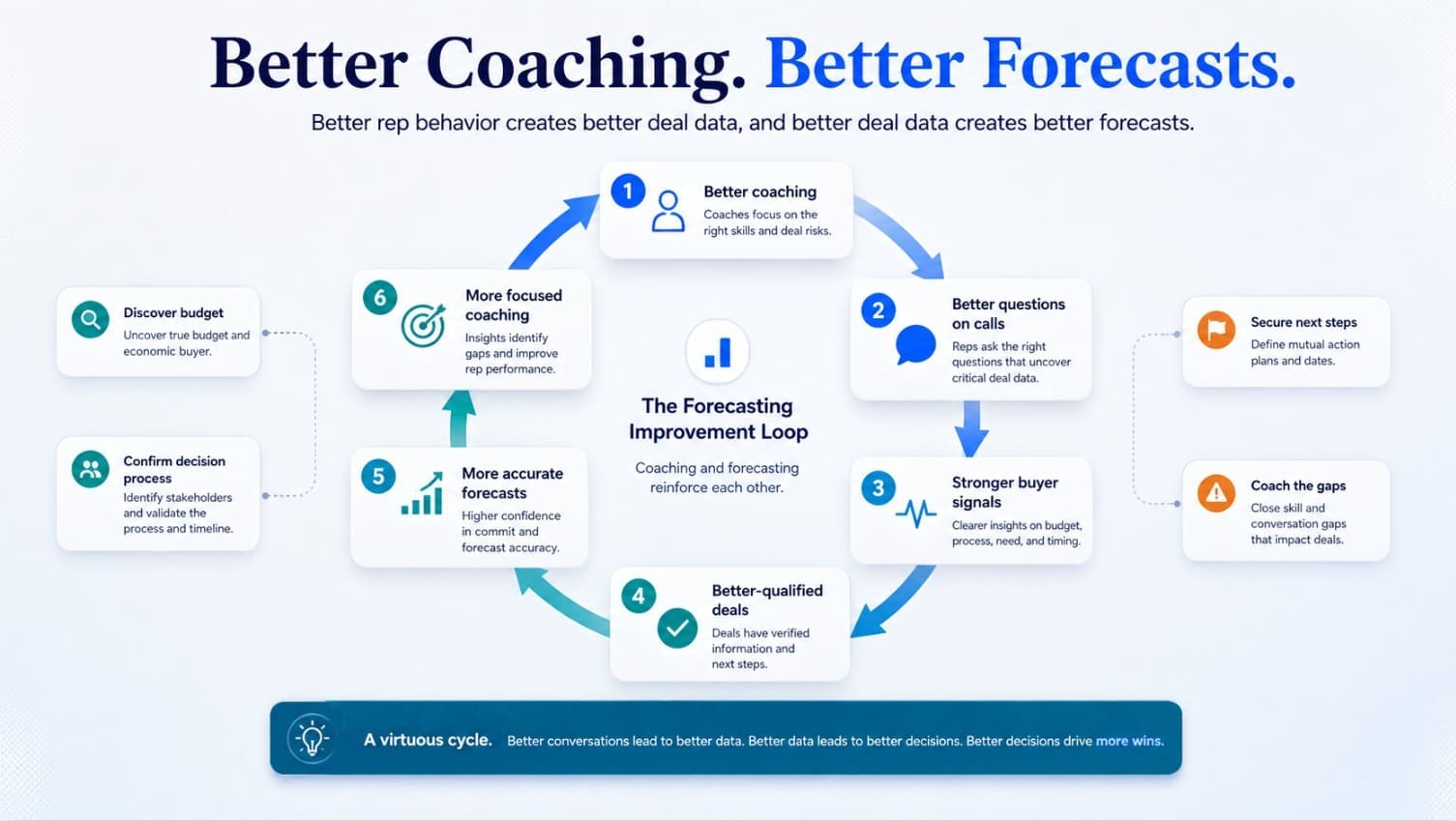
This is where sales coaching software closes the loop. Because conversation intelligence already captures every call, it can show each rep exactly where their calls go off track: talking too much, skipping the budget question, ending without a scheduled next step. An AI sales coaching platform turns those patterns into specific, personal feedback. Not generic training, but “in your last five calls, you never asked about the decision timeline.”
Automated sales coaching software also solves the manager bandwidth problem. Most managers can review a handful of calls a week. AI reviews all of them and points managers to the moments worth coaching. Reps improve faster, qualifying gets more consistent, and every deal enters the pipeline with better data attached.
Better questions on calls lead to better signals in deals. Better signals in deals lead to better forecasts. Coaching is what keeps that cycle turning.
What to Look for in AI Sales Forecasting Software
If you’re ready to move from gut-feel forecasting to evidence-based forecasting, the tooling matters. Plenty of products call themselves a revenue intelligence platform or sales intelligence software, but capabilities vary widely. Here’s a practical checklist:
- It captures conversations automatically. The foundation is complete data. Sales call intelligence software should record and transcribe every call and meeting without reps lifting a finger. Salespeople love selling and hate documenting; if logging is manual, coverage will be partial, and partial data means blind spots.
- It analyzes, not just transcribes. A searchable transcript is nice. What you actually need is true sales call analysis software. A sales call analytics platform that extracts insights and actionable intelligence: buying signals, objections, sentiment, competitor mentions, and risk indicators.
- It scores deal risk and explains why. The best AI sales forecasting software doesn’t just output a probability. It shows the evidence behind it, so reps and managers know what to fix.
- It integrates with your CRM. Conversation insights should flow into the systems you already use. AI pipeline management software that lives in a silo just creates another black hole.
- It coaches while it forecasts. Look for a platform that connects the diagnosis (this deal is at risk) to the remedy (here’s what the rep should do differently). Forecasting and coaching are stronger together.
- It allows for customizable analyses that uniquely fit your business. Every sales organization runs differently. Whether you sell on MEDDPICC, BANT, or a playbook of your own, the analysis and scoring should adapt to your methodology, your terminology, and your definition of a healthy deal rather than force you into someone else’s template.
- It can evaluate a large body of calls, not just a single call. One call is a snapshot; the deal is the movie. Look for a platform that can analyze the entire history of conversations on an opportunity like the 14-month deal mentioned above and tell you how the sale has progressed, what the buyers care about, and what’s still missing.
Forecast on Facts, Not Feelings
Improving sales forecast accuracy isn’t about finding a smarter formula, and it doesn’t require ripping out your CRM for the latest revenue intelligence software. It’s about feeding your forecast better inputs. And the best inputs you have are the conversations your team is already having with buyers every day.
Capture every call. Let AI surface the risk signals humans miss. Run pipeline reviews on evidence instead of opinions. Coach reps on the behaviors that make deals forecastable. Do those four things and your forecast stops being a quarterly guessing game and starts being a number you can stand behind.
Why TRAQ Exists
In conversations with over 700 sales leaders, we heard the same thing again and again: nobody had solved this problem. That’s why TRAQ exists. TRAQ is a conversation intelligence platform that combines AI conversation intelligence for sales with deal risk scoring and personalized coaching. It records and analyzes your sales calls, flags the deals showing risk, and tells you why, so your forecast reflects what buyers are actually saying instead of what your pipeline hopes they’re saying.
Ready to hear what your customer conversations have been trying to tell you? Book a demo of TRAQ and find out which deals in your pipeline are solid and which ones are quietly slipping away.
About TRAQ
Adam Rubenstein, CEO and Co-founder of TRAQ, has been leading sales teams for more than 25 years. He built TRAQ to get himself out of the doghouse when his investors and board demanded better results … and better forecasts. Today, TRAQ is the leading sales conversation intelligence platform, designed to improve win rates, shorten sales cycles, speed up onboarding, and make life better for sales leaders and their teams. Less work; better results. Reach Adam at Adam@TRAQ.ai
Learn How TRAQ Transforms Sales Teams
See TRAQ in action in this 5-min intro

Keep Learning

Conversation Intelligence vs Call Recording:
What Actually Moves Revenue
Some of Your Most Important Sales Conversations Never Make It Into Your Tech Stack