





Deal Risk Detection Software:
How to Catch a Slipping Deal Before It’s Gone
Quick Summary
That’s the hard part about deal risk. By the time it’s obvious, it’s usually too late to do anything about it. The warning signs were there. They almost always are. But they were buried in conversations nobody had the time or tools to review.
This post is about how to change that. Deal risk detection software gives sales leaders something they’ve never really had before: a clear, early look at the objections and risks that quietly threaten a deal. You don’t have to work in the dark anymore. For the first time, you can know exactly what’s putting a deal at risk while there’s still time to save it.
Why Deal Risk Hides Until It's Too Late
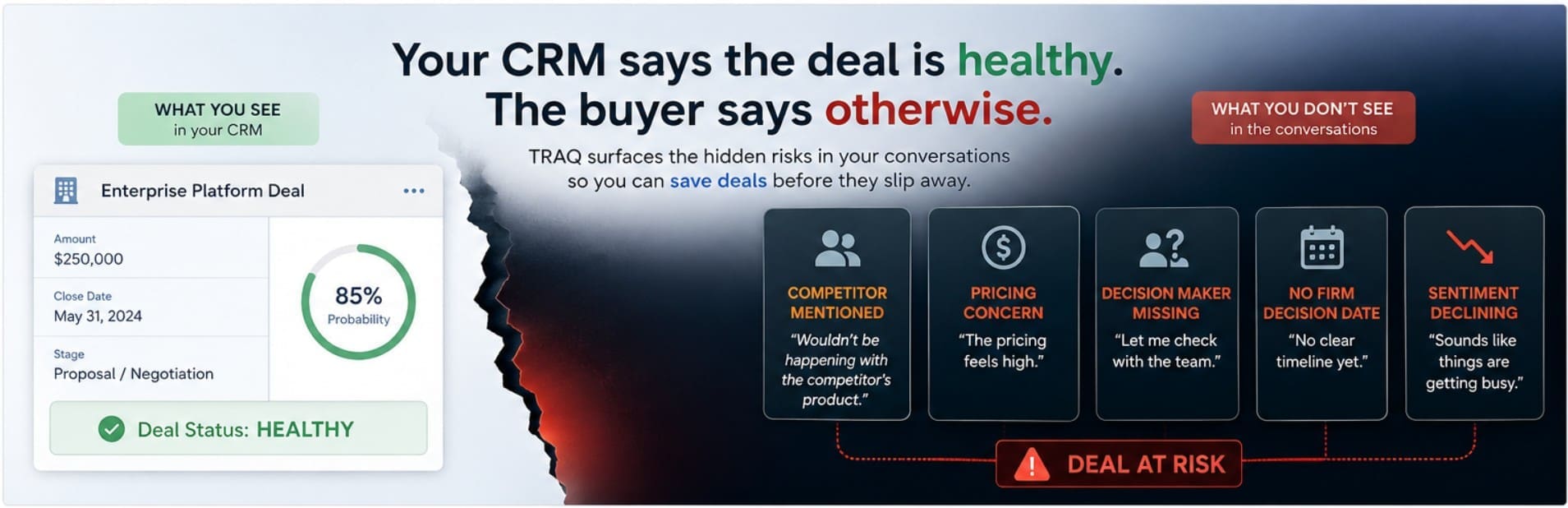
So the risk doesn’t show up in the CRM, because the person filling out the CRM didn’t register it as risk in the first place.
It gets worse when a deal involves more than one person on the buyer’s side, which most real deals do. If you’ve ever asked yourself why sales deals are stalling, this is a big part of the answer. The risk was sitting right there in the conversation, but it stayed invisible to everyone managing the deal.
Watch how this plays out. Your support rep is on a call and the buyer mentions their problem “wouldn’t be happening with the competitor’s product.” That comment lands in one place. That same week, a different contact tells your account manager that “the pricing feels high.” That lands somewhere else. Then a third contact mentions the project is going out for bid. Three separate warning signs, sitting in three separate records, seen by three different people. One strike each. But nobody sees all three. Put them together and you have a deal about to go to a competitor. Because nobody connected the dots, the account is at risk and the organization doesn’t know it, and may never know it until the deal is gone.
You Can't Fix What You Can't See
That’s really the heart of the problem. It was never that sales leaders didn’t care about risk, or didn’t know that deals slip. It’s that they had no practical way to see the risk in time. In an ideal world, a sales manager would sit in on every call, read every email, and personally review every conversation on every deal in the pipeline. From that kind of review, they could diagnose exactly where each deal stood and what it needed. But with a team of 10, 50, or 100 salespeople, reviewing every conversation is an impossible task. There aren’t enough hours in the day.
So leaders have been forced to manage on partial information. A stage field. A close date. A rep’s gut feel. Meanwhile the richest and most honest data about the deal, the actual conversations with the buyer, stayed invisible.
Deal risk detection software closes that gap. It’s a form of conversation intelligence software, and you can think of it as pipeline visibility software that finally reaches the part of the pipeline that mattered all along: the conversations. If you’ve ever wanted to see what is really happening in your pipeline, this is how you get there. It gives you a clear view of what’s actually being said across every deal, so risk stops being something you discover at the end of the quarter and becomes something you can see coming. And once you can see it, for the first time, you can actually do something about it.
What Deal Risk Actually Looks Like
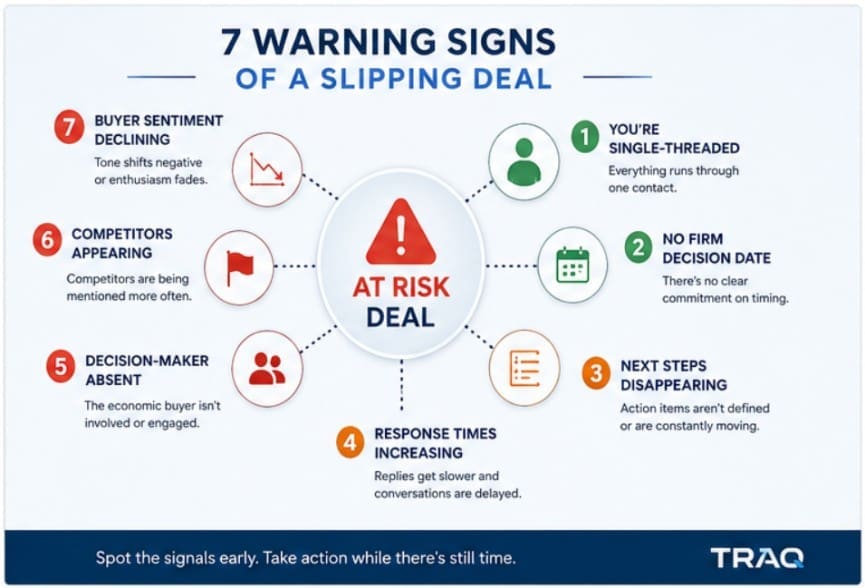
- You’re single-threaded. Every conversation runs through the same one contact. No economic buyer, no other stakeholders. If that person leaves or goes quiet, the deal goes with them.
- There’s no real decision date. The buyer keeps things vague: “sometime next quarter, probably.” Deals without a firm decision date slip far more often than deals with one.
- Next steps are disappearing. Early calls ended with clear commitments. Recent calls end with “we’ll be in touch.” Lost momentum is one of the earliest signs of trouble.
- Response times are stretching. Emails that used to get answered the same day now take a week. The buyer isn’t saying no. They’re just saying less.
- The decision-maker never shows up. You’ve had four calls and the person who signs the contract hasn’t been on any of them.
- Competitors keep creeping in. The buyer mentions another vendor’s features, pricing, or approach. Once is curiosity. Again and again is a signal.
- The tone has shifted. Enthusiasm has cooled. Questions have turned skeptical. Objections that were resolved keep coming back.
Any one of these can be explained away, and a hopeful rep usually will. It’s the combination, seen early and across the whole deal, that tells the real story.
What Deal Risk Detection Software Is (and Isn't)
Deal risk detection software isn’t just call recording. A library of recorded calls nobody has time to watch is just another black hole, the same problem as the CRM in a new location. Recording is table stakes. It’s what happens after the recording that matters.
Real deal risk detection software uses AI to analyze the conversation, not just store it. This is where sales call analysis software earns its name. Software that analyzes sales calls for deal risk reads the transcript the way an experienced sales leader would, listening for the buying signals, objections, competitor mentions, and shifts in sentiment that point to risk. Buyer sentiment analysis for sales is a big part of this. A tone that cools from one call to the next often says more than any words in the CRM. Then it surfaces what it finds. Instead of a rep’s optimistic two-line summary, you get an objective read on what the buyer actually said and where the deal actually stands. Some people call this deal intelligence software. Whatever you call it, the point is the same: real deal risk analysis from customer calls, not from a rep’s gut feel.
The key word is objective. The whole reason risk hides is that it passes through the filter of a hopeful human before it ever reaches you. Software doesn’t have happy ears. It hears the concern the rep glossed over. It flags the objection that never got resolved. It notices the competitor that keeps coming up. It gives you the unfiltered version.
How It Works: From Raw Calls to a Risk You Can Act On
First, it captures every conversation automatically, calls and meetings, without asking reps to do extra work. Complete data is the foundation. Salespeople love selling and hate documenting, so if capture depends on them, coverage will be spotty. And spotty coverage means blind spots exactly where you can least afford them.
Second, it analyzes each conversation for meaning: the signals, objections, and concerns that predict whether a deal moves forward or dies. Good software can measure this against the sales methodology your team already uses, so the analysis speaks your language instead of forcing you into someone else’s template. This is also how sales methodology compliance software helps you answer a question every leader wants answered: are reps actually following our discovery process, or just saying they are?
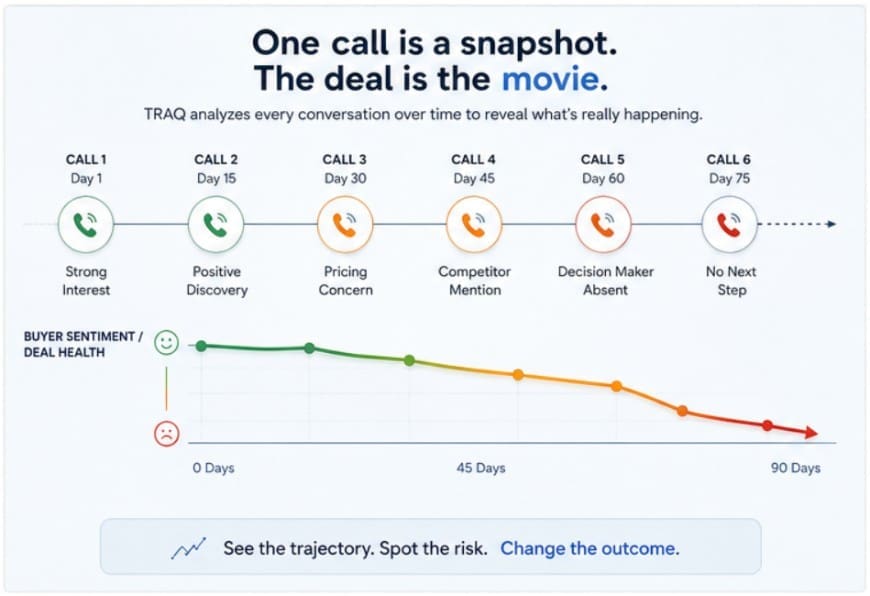
Third, and this is the part that separates a serious tool from a novelty, it evaluates the entire body of conversations on a deal, not just the most recent call. This is cross-call analysis, and it’s the piece most tools miss. The ability to analyze multiple sales calls at once, across the whole life of a deal, is what turns raw recordings into a real picture. One call is a snapshot. The deal is the movie. A single good call can make a rep feel great while the overall deal has quietly gone sideways over the last three months. Only by looking at the full history can you see the true progression: where the deal started, how it’s moved, what the buyers care about, and what’s still missing.
The result is an assessment you can actually act on. Not just a flag that says a deal is risky, but a clear reason why. “This deal is at risk because there’s no decision date, the economic buyer has never joined a call, and a competitor has come up in the last three conversations” is something a leader can do something with. A number with no explanation is not.
From Risk Flags to a Winning Strategy
This is the part that gets lost when people think of risk detection as just an alarm system. An alarm tells you something is wrong. Real insight tells you what to do about it. If the analysis shows you’re single-threaded, the strategy is to multi-thread and get more stakeholders into the conversation before your lone champion disappears. If a competitor keeps surfacing, the strategy is to reframe the value on the terms that matter to this buyer. If the economic buyer has never been on a call after months of selling, the strategy is obvious and urgent: get them on the phone before you waste another quarter.
None of that is possible when you’re guessing. This is sales pipeline risk analysis put to work. When you can see the specific risks on a specific deal, coaching gets specific too. Instead of a vague “how’s the Acme deal looking?”, a manager can point to exactly what’s missing and help the rep go get it. Used this way, deal risk detection becomes one of the most useful sales pipeline inspection tools a leader has. Pipeline reviews stop being interrogations built on optimism and become working sessions built on evidence. The conversation moves from “I think it’s going well” to “here are the two gaps, and here’s the plan to close them.”
That’s the difference between knowing a deal is at risk and knowing what to do about it.
The Forecasting Payoff
Most forecast misses trace back to the same root cause: deals that everyone believed were healthy turned out not to be. Deal risk detection strips the optimism out of the pipeline. The deals that look strong actually are strong, because their health is based on what buyers said and did, not on what a hopeful rep felt. The shaky deals get flagged early, so they’re either saved or set aside before they blow a hole in your number. Fewer end-of-quarter surprises, cleaner pipeline data, and a forecast you can stand behind.
The same data pays off after the deal closes, win or lose. When every conversation is captured and analyzed, you can finally know why sales deals are lost instead of guessing. AI win loss analysis compares the deals you won with the deals you lost and shows you the patterns: the objections that killed deals, the steps top reps took that others skipped, the moments a deal started to slide. Those lessons then feed right back into the deals still in flight
What to Look for in Deal Risk Detection Software
- It captures conversations automatically. No manual logging, no gaps in coverage.
- It analyzes, not just records. A pile of recordings isn’t insight. Look for real AI sales call analysis of signals, objections, sentiment, and competitor mentions.
- It scores calls and explains the risk. Automated call scoring software should tell you why a deal is at risk, with the evidence behind it, not just wave a flag.
- It evaluates the whole deal. Cross-call analysis of every conversation on an opportunity, not a single-call snapshot.
- It adapts to how you sell. Look for customizable call scoring software that fits your methodology, your terminology, and your definition of a healthy deal, not the other way around.
- It connects to your workflow. Insights should flow into the systems your team already uses, not sit in yet another silo.
- It points toward action. The best tools don’t stop at detection. They help you turn a risk into a plan.
You Don't Have to Sell in the Dark
That era is ending. With the right software, you can finally see what’s actually happening inside your deals: the objections, the hesitations, the competitors, the risks. Clearly, and early enough to act. You can stop selling on hope and start managing on evidence.
You don’t have to work in the dark. And once you can see the risks in your pipeline, you’ll wonder how you ever sold without it.
About the Author
Learn How TRAQ Transforms Sales Teams
See TRAQ in action in this 5-min intro

Keep Learning

Conversation Intelligence vs Call Recording:
What Actually Moves Revenue
Some of Your Most Important Sales Conversations Never Make It Into Your Tech Stack