


Built for Today.
Architected for Tomorrow.
Why We Built TRAQ for Where Sales Is Going
“It’s difficult to manage what you cannot measure.”
I learned that lesson the hard way.
I cofounded my last company and helped build it from the ground up. Eventually, our sales organization grew to approximately 125 people.
Every quarter, our Board of Directors would fly in for our board meeting. We had sophisticated investors around the table, including Riverwood Capital and Morgan Stanley Expansion Capital.
Almost every meeting started the same way.
“Are we going to hit our number?”
Sometimes I was fortunate enough to say yes.
Too often, I had to say no.
When the answer was no, the next question was always some version of:
“What are you going to do about it?”
That was the hard question.
Like most sales leaders, I always had an answer.
We were going to work harder. Make more calls. Increase activity. Do more sales training. Spend more time coaching. Dig deeper into the pipeline.
All reasonable answers.
But they were guesses.
The truth was that we didn’t really know what we needed to fix.
We knew the results. We knew the pipeline. We knew the close rate. We knew which salespeople were above quota and which were below quota. We knew how many calls were being made and how many meetings were taking place.
THE PROBLEM
We knew what happened. What we didn’t know was why.
Why was one salesperson winning while another was struggling?
Why were deals getting stuck?
Why did some prospects move quickly and others disappear?
Why did one manager consistently develop better salespeople?
Why were some customers thrilled while others quietly started looking at the
competition?
And perhaps the most important question of all:
What should we actually do about it?
That question stayed with me for years.
And eventually, it helped lead to TRAQ.
We Had Plenty of Data. We Didn't Have Enough Answers.
Sales organizations have never suffered from a shortage of data.
We have CRM data. Pipeline data. Activity data. Forecast data. Email data. Marketing data. Revenue data.
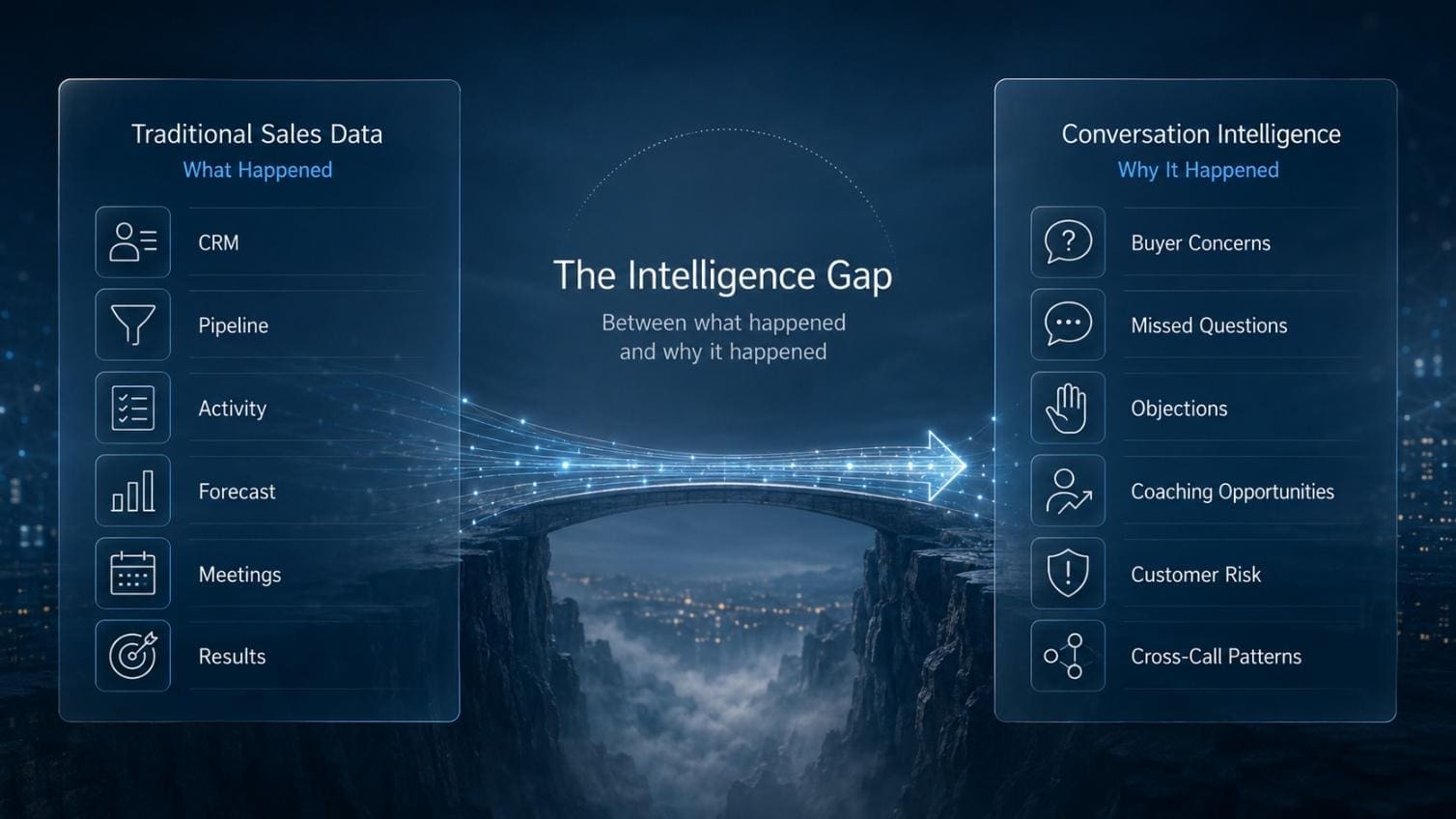
The problem is that most of it tells us what happened.
It doesn’t always tell us why it happened.
Your CRM might tell you that the opportunity was lost.
It probably won’t tell you that during the third meeting the buyer raised a concern about implementation, the salesperson gave a weak answer, and the subject was never brought up again.
Your dashboard might tell you that a salesperson’s close rate is falling.
It probably won’t tell you that the salesperson has stopped asking enough questions, is talking too much, or consistently fails to uncover who else is involved in the decision.
Your customer success system may eventually tell you that an account churned.
It may not tell you that three different people from that customer expressed concerns during three different conversations over the prior four months.
Each concern went into a different record.
Three warning signs.
Three conversations.
Nobody connected them.
Then the customer left.
THE INTELLIGENCE GAP
We know the outcome. We don’t always know what caused it. And if you don’t know what caused the problem, fixing it becomes difficult.
The Most Important Business Information Is Often Hiding in the Conversation
I’ve come to believe something very simple:
Not everything in a conversation is important, but almost everything important can be found within the conversation.
Think about what your prospects and customers tell you every day.
They tell you what they want. They tell you what they don’t want. They tell you why they buy. They tell you why they won’t buy. They tell you about your competitors. They tell you what frustrates them. They tell you what they value. They tell you what scares them.
Sometimes they practically tell you exactly how to win the deal.
The problem is that much of this intelligence has historically disappeared the moment the conversation ended.
Maybe the salesperson remembered it.
Maybe they typed a few notes into the CRM.
Maybe they didn’t.
Salespeople love selling.
Most of them don’t love documenting their sales.
I understand why. I’ve managed enough salespeople to know that updating a CRM can feel like a bore and a chore.
So an enormous amount of incredibly valuable information gets reduced to:
“Good meeting. Follow up next Tuesday.”
Then it disappears into what I sometimes call the black hole of the CRM.
We believed it didn’t have to be this way.
Then AI changed what was possible.
AI Changed the Conversation
For the first time, conversations could become data.
Not just recordings.
Not just transcripts.
Data.
We could start asking questions of conversations.
Did the salesperson ask the right questions?
What objections did the buyer raise?
How were those objections handled?
Was pricing discussed?
Who is involved in the decision?
How does the buyer feel?
Is the customer showing signs of dissatisfaction?
Was the salesperson following the company’s methodology?
What should the manager coach?
Now take that one step further.
What if we could ask those questions across 10 conversations?
Or 100? Or 1,000? Or 10,000?
That’s where things get really interesting.
And that is the opportunity we saw when we built TRAQ.
We Didn't Want to Build Another Meeting Recorder
There are a lot of meeting tools in the market.
Fireflies. Fathom. Otter. Gong. Chorus. And plenty of others.
Many of them do some things very well.
But we were frustrated.
We didn’t want another application that recorded the call, created a transcript and summary, and then handed everything back to the sales leader.
That still left me with the same problem I had sitting in those board meetings.
I still had to figure out what it meant.
I still had to hunt for the answer.
With 10 salespeople, maybe I could spend hours reviewing calls.
With 50 people, it became extremely difficult.
With 100 or 125 people, reviewing every important conversation was an impossible task.
In an ideal world, a great sales leader would listen to every important conversation.
They would spot the missed question. They would recognize the weak response to an objection. They would notice that a salesperson rushed discovery. They would see the warning signs in an important account.
Then they would sit down with the salesperson and coach them.
That’s the ideal world.
Unfortunately, nobody has enough hours in the day.
That became one of the ideas behind TRAQ.
THE IDEA
Use AI to do the listening that humans simply don’t have time to do. Then turn that listening into insights and actionable intelligence. Not more information. Answers.
Recording Is Only the Beginning
Recording
Transcription
Summary
Analysis
Intelligence
Action
The value moves from capturing what happened to understanding what it means and knowing what to do next.
Recording was useful.
Transcription made recording searchable.
Summaries saved time.
All important steps.
But the real value comes later.
Analysis tells you what happened.
Intelligence helps you understand what it means.
Action tells you what to do next.
That’s where we’re focused.
A platform shouldn’t simply tell a sales manager:
“Adam’s call lasted 46 minutes. Here is the summary.”
It should be able to say:
“Adam’s buyer expressed strong interest, but raised two concerns about implementation. Neither concern was fully resolved. Adam also skipped three important discovery questions. This same pattern has appeared in four of his last six calls. Here is what Adam should work on.”
That’s different.
That’s actionable.
More data leads to better insights. Better insights lead to better decisions. And better decisions should lead to better sales results.
That’s why TRAQ exists.
Don't Just Look at What an AI Platform Does Today
This brings me to the bigger reason I’m writing this.
AI is moving incredibly fast.
I have spent most of my career in technology, and I’m not sure I’ve ever seen anything move quite like this.
Something that seemed almost impossible 18 months ago can become routine today.
The AI models get better. The costs change. Context windows increase. Reasoning improves. Voice technology improves. Integrations improve. New capabilities appear.
And that creates an unusual challenge when you are selecting an AI platform.
Of course you should ask:
What does this platform do today?
But I think you should also ask:
What is this platform designed to become?
That may prove to be the more important question.
A long feature checklist can tell you who has the most boxes checked today.
It doesn’t necessarily tell you who will be ready for tomorrow.
A BETTER WAY TO EVALUATE AI
Don’t just evaluate the feature list. Evaluate the trajectory.
We designed TRAQ with that in mind.
It’s a powerful platform today.
But we have also architected it for where we believe AI and conversation intelligence are going.
Our roadmap is what I call future-bound.
What Does “Future-Bound” Mean?
FUTURE-BOUND
We aren’t simply asking, “What feature should TRAQ build next?” We’re asking, “What should a sales organization be able to know and do when AI becomes dramatically more capable?”
It doesn’t mean we have a crystal ball.
We don’t.
I have no idea exactly what AI will be capable of five years from now.
Neither does anyone else.
But we know the direction.
AI will understand more. It will reason better. It will connect more information. It will interact with more systems. It will get better at identifying patterns that humans could never reasonably find on their own.
That question drives a lot of what we’re building.
Capture the Whole Sales Narrative.
It starts with conversations.
If the system can’t hear the conversation, it can’t learn from it.
But business doesn’t only happen on Zoom and Teams.
A salesperson may talk to a prospect on the phone. An account manager may visit a customer. A salesperson may meet someone at a trade show. A field sales rep may spend an hour at the customer’s office. A manager may have an important conversation over lunch.
Those conversations matter too.
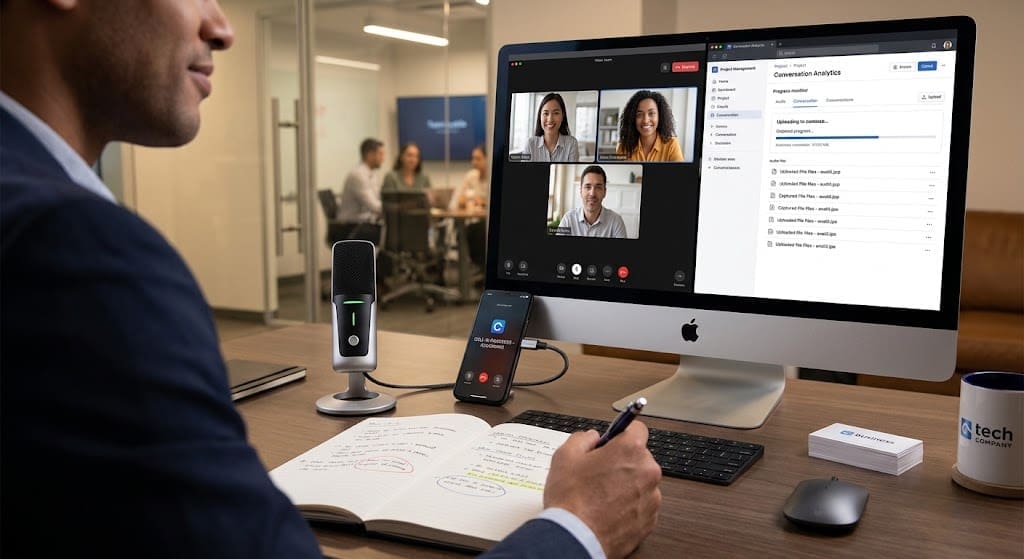
That’s why we’ve invested in multiple ways to bring conversations into TRAQ, including our mobile application for in-person meetings.
We want to capture the sales narrative.
Not just the neatly scheduled online meetings.
The real story.
Because the more complete the story becomes, the more useful the intelligence becomes.
What Does “Good” Look Like for Your Company?
Here’s another problem I’ve had with sales technology.
Companies are different.
Yet many software platforms try to analyze them as though they were the same.
Your company may sell enterprise software. Another may sell insurance. Another provides healthcare services. Another sells consulting. Another manages existing customer relationships where retention matters more than new logo sales.
Each company has different buyers, different processes, different terminology and different risks.
So why should they all receive exactly the same analysis?
They shouldn’t.
One of the most important ideas behind TRAQ is the ability to define what good looks like for each organization.
Maybe you care about discovery. Maybe you have a specific sales methodology. Maybe regulatory language must be used. Maybe your greatest problem is cross-selling. Maybe customer retention is your top priority. Maybe managers need to know whether salespeople are uncovering the economic buyer. Maybe you have five questions that must be asked on every call.
TRAQ can be configured around those things.
I sometimes use the word bespoke when describing TRAQ, but I don’t mean that we want to build custom software for every customer.
Quite the opposite.
OUR GOAL
Customized intelligence without custom software. The platform adapts to what matters to your organization.
You shouldn’t have to change your business to fit your sales intelligence platform.
The platform should understand your business.
One Conversation Tells a Story. Thousands Tell You How the Business Is Doing.
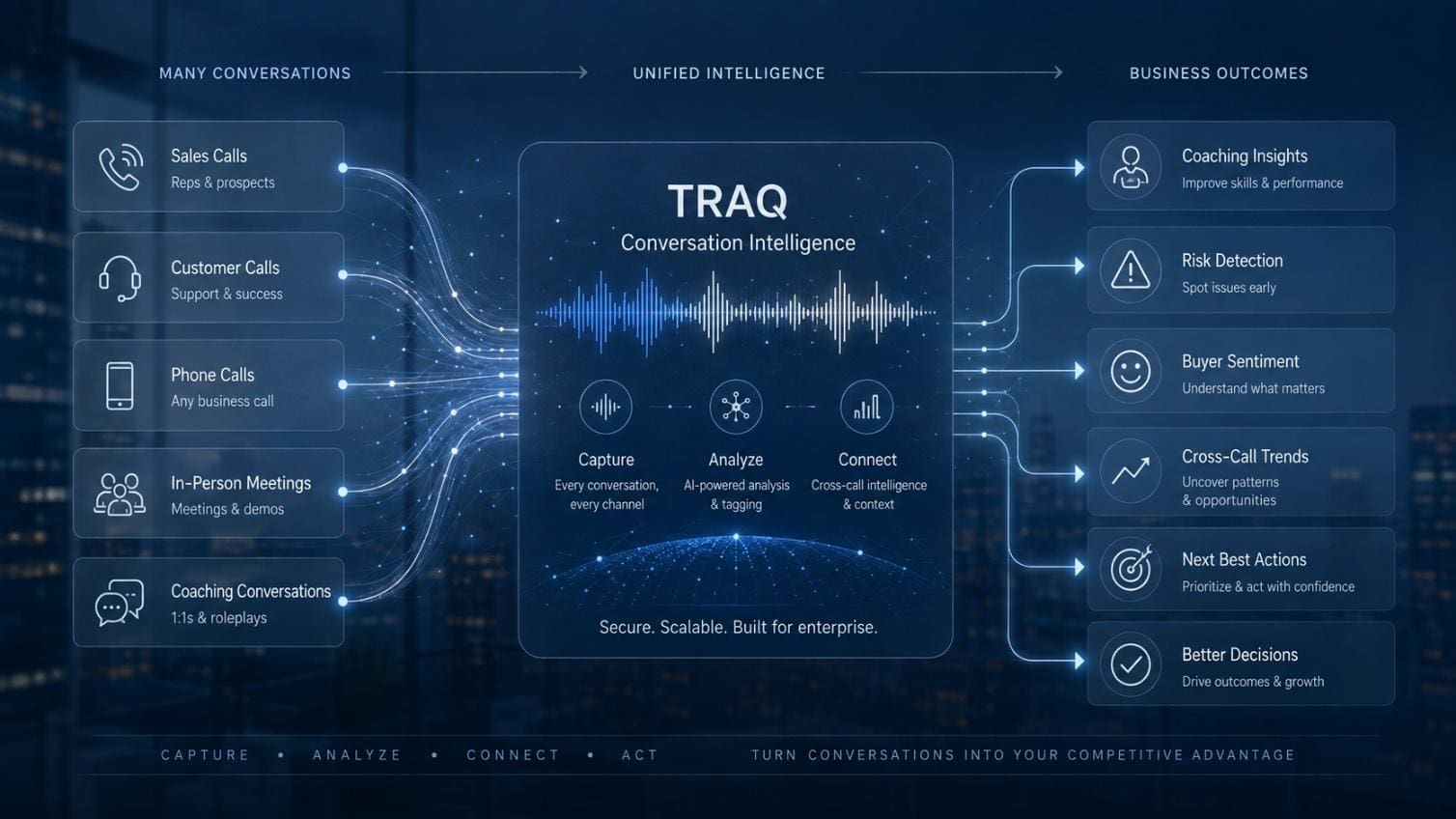
Analyzing one call is useful. Analyzing thousands can be transformational. That’s why I am so excited about Cross-Call Analysis.
Instead of asking:
“What happened on this call?”
you can begin asking:
“What is happening across our calls?”
Why are we losing?
What objections are increasing?
What competitors are we hearing about?
What are customers saying about our pricing?
Why are our best salespeople better?
Where are deals getting stuck?
What product features are prospects requesting?
Are customer concerns getting better or worse?
Think about the scale of this. With 100 salespeople, you might have thousands of conversations every month. No manager can listen to all of them. No analyst can manually connect all of the dots.
AI can.
That means conversation intelligence starts becoming something much bigger.
It starts becoming business intelligence.
Your Conversations Are an Asset.
Most organizations don’t think about conversations this way yet.
I believe they will.
Your company has years of accumulated knowledge sitting inside calls and meetings.
Your customers have told you what they think. Your prospects have told you what they want. Your best people have demonstrated how they sell. Your weaker people have shown you where they struggle. Your market has been talking to you every day.
Historically, much of that intelligence was lost.
Now imagine being able to ask:
“What are our customers saying about our newest product?”
“Why did we lose deals to Competitor X during the last six months?”
“What do our top 10% of salespeople do differently?”
“Which customers have shown increasing signs of dissatisfaction?”
“What objections are we hearing that we weren’t hearing last year?”
In the past, answering those questions might require a research project.
Soon, companies will expect answers in seconds.
That’s one reason we’re building around technologies such as MCP and making TRAQ increasingly capable of allowing other AI systems to securely interact with the intelligence contained within conversations.
The point isn’t to have an MCP because MCP is the current hot acronym.
The point is much simpler.
Your conversation data should be usable. It shouldn’t be locked inside an application. It should become part of the intelligence your business can draw upon.
TRAQ Cannot Become Another Technology Island
Salespeople already have enough applications.
Every time you introduce another one, you can almost hear the collective groan:
“Jeez, what more do they want from me?”
I get it.
Salespeople want to sell. They don’t want another piece of software asking them to do more work.
I don’t believe the answer is to give them more technology to manage.
The technology has to work for them.
That’s why TRAQ has to fit into the way companies and their salespeople already work.
CRM. Phone systems. Calendars. Training platforms. Sales enablement systems. Business intelligence. AI assistants. Whatever comes next.
That is why integrations matter so much.
Over time, I see TRAQ becoming less about asking people to visit another screen and more about getting the right intelligence to the right person at the right moment.
The conversation is the source.
TRAQ becomes the intelligence layer.
And the intelligence can go where it is needed.
Analysis Without Coaching Only Solves Half the Problem
That’s helpful. But what happens next?
Traditionally, the manager talks to Zach. Maybe they coach him. Maybe someone sends him training material. Maybe Zach watches a video. Then everyone gets busy and moves on.
We want to close that loop.
The future looks more like this:
Observe
Diagnose
Coach
Practice
Measure
Improve
Find the problem. Coach the problem. Practice the solution. Measure whether the behavior actually changed.
TRAQ sees what Zach is actually doing.
TRAQ helps identify the behavior that needs to change.
Zach can practice through role-play and coaching.
Then TRAQ can look at subsequent real-world conversations to see whether the behavior improved.
That’s a meaningful coaching loop.
Not coaching for coaching’s sake.
Coaching tied directly to what is happening in the field.
We Build TRAQ From the Problem Backward.
One thing about TRAQ won’t change.
We are salespeople. We have lived these problems.
I know what it feels like to sit in front of a Board and explain why the number isn’t where it needs to be.
I know what it’s like to have one salesperson crushing quota while another with seemingly the same skills and territory struggles.
I know what it’s like to spend money on sales training and wonder whether anything actually changed.
I know what it’s like to look at a CRM filled with opportunities and still wonder what is really happening.
Those are the problems we think about.
We don’t wake up in the morning asking:
“What cool thing can AI do today?”
We ask:
“What problem can we help a sales leader solve?”
Then we use the best technology we can find to solve it.
That distinction matters to me.
TRAQ is not technology looking for a problem. It came from the problem.
Some Things Will Change. One Thing Won't.
AI will change.
The models will change.
Sales technology will change.
TRAQ will change.
It has to.
A platform that looks exactly the same five years from now will probably have been left behind.
But one thing will not change.
Our mission.
As the cofounder of TRAQ, and someone with years of scars from selling, building sales teams and leading sales organizations, I can make you one promise.
MY PROMISE
TRAQ will always be built for the people who have to win.
We will continue to use the best technology available to help salespeople sell better.
We will help leaders understand what is really happening.
We will help managers coach the things that actually need coaching.
We will help companies see risks before those risks become losses.
And we will continue to help our clients win more business and keep the customers they’ve worked so hard to earn.
That’s what we’re building today.
That’s what we’ll be building tomorrow.
I can’t tell you exactly what AI will make possible five years from now.
I can promise you that TRAQ will be there to take advantage of it.
That’s my personal guarantee to you.
— Adam Rubenstein
Cofounder & CEO, TRAQ
Want to See What This Looks Like Today?
TRAQ is helping sales and customer-facing teams today capture their conversations, analyze what matters, identify coaching opportunities, understand buyer and customer sentiment, and turn thousands of conversations into insights and actionable intelligence
If you’d like to see what TRAQ could uncover in your organization, schedule a demonstration and let us show you.
Learn How TRAQ Transforms Sales Teams
See TRAQ in action in this 5-min intro

Keep Learning

Conversation Intelligence vs Call Recording:
What Actually Moves Revenue
Some of Your Most Important Sales Conversations Never Make It Into Your Tech Stack