


Your Business Is Unique. Your AI Should Be, Too.
by Adam Rubenstein | Sales Management | November 13, 2026
Introducing TRAQ's Configurable Intelligence Layer: Why the future of conversation intelligence depends on understanding how your organization actually does business.
I've spent much of my career building companies, managing sales organizations, and trying to figure out how to help salespeople become more successful.
One thing I've learned is that every organization has its own approach to selling, serving customers, and measuring success. Yet most conversation intelligence platforms weren't designed to understand those differences. That's why we developed TRAQ's Configurable Intelligence Layer — a way to make AI understand how your organization does business and deliver insights that actually matter to you.
The idea grew out of a frustration I'd experienced for years.
One of the biggest challenges in sales leadership is understanding what's really happening between salespeople and their prospects. Not what the salesperson tells you happened. Not what they've entered into the CRM. But what actually took place during the conversation.
When conversation intelligence platforms started gaining traction, I was excited. Finally, technology could give sales leaders visibility into something that had always been difficult to measure.
Unfortunately, my initial experience was disappointing.
Many of the platforms I tried did little more than summarize conversations and generate lists of follow-up tasks. Those capabilities were certainly useful, but they didn't address the problems I was trying to solve.
The more sophisticated platforms offered additional analyses, often at a significantly higher price. But I found much of that intelligence was generic. It wasn't designed around how our sales organization operated, how we trained our people, or what we believed made a salesperson successful.
I still found myself searching for the proverbial needle in a haystack.
I didn't need another dashboard filled with information. I needed answers.
Who was doing well? Who needed help? Why were some salespeople consistently successful while others struggled? Were we following the sales process we'd invested so much time developing? And most importantly, what could we do to help our people improve?
I wanted answers that were relevant to my business and easy to put to use.
That's what the Configurable Intelligence Layer is designed to deliver.
Rather than forcing organizations to adapt to a generic set of AI evaluations, TRAQ adapts its analyses to each organization's unique sales methodology, operating procedures, compliance requirements, and business objectives.
Because the real value of AI isn't simply understanding what happened during a conversation. It's understanding what that conversation means to your business and what you should do about it.
The Problem With One-Size-Fits-All Intelligence
Think about how much time and money organizations invest in developing their sales processes.
They hire consultants, develop training programs, create playbooks, define qualification requirements, establish coaching standards, and build methodologies they believe will give them a competitive advantage.
Then they purchase a conversation intelligence platform that evaluates their salespeople using somebody else's definition of a successful conversation.
Something doesn't add up.
Consider two organizations selling entirely different products.
One sells complex enterprise software, where success depends on understanding business requirements, identifying decision-makers, navigating purchasing committees, and managing a lengthy sales cycle.
The other sells insurance, where success might depend on establishing trust, asking appropriate coverage questions, explaining products clearly, identifying additional insurance needs, and following strict compliance procedures.
Both organizations conduct sales conversations. Both want to improve performance. But the behaviors that matter, the questions that should be asked, and the outcomes they expect can be dramatically different.
Even within the same organization, a successful qualification call looks nothing like a successful product demonstration or an account management conversation.
So why would we evaluate them the same way?
Generic conversation intelligence can provide useful information. But if the analysis doesn't reflect how an organization expects its people to perform, much of that information may have limited practical value.
A good call isn't simply one that meets a generic set of criteria. It's one that accomplishes what your organization intended that conversation to accomplish.
That's an important distinction.
From Conversation Intelligence to Organizational Intelligence
Traditional conversation intelligence helps answer a fundamental question: What happened during the conversation?
Who said what? What questions were asked? Which objections came up? What commitments were made? What happens next?
Those are valuable things to know. But they're only the beginning.
Organizations need another level of intelligence.
They need to understand whether their people are doing the things that lead to success, based on how their business operates.
Did the salesperson properly qualify the opportunity? Did they uncover the customer's real problem? Did they follow the company's discovery process? Did they recognize a buying signal? Did they miss an opportunity to advance the relationship?
For a customer service organization, the questions might be entirely different.
Was the customer's problem resolved? Did the representative demonstrate empathy? Were required troubleshooting procedures followed? Did the customer leave the conversation feeling better about the company?
For a regulated business, we might need to know whether specific disclosures were made or whether the representative followed required procedures.
This is what I think of as the difference between conversation intelligence and organizational intelligence.
Conversation intelligence tells you what happened.
Organizational intelligence helps you understand whether what happened was right for your business, and what you can do to make the next conversation better.
That requires something more than a standard AI summary or a generic scorecard.
It requires intelligence that understands your organization.
How the Configurable Intelligence Layer Works
At TRAQ, we believe organizations shouldn't have to change how they operate to accommodate their AI. The AI should adapt to how they operate.
That's the thinking behind our Configurable Intelligence Layer.
Rather than forcing every organization into the same evaluation framework, TRAQ allows us to create analyses based on each client's specific business processes, requirements, and objectives.
We don't expect clients to become experts in AI or prompt engineering.
Instead, we work with them to understand their business.
We interview their leadership teams, review their sales training materials, examine their processes, and learn what they expect from their people.
Then our team does the heavy lifting, translating those expectations into analyses designed specifically for that organization.
And the configuration can be remarkably granular.
Different departments can have entirely different analyses. A sales team might evaluate qualification, discovery, and closing effectiveness, while an account management team focuses on customer satisfaction, relationship management, and expansion opportunities.
Different call types can also have different evaluations. A first conversation with a prospect shouldn't be measured against the same criteria as a renewal discussion or a customer support call.
And a single conversation can be evaluated in multiple ways.
Imagine one customer conversation producing insights about sales effectiveness, customer sentiment, compliance, missed opportunities, and coaching needs.
Each analysis serves a different purpose, yet all are based on the same conversation.
The possibilities extend far beyond traditional sales scoring. Organizations can evaluate script adherence, deal qualification, sales stage progression, campaign effectiveness, customer experience, manager coaching requirements, and much more.
The key isn't how many analyses we can run.
It's whether those analyses answer questions that matter to the organization.
Let me share a few examples of what that looks like in practice.
SaaS Companies: Making Sure the Sales Process Actually Gets Followed
Many SaaS companies have developed sophisticated approaches to selling their products.
Their process may begin with a qualification call, progress to a discovery conversation, and eventually lead to a product demonstration.
Each stage has a specific purpose.
During qualification, the salesperson might need to determine whether the prospect fits the company's ideal customer profile and whether there's a legitimate business opportunity.
During discovery, the objective might be to uncover business challenges, understand their financial or operational impact, and establish what a successful solution would look like.
During a demonstration, the salesperson should connect the product's capabilities to the needs uncovered during discovery, rather than simply walking through a list of features.
Companies spend considerable time training their teams to execute this process.
But training is only part of the equation.
How do managers know whether their salespeople are consistently following what they've been taught?
Historically, the answer involved listening to recorded calls, reviewing notes, and conducting occasional coaching sessions. That might work when a manager has a handful of salespeople. It becomes increasingly difficult as teams grow.
And even when a manager finds the time, they're often reviewing only a small fraction of the conversations.
With TRAQ, we can build separate analyses for qualification, discovery, and demonstration calls, each reflecting the company's established methodology.
The organization can evaluate whether the salesperson asked the expected questions, identified important business needs, addressed the right issues, and accomplished the objectives of that stage.
More importantly, it can identify precisely where the salesperson deviated from the process or missed an opportunity.
Instead of telling someone, "You need to do a better job with discovery," the manager can identify what was missed and provide specific guidance.
The organization finally has a practical way to measure whether its investment in sales training is showing up in actual customer conversations.
Digital Marketing: Winning Clients Is Hard. Keeping Them Can Be Harder.
Consider another example from the digital marketing industry.
Winning a new client can be difficult. Keeping that client satisfied, demonstrating ongoing value, and growing the relationship may be even more challenging.
Clients have high expectations. They expect results, regular communication, responsiveness, and a clear understanding of what their marketing investment is accomplishing.
This puts tremendous responsibility on account management teams.
They're expected to maintain strong relationships, recognize dissatisfaction before it becomes a serious problem, and identify opportunities to provide additional services.
For one digital marketing organization, we developed several different analyses to help accomplish these objectives.
One focuses on client satisfaction. It evaluates conversations for indications that clients are pleased, frustrated, concerned, or potentially dissatisfied.
Another identifies opportunities to expand the relationship. Perhaps a client mentions a new initiative, an emerging business challenge, or an area where additional services might help.
These comments can easily get overlooked during a busy account management conversation. But they may represent meaningful opportunities.
We also developed something less conventional: an analysis that identifies enthusiastic customer feedback and uses those positive comments to create draft "mini blogs."
Imagine a client describing how pleased they are with the results of a campaign. Rather than allowing that enthusiasm to disappear into a recording, TRAQ can help turn the conversation into a potential customer success story that the agency can review and, with appropriate client approval, share.
What's interesting is that all three analyses can operate on the same conversation.
One helps the company understand customer satisfaction. Another identifies potential revenue opportunities. A third helps recognize positive customer experiences worth sharing.
That's not traditional call scoring.
It's a practical example of how organizations can use conversations to support customer retention, revenue growth, and marketing.
And it's possible because the analyses were designed around what that organization wanted to accomplish.
Insurance: When Products Are Similar, Professionalism Makes the Difference
Insurance provides another compelling example.
It's a competitive industry where customers often compare products that appear very similar. Price matters, but so does the professionalism and knowledge of the person helping the customer.
Does the producer understand the products they're recommending?
Are they asking the right questions to understand the customer's circumstances?
Are they identifying opportunities to provide more complete coverage through appropriate cross-selling or upselling?
Are they responsive to customer concerns?
And are they following the organization's compliance requirements?
Each of these areas can be evaluated using analyses tailored to the agency's expectations.
For example, one analysis might focus on product knowledge and professionalism. Another might identify missed cross-selling opportunities. A third could review adherence to required disclosures and procedures, flagging areas that warrant further compliance review.
Instead of measuring every conversation against a generic definition of success, the agency can evaluate the behaviors that matter most to its business.
That gives leadership a more consistent understanding of producer performance and provides specific direction for coaching.
It also illustrates an important point: The value of configurable intelligence isn't restricted to helping organizations sell more. It can also help them serve customers better and monitor whether their teams are following established requirements.
The Real Value Isn't More Data. It's Knowing What to Do.
All of these capabilities are interesting, but there's another problem we wanted to solve when we designed TRAQ.
Sales leaders are busy.
They don't have unlimited time to review recordings, interpret complicated reports, or search through dashboards looking for something important.
That's one of the things that frustrated me most about earlier conversation intelligence platforms.
They gave me information, but too often left me to figure out what to do with it.
I wanted something different.
I wanted to open the platform and quickly understand who was performing well, who needed help, where the problems were, and what actions would make a difference.
If a salesperson was struggling with discovery, I wanted to know that.
If another salesperson was consistently handling objections exceptionally well, I wanted to know that, too.
If the team was regularly failing to uncover important qualification information, I wanted to recognize the pattern before it affected an entire quarter of results.
And if a customer was expressing frustration, I didn't want that information buried in a transcript where someone might discover it weeks later.
The goal is to make these insights easy to find, understand, and act upon.
This is where configuration becomes especially important.
When the intelligence is built around the organization's specific processes, the findings are more relevant. Managers don't have to spend as much time translating generic observations into useful coaching.
The analyses already reflect what their organization expects.
The intelligence becomes valuable not because there's more of it, but because it helps people understand what matters and what to do next.
Give Salespeople the Tools to Coach Themselves
There's another part of this story that I think is equally important.
Most organizations assume that improving sales performance requires more coaching from sales managers.
And coaching is certainly important.
But managers have limited time. They have forecasts to prepare, deals to help close, customers to meet, people to hire, and countless other responsibilities.
Even the best sales manager can't personally coach every salesperson after every important conversation.
So we started thinking about the problem differently.
Why should all coaching depend on the manager?
Think about professional athletes.
After a game, athletes review game film. They study their performance, recognize where they made mistakes, and identify what they could have done differently.
They look at the plays they executed well and the opportunities they missed.
And they don't always need a coach sitting beside them to recognize something that needs improvement.
Why shouldn't salespeople be able to do the same thing?
That's the idea behind TRAQ's Self-Guided Coach.
We wanted salespeople to have the ability to review their own performance and learn from their conversations.
Instead of simply receiving a call recording and a summary, they can examine evaluations based on their organization's own sales methodology.
They can see where they performed well, where they missed opportunities, and what they might do differently the next time.
Imagine a salesperson finishing a discovery call and learning that they did a great job establishing rapport and identifying the customer's initial requirements, but failed to explore the financial impact of the problem.
That's useful information they can apply to their very next conversation.
Or consider someone who consistently struggles with objections. Rather than waiting for their next coaching session, they can review how they've handled objections and identify opportunities to improve.
It's the sales equivalent of watching game film.
And because the evaluations reflect how the company expects its people to sell, the coaching is specific and relevant.
This doesn't eliminate the need for sales managers. Quite the opposite.
It makes their coaching more productive.
Salespeople can take greater responsibility for their own development, while managers can focus their time on the people and challenges that need additional attention.
The result is an approach to coaching that can scale without requiring a corresponding increase in management workload.
The objective isn't simply to tell salespeople how they performed. It's to help them perform better the next time.
Intelligence That Improves the Entire Organization
There's also a broader benefit that becomes increasingly important as organizations grow.
Individual coaching is valuable. But understanding what's happening across an entire sales organization can be even more powerful.
Suppose several salespeople are struggling with the same part of the discovery process.
Is that an individual performance problem? Or does it suggest that the company's training needs improvement?
What if salespeople consistently encounter an objection they aren't prepared to handle?
Perhaps the organization needs better sales materials, clearer competitive positioning, or a revised approach to presenting its products.
Or imagine an account management team where customer conversations repeatedly reveal dissatisfaction with the same service issue.
That may not be a coaching problem at all. It may be an operational issue that leadership needs to address.
When analyses are tied to an organization's actual processes and expectations, the findings can help leaders identify patterns that deserve attention beyond any individual call.
This creates the opportunity to move from coaching individuals to improving the system in which those individuals operate.
For me, that's an important part of what makes organizational intelligence so powerful.
You're no longer just asking whether a salesperson did a good job.
You're asking what the organization can learn from its conversations and how those lessons can help the entire business improve.
Your Business Changes. Your Intelligence Should Change With It.
One final point is worth emphasizing.
Sales processes aren't static.
Companies introduce new products, enter new markets, change pricing strategies, adjust qualification requirements, and refine their sales methodologies.
Compliance requirements can change. Customer expectations evolve. New competitors emerge. And organizations continually learn new things about what makes their most successful people effective.
The way a company sold two years ago may not be the best way to sell today.
So why would its conversation intelligence remain unchanged?
One of the principles behind TRAQ's Configurable Intelligence Layer is that the analyses should evolve alongside the business.
When a company changes its discovery methodology, we can update the analysis to reflect the new expectations.
When leadership decides to emphasize a different qualification approach, the evaluation can change.
When an account management team introduces new procedures or focuses on different customer health indicators, the intelligence can be adjusted accordingly.
This is important because AI shouldn't become another system that forces an organization to maintain outdated processes.
It should support the organization's ability to improve.
And that means the intelligence needs to remain aligned with how the organization operates today, not simply how it operated when the software was first implemented.
The Future of Conversation Intelligence Is Personal to Your Business
I believe we're still in the early stages of understanding what AI can do for sales and customer-facing organizations.
Summarizing conversations is useful. Automatically generating meeting minutes and follow-up tasks saves time. Those capabilities have value, and they're becoming increasingly commonplace.
But I don't believe they represent the greatest opportunity.
The real opportunity is to take the knowledge an organization has developed about how to succeed and apply that knowledge consistently across its customer conversations.
It's about making the company's sales methodology measurable.
It's about identifying the behaviors that separate strong performers from those who need help.
It's about enabling managers to coach more effectively and giving salespeople the tools to improve themselves.
It's about recognizing missed opportunities, customer concerns, and business risks before they become bigger problems.
And it's about delivering those insights without requiring people to spend hours hunting through information to find them.
That's why we built TRAQ's Configurable Intelligence Layer.
We believe every organization has its own definition of success. Its AI should understand that definition, evaluate performance against it, and help its people continually improve.
So if you're considering conversation intelligence for your organization, I'd encourage you to ask a few questions.
Does the platform understand how your business operates? Can it evaluate your people against your own processes and expectations? Can it tell you not just what happened, but what needs improvement and how to improve it?
And can it put that intelligence directly into the hands of the people who need it, without adding more work to their already busy days?
Because ultimately, the best conversation intelligence isn't the platform that produces the most information.
It's the one that helps your people get better, your managers become more effective, and your organization achieve better results.
Your business is unique. Your AI should be, too.
TRAQ helps organizations turn customer conversations into actionable intelligence through configurable analyses, sales coaching, and performance insights tailored to how they do business. Learn more at traq.ai.
Learn How TRAQ Transforms Sales Teams
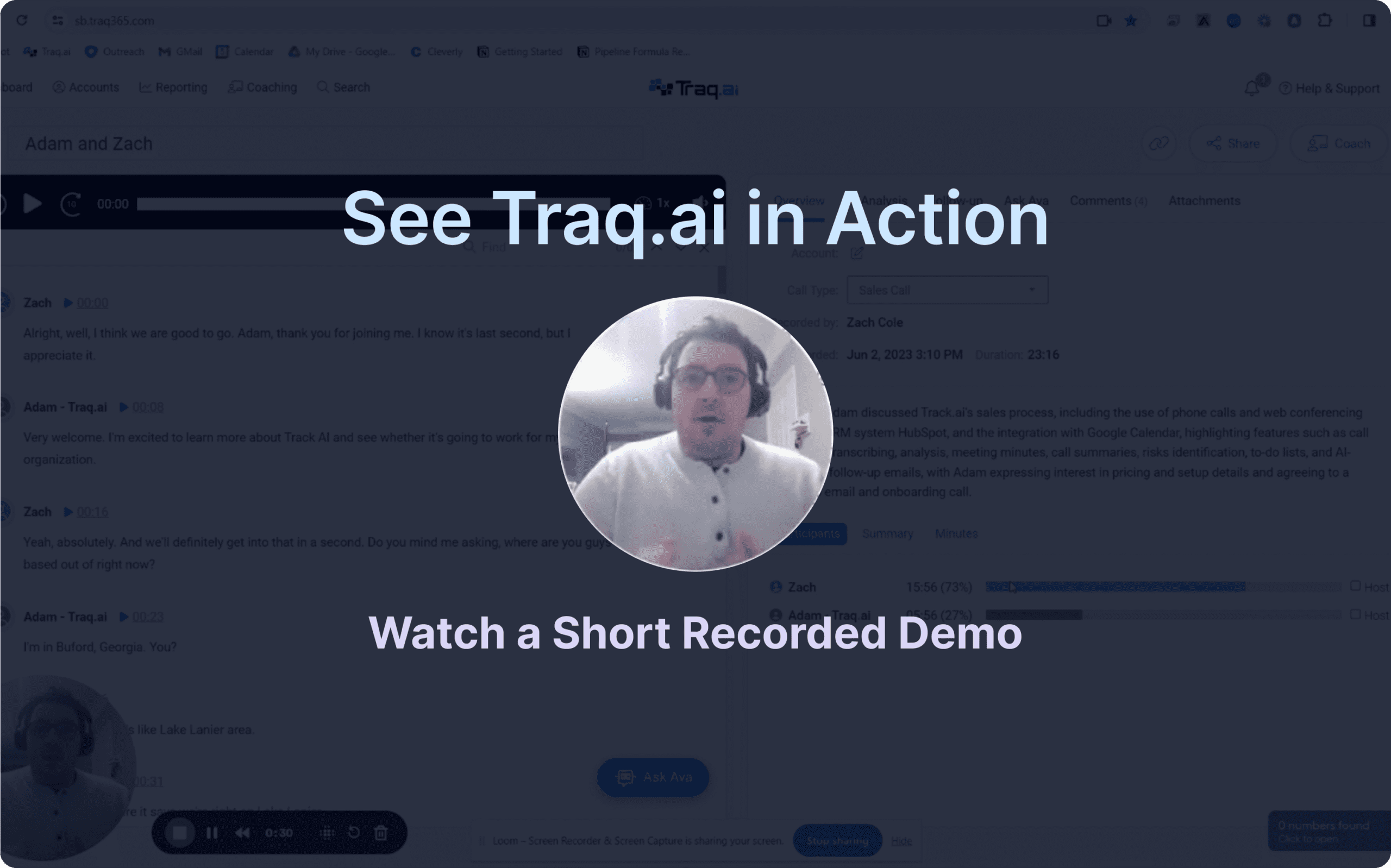
See TRAQ in action in this 5-min intro
Keep Learning

Conversation Intelligence vs Call Recording:
What Actually Moves Revenue
Some of Your Most Important Sales Conversations Never Make It Into Your Tech Stack