

How to Improve Sales Forecast Accuracy (Without the Guesswork)
Then the quarter ends. Half those sure things slipped. A few vanished entirely. And you’re left explaining a miss you never saw coming.
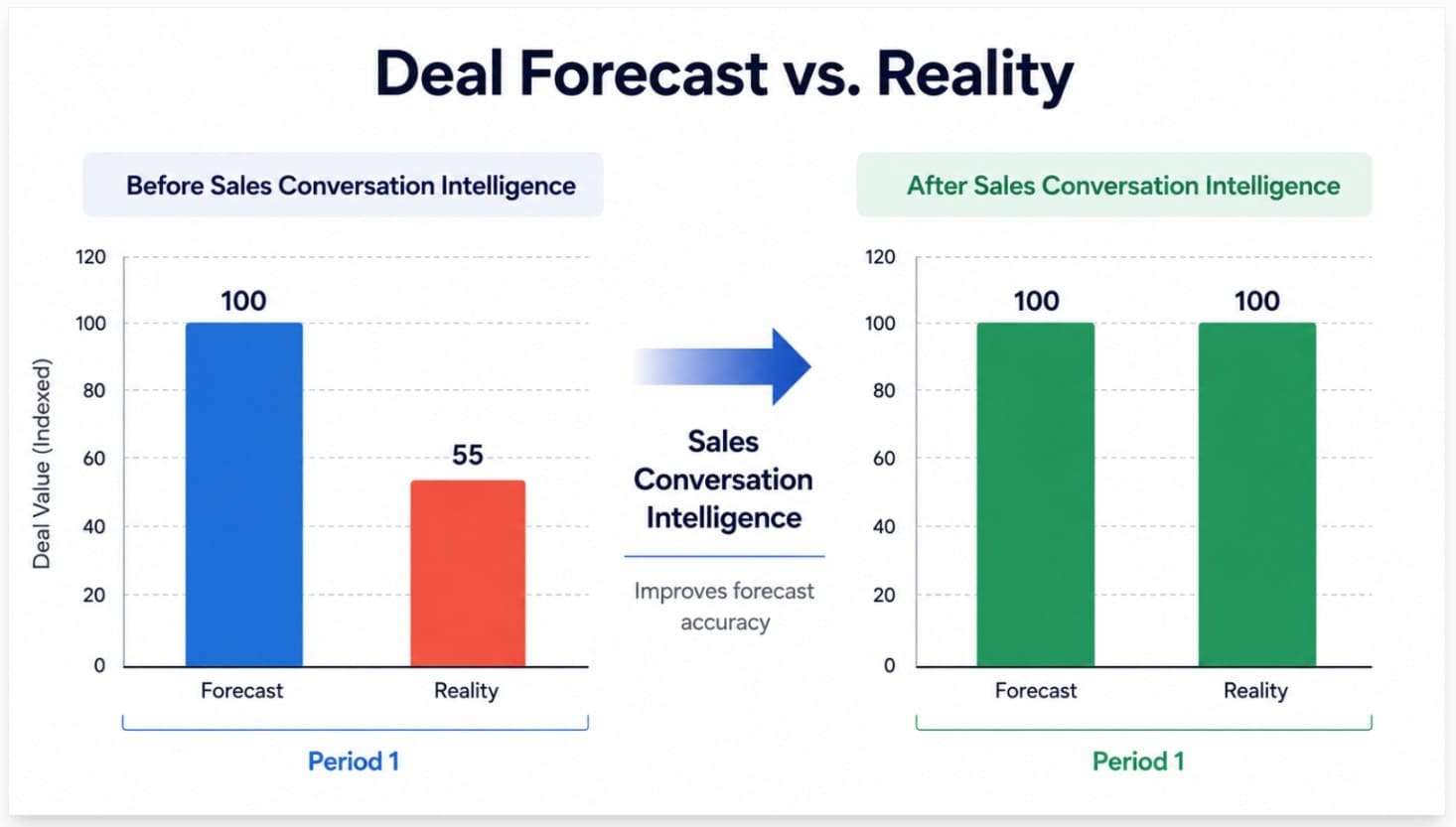
If that sounds familiar, you’re in good company. Roughly 60 percent of sales teams will miss their number this year, and it’s rarely because anyone is bad at math. So don’t beat yourself up. The fact that you’re looking for ways to improve already puts you ahead of the pack. The real problem isn’t your spreadsheet or your CRM stages. It’s the raw material your forecast is built from. Fix the inputs, and the forecast starts fixing itself.
Let’s talk about how.
The Real Reason Forecasts Go Wrong: Happy Ears
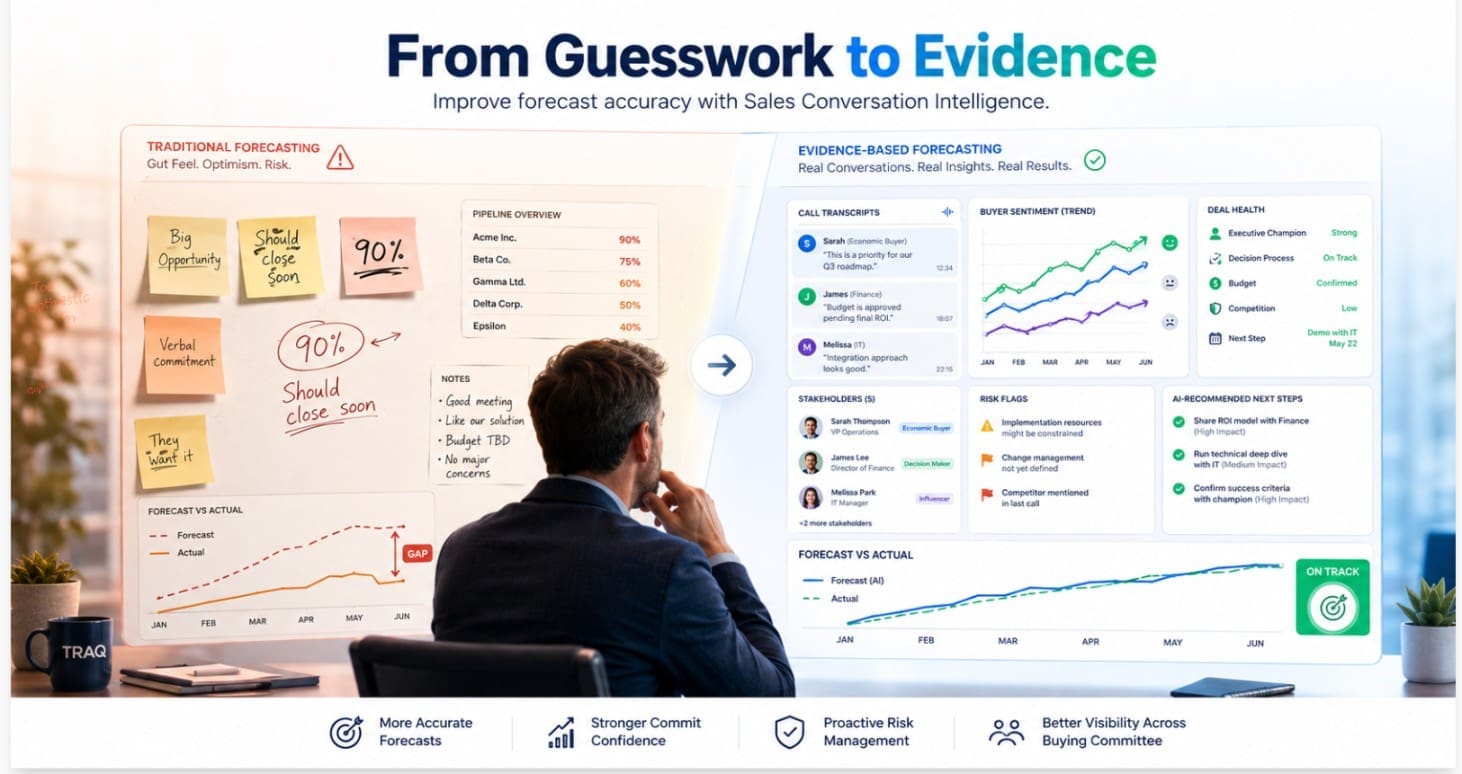
Here’s an uncomfortable truth. Most forecasts are really just a stack of opinions. A rep looks at a deal, remembers the good parts of the last call, and picks a probability that feels right. Multiply that across the whole team and you get a number that reflects confidence, not evidence.
And salespeople are optimists. They have to be. Optimism is what keeps them dialing after five straight no’s. But that same optimism creates what sales leaders call “happy ears.” The buyer says “this looks interesting,” and the rep hears “we’re ready to buy.”
A few classic failure modes show up again and again:
-
-
- Gut-feel probabilities. “It feels like 75 percent” isn’t data. It’s a mood.
- Stale CRM notes. The deal record says “sent proposal” from three weeks ago, and nobody knows what’s happened since.
- Selective memory. Reps remember the buyer’s enthusiasm and forget the budget concern they raised at minute 42.
- Single-threaded deals. Everything runs through one champion, and when that person goes quiet, so does the deal.
-
None of this makes your reps dishonest. It makes them human. The fix isn’t to interrogate them harder. It’s to stop relying on memory and opinion in the first place.
Shift From Rep Confidence to Buyer Signals
Here’s the pivot that changes everything: the most reliable forecast inputs don’t come from your reps. They come from your buyers.
What did the buyer actually say on the call? What questions did they ask? Did they talk about timelines and budget, or did they stay vague? Did they mention a competitor? Did they agree to a concrete next step, or just say “let’s touch base soon”?
Those signals live inside your sales conversations. In an ideal world, the sales leader would sit in on every call. The trouble is, no manager has time to sit in on every call, and no rep can remember every detail. That’s exactly the problem conversation intelligence software was built to solve.
A conversation intelligence platform like TRAQ records and transcribes every sales call, then uses AI to analyze what was actually said. Instead of relying on a rep’s recap, you get an objective record of buyer priorities, objections, risks, and competitor mentions. Sales conversation intelligence turns every call into forecast data, automatically.
Think of it this way. Your CRM tells you what your team did. AI conversation intelligence for sales tells you what your buyer thinks. Only one of those predicts whether the deal will close.
Score Deals on Sentiment, Not Just Stages
Most forecasts lean heavily on pipeline stages. Discovery, demo, proposal, negotiation. The further along a deal is, the higher the probability we assign it.
But here’s the catch: stages measure where a deal sits in your process. They say almost nothing about where the buyer is. A deal can sail into “Negotiation” while the buyer’s interest is quietly fading. Meanwhile, a deal still in “Discovery” might have a buyer who is fully engaged, asking implementation questions, and pulling colleagues into the conversation.
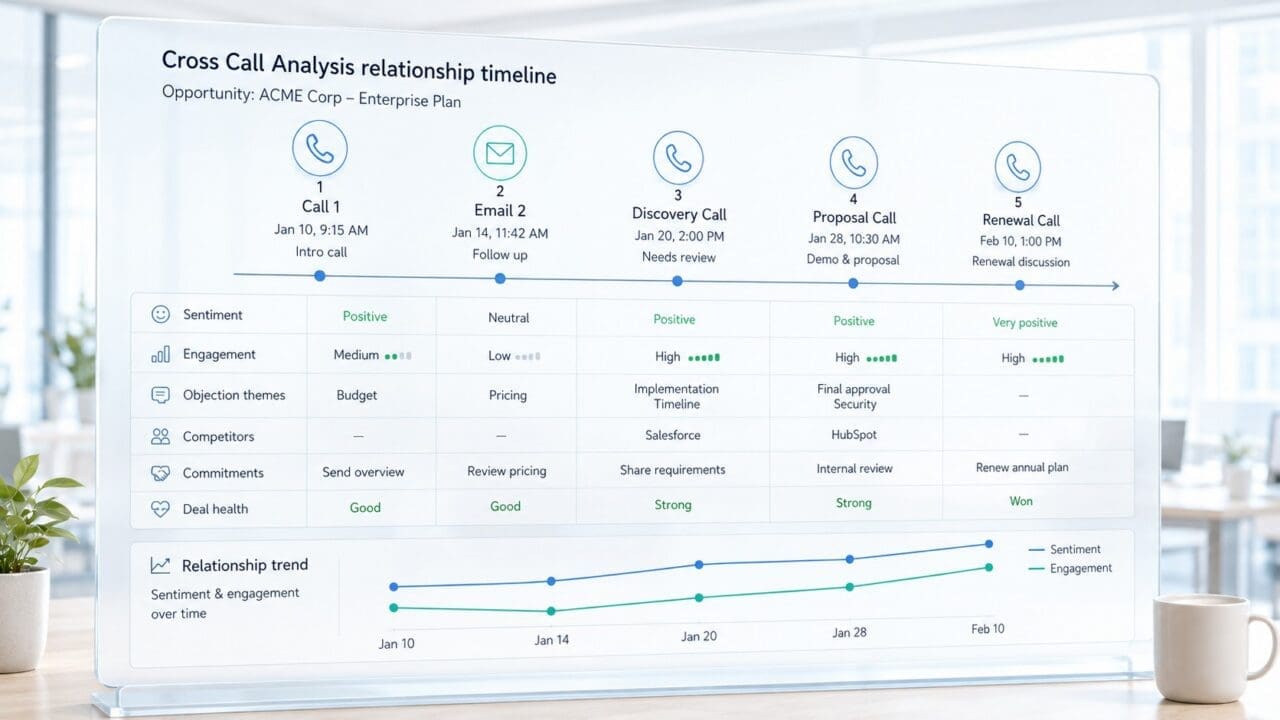
That’s why we built the Buyer Sentiment Score into TRAQ. Our sales call analytics platform generates a fresh, unbiased sentiment score for every single call, so you can watch buyer interest rise or fall across the entire sales cycle. It’s customer conversation analytics doing the work your gut used to do, minus the wishful thinking.
The practical payoff is simple. A late-stage deal with declining sentiment is a bigger forecast risk than an early-stage deal with climbing sentiment. When you can see that trend line, you stop forecasting on stage names and start forecasting on real buyer behavior.

Catch Stalls Before They Hit Your Number
Deals almost never die suddenly. They leave clues first, and those clues show up in conversations weeks before they show up in your pipeline report.
Watch for patterns like these:
-
-
- Next steps get vague. “Let’s reconnect after the holidays” replaces specific meeting dates.
- Objections go unanswered. A pricing concern comes up on a call and never gets resolved.
- Follow-ups get ghosted. Emails that used to get same-day replies now sit for a week.
- New stakeholders appear late. A procurement lead or skeptical VP shows up in month three, and the whole evaluation resets.
-
The challenge is spotting these clues across dozens of active deals. That’s where sales call analysis software earns its keep. TRAQ monitors conversations for red-flags, then surfaces the risks so you don’t have to hunt for them. And when a deal does fall through, AI sales call analysis helps you understand exactly why, so the same pattern doesn’t sink the next one.
For your forecast, this is gold. It means you can pull a shaky deal out of the commit column in week four instead of explaining the miss in week thirteen.
Clean Data Without the Busywork
Let’s be blunt about something: your forecast is only as good as the CRM behind it, and most CRMs are a mess. Not because reps are lazy, but because manual data entry is nobody’s favorite part of the job. After a long day of calls, updating deal records loses out to, well, almost anything else.
The old fix was nagging the reps. The better fix is automation. Modern call recording and analysis software takes the admin work off your reps’ plates entirely. TRAQ automatically captures every meeting, writes the summary, pulls out action items, and syncs everything to your CRM, attached to the right contact.
Our customers tell us this saves each salesperson five or more hours a week. But the forecasting benefit matters just as much as the time savings. When deal records update themselves after every conversation, your pipeline data stays current without anyone lifting a finger. Sales meeting intelligence software quietly does the housekeeping, and your forecast gets built on fresh information instead of three-week-old notes.
Inspect Deals With Evidence, Not Interrogation
Forecast calls have a reputation problem. Too often they turn into cross-examinations. “Are you sure this closes? Really sure? What’s your confidence level?” The rep gets defensive, the manager gets suspicious, and nobody learns anything new.
Sales call intelligence software changes the dynamic. Instead of debating opinions, you and your rep can look at the same evidence together. What did the buyer commit to on the last call? Was budget actually discussed, or just hinted at? Who else from their team was in the room? The conversation shifts from “convince me” to “let’s look at what happened.”
This is also where coaching and forecasting meet. Sales coaching software like TRAQ shows you how your top performers run discovery, handle objections, and lock in next steps, and how that differs from the rest of the team. With an AI sales coaching platform, every manager gets an always-on assistant that spots what’s working and what needs work. And because the coaching is built into the same automated sales coaching software that analyzes every call, reps improve on real examples from their own deals, not generic training videos.
Better-run deals are more predictable deals. As your team’s habits tighten up, so does your forecast.
A Simple 30-Day Plan to Tighten Your Forecast
You don’t need a six-month transformation project to see results. Here’s a plan you can run in a month:
Week 1: Start capturing calls. Turn on recording and transcription for every sales conversation. You can’t analyze what you don’t capture, and this single step gives your sales intelligence software something to work with.
Week 2: Add sentiment to deal reviews. In your pipeline meetings, pull up the sentiment for each committed deal. Rising, flat, or falling? Let that shape the conversation.
Week 3: Define evidence-based exit criteria. For each pipeline stage, agree on what proof a deal needs before it advances. A confirmed budget conversation. A scheduled meeting with the decision maker. No proof, no promotion.
Week 4: Reconcile the forecast against buyer signals. Compare your committed number to what the conversations actually show. Move deals that don’t hold up. It’ll sting the first time, but a smaller honest number beats a bigger fictional one every single time.
Run that loop for a quarter and watch what happens. This is the core promise of revenue intelligence software: decisions built on what buyers actually say and do, not on hope.

Forecast Accuracy Is a Listening Problem
Here’s the big takeaway. Improving forecast accuracy isn’t really a spreadsheet problem. It’s a listening problem. The signals that predict whether deals close are already there, spoken out loud in every sales call. The teams that hear them, and act on them, forecast better. It’s that simple.
That’s what we built TRAQ to do. It’s a revenue intelligence platform that listens to every conversation, scores buyer sentiment, flags risk, keeps your CRM clean, and coaches your team along the way. Less guessing, more knowing.
If your forecasts have been more art than science lately, we’d love to show you what your calls have been trying to tell you. Start a free trial or book a quick demo at traq.ai. Your next pipeline meeting could feel very different.
What to learn more? Check out TRAQ.ai and sign up for a brief demo.
Learn How TRAQ Transforms Sales Teams
See TRAQ in action in this 5-min intro

Keep Learning

How to Improve Sales Forecast Accuracy: Stop Guessing, Start Listening to Your Customer Conversations
The Builder’s Platform: How RevOps and Technical Teams Are Unlocking Conversation Intelligence Data with TRAQ