The Ultimate Guide to Conversation Intelligence: What It Is, How It Works, and Why Sales Teams Need It
Table of Contents
If you’re curious about conversation intelligence, you’ve come to the right place. A quick search reveals conflicting definitions, overlapping terms, and enough jargon to make your head spin—conversation analytics, conversational AI, conversational intelligence, and more.
This guide cuts through the confusion. We’ll cover what conversation intelligence actually is, how it works under the hood, what separates general CI from sales-focused CI, and how to evaluate tools for your team. Whether you’re exploring CI for the first time or looking to upgrade your current approach, you’ll find the answers here.
What Is Conversation Intelligence?
Conversation intelligence (CI) is the practice of using software, typically combining conversation capture, transcription, analytics, and AI, to turn real conversations into searchable, structured insights.
Forrester defines conversation intelligence for B2B revenue as tools that use natural language processing (NLP) to capture unstructured data across conversation channels, then use embedded AI to surface insights that guide best practices and inform coaching, enablement, and decision-making. (Forrester)
CI is an umbrella term because it applies to many kinds of conversations: sales calls, customer success meetings, support interactions, interviews, and internal meetings. But not all CI is designed for the same outcome. Sales conversation intelligence, which is the focus of this guide and what platforms like TRAQ specialize in, is purpose-built for revenue teams, optimized for coaching, repeatable process, and deal execution.
How Conversation Intelligence Works
Most conversation intelligence platforms follow a five-stage pipeline. Understanding this pipeline helps you evaluate what a tool actually does versus what it claims to do.
1. Capture
CI starts by capturing conversations from where your team actually works, be it phone systems, Zoom, Teams, Meet, in-person meetings or other channels. Adoption lives or dies here: if capture is inconvenient, usage drops. TRAQ integrates with the tools sales teams already use, so recording happens automatically without changing how reps work.
2. Transcribe
Transcription produces a time-stamped record of what was said. Quality platforms also perform speaker separation called “diarization” so you can see “who said what” reliably. This matters for sales because you need to know whether a key objection came from the decision-maker or someone else in the room.
Synchronized playback, where you can listen to audio while seeing corresponding words highlighted in the transcript, helps you catch nuances that text alone might miss. Was that “sounds great” genuine enthusiasm or polite skepticism? Context matters.
3. Structure Unstructured Data
CI becomes valuable when it converts raw dialogue into structured elements you can query and aggregate: topics, key moments (like when pricing came up), entities (competitor names, product features), and searchable snippets. This transformation is what separates CI from simple call recording.
4. Analyze Meaning
At the analysis layer, CI uses AI-powered language analysis to extract signals and patterns. IBM describes how conversational analytics identifies entities, sentiment, intents, context, and other linguistic features from text. (IBM)
This is where AI truly comes into play. AI-powered language analysis reveals “hidden” signals like when a buyer isn’t really interested, would rather not be on the call, or isn’t in a position to buy. The AI is tireless and objective, detecting buying signals (or their absence) that humans miss under pressure.
5. Deliver Actionable Outcomes
Outputs vary by platform, but typically include summaries, action items, key moments, coaching cues, QA/compliance flags, and cross-call reporting. Outreach describes CI as leveraging AI to analyze sales conversations and uncover actionable insights so teams understand what’s happening in a deal and don’t lose follow-up actions. (Outreach)
With a complete CI tool, an hour-long conversation only requires a few minutes to review. The AI provides insights and next steps automatically; no manual highlighting, no frantic note-taking, no wondering if you missed something important.
What Conversation Intelligence Produces
CI outputs fall into two categories, and understanding both is key to evaluating ROI.
Single-Conversation Outputs (Immediate Value)
- Summaries and notes: automatically generated, ready to share
- Action items and follow-up tasks: never lose a commitment again
- Key moments: objections, pricing discussions, competitor mentions, next steps
- Speaker dynamics and timestamped highlights
Cross-Conversation Intelligence (Where ROI Compounds)
- Patterns across many conversations: themes that correlate with wins and losses
- Coaching priorities by rep, team, and topic
- Process breakdowns: where discovery or follow-through consistently fails
- Pipeline Accuracy and Reliability: is this deal in a strong position to close
- Voice-of-customer insights: what buyers repeatedly ask for or resist
This cross-conversation analysis is where organizations find the most value over time. TRAQ’s cross-call analysis helps teams identify what separates top performers from the rest, so managers can coach to specific behaviors rather than general impressions.
Sales Conversation Intelligence: The Specialized Form of CI
Sales conversation intelligence is conversation intelligence designed for revenue outcomes. It’s less about generic meeting productivity and more about improving sales execution through coaching, repeatable process, and deal clarity.
A practical way to separate the two:
General CI often prioritizes:
- Meeting documentation (summary, notes, tasks)
- Broad meeting types (internal and external)
- Organization and search
Sales CI often prioritizes:
- Coaching and enablement – what “good” looks like and how reps improve
- Discovery quality – whether key questions were asked and answered
- Methodology/process adherence – consistency with your playbook (Sandler, MEDDIC, etc.)
- Objections and deal risk – surfacing weak spots early
- Script/compliance checks – especially in regulated environments like insurance and financial services
- Conversation Scoring – where did the conversation go well and where did it falter
- Revenue workflows – CRM write-back, activity logging, pipeline hygiene
This distinction matters when choosing a platform. A tool built for general meeting productivity won’t give you the coaching depth and methodology tracking that sales teams need.
Why Sales Conversation Intelligence Matters More Than Ever
Sales cycles are longer, stakeholder groups are larger, and the burden of capturing and organizing details has grown. Meanwhile, managers can’t manually review enough conversations to coach consistently at scale.
Consider the math: A sales manager with 10 reps, each making 5 calls per day, has 50 calls to potentially review. That’s 250 per week. Listening to even 10% of those at real speed would consume 25+ hours weekly. It’s impossible without AI.
Sales CI helps by:
- Preserving “what was said” so critical details aren’t lost between meetings
- Surfacing nuances humans miss, especially when reps are under pressure
- Standardizing execution so discovery and follow-through are repeatable
- Enabling consistent coaching without requiring managers to listen to everything
Organizations that collect conversation intelligence are building a competitive advantage, a treasure trove of buyer data that reveals which strategies work, which should be retired, and what buyers actually care about (not what we assume they care about).
The value of conversation intelligence over a long period of time compounds in value. Capture six months of calls, and you start seeing patterns. Capture two years, and you have an asset no competitor can replicate: a detailed map of how your buyers think, what they push back on, and what makes them say yes. That intelligence flows into messaging, playbook design, product roadmaps, and coaching priorities—grounded in evidence, not guesswork.
Conversation Intelligence vs. Call Recording
Call recording captures audio (and sometimes a transcript). Conversation intelligence goes further by analyzing those conversations to produce insights and patterns you can act on.
A helpful mental model:
- Recording = storage
- CI = analysis + structure + insight
Although recordings are a source of intelligence, listening to them takes time. Imagine sitting through an hour-long conversation, taking notes, extracting next steps, then repeating for every call. One-hour conversation = one hour manually extracting intelligence. Even at 2x playback, you’re still doing the analysis yourself.
CI platforms like TRAQ automate this work. The AI handles note-taking, highlights key moments, and surfaces coaching opportunities—so you can focus on actually selling.
Conversation Intelligence vs. Conversational AI
These terms get mixed up constantly. Here’s the difference:
- Conversation intelligence analyzes real human conversations to produce insights, coaching, documentation, and patterns.
- Conversational AI refers to systems that conduct conversations such as chatbots, voice assistants to answer questions or complete tasks.
They can complement each other, but they solve different problems. TRAQ focuses on conversation intelligence: understanding what happened in human-to-human conversations and turning that understanding into actionable coaching.
Common Use Cases for Sales Conversation Intelligence
1. Faster Onboarding and Sales Enablement
Build a library of excellent examples: strong discovery calls, effective objection handling, clear next-step setting. New reps can learn asynchronously from real conversations, not just theory. TRAQ customers use call libraries to cut ramp time by showing new hires exactly what “good” looks like in their specific context.
2. Coaching at Scale
Use scoring, rubrics, and highlighted moments to prioritize what managers review. Instead of random sampling, coach the behaviors that actually matter. TRAQ’s methodology-aligned scoring helps managers focus on the 20% of coaching that drives 80% of improvement.
3. Deal Execution and Risk Visibility
Spot weak next steps, vague timelines, missing stakeholders, pricing pressure, and unresolved objections before deals slip. When your buyer expects nothing short of the perfect proposal, knowing all the details – really understanding them – makes the difference between winning and losing.
4. Script Adherence and Compliance Monitoring
When configured to your process, CI can flag when required steps or disclosures were missed. This is especially valuable in regulated industries like insurance, wealth advisory, and financial services where TRAQ has deep experience.
5. Voice-of-Customer Learning
Across many conversations, CI reveals what buyers consistently want, resist, and value. This intelligence flows beyond sales. Marketing can create more relevant content. Product can prioritize features, and Customer Success can anticipate friction before it happens.
In the end, everyone wins: more intelligence → better proposals → better products → happier customers.
How to Choose a Conversation Intelligence Tool
There are plenty of CI platforms available, and the right choice depends on your specific needs. Here’s what to consider:
Think about the future.
AI keeps getting smarter, building on what it learned yesterday. The insights being collected need to be the “right” type; those that make a measurable impact on sales, market knowledge, and coaching. Anything else is a waste of time.
Prioritize buyer-centric intelligence.
Some tools define conversation intelligence primarily as intelligence about the seller such as measuring talk time, filler words, and similar metrics. These have their place, but they’re marginal. Focusing on your buyer. What they want, need, say, and mean matters more to the final sale than critiquing the seller’s delivery.
Look for complete capabilities.
You need the full pipeline: capture, transcription, synchronized playback, AI-generated summaries, AI-powered language analysis, and cross-call insights.
But beware of platforms that are feature-complete yet inflexible. If the analysis is fixed, you’re stuck fitting your process into their mold. Every organization sells differently. Different methodologies, different questions, different markers of success. The right CI platform adapts to your business, not the other way around.
Ensure Fit with how your team actually sells.
Capture must match your channels. Analysis should reflect your playbook; what must be asked, what must be captured, and what “good” looks like for your organization. The most important driver of value for any CI platform is Fit.
How TRAQ Approaches Sales Conversation Intelligence
TRAQ is built around sales-focused conversation intelligence: helping teams convert customer conversations into structured insights that support coaching, consistency, and execution.
Our platform is designed for professional services organizations with 25-1,000 person sales teams, particularly in professional services, insurance, wealth advisory, digital agencies, logistics, consulting and consulting. These are environments where conversations are complex, compliance matters, and the difference between a good call and a great call directly impacts revenue.
TRAQ emphasizes buyer-centric intelligence because we believe understanding your customers, really understanding them, is what separates winning teams from everyone else. The AI handles the tedious work of note-taking and analysis, freeing your reps to focus on what humans do best: building trust and rapport with buyers.
Key TRAQ capabilities include:
- Automatic capture from phone systems, Zoom, Teams, in-person meetings, cell phones, and other channels
- High-quality transcription with speaker separation
- AI-powered summaries and action item extraction
- Methodology-aligned scoring (Sandler, MEDDIC, custom frameworks)
- Cross-call analysis to identify patterns and coaching priorities
- CRM integration for seamless workflow
- Compliance-ready features for regulated industries
- Customized Call Analyses to fit with how your organization does business
To learn more about specific features, visit our pages on How TRAQ Works, Integrations, Security & Privacy, and our AI Data Policy.
Frequently Asked Questions
What is conversation intelligence software?
Conversation intelligence software captures, transcribes, and analyzes spoken conversations, typically sales or customer service calls, using AI-powered language analysis. It transforms unstructured dialogue into searchable, structured insights that teams can use for coaching, deal visibility, and process improvement. TRAQ is an example of conversation intelligence software designed specifically for sales teams.
What’s the difference between conversation intelligence and call recording?
Call recording simply stores audio (and sometimes transcripts). Conversation intelligence goes further by analyzing those recordings to extract insights, patterns, and actionable data. Recording is storage; CI is analysis plus structure plus insight.
How does conversation intelligence help with sales coaching?
CI platforms like TRAQ automatically identify coachable moments such as objection handling, discovery quality, next-step setting across all calls. Managers can review highlighted excerpts instead of listening to entire recordings, making coaching scalable. Cross-call analysis reveals patterns by rep and team, showing exactly where coaching will have the most impact.
What is AI-powered language analysis in conversation intelligence?
AI-powered language analysis is the technology that enables conversation intelligence platforms to understand meaning, not just words. It extracts entities (like competitor names), detects sentiment and intent, identifies topics, and recognizes patterns that humans might miss, especially at scale. Modern platforms like TRAQ use advanced AI that goes beyond traditional approaches to deliver deeper, more actionable insights.
Is conversation intelligence the same as conversational AI?
No. Conversation intelligence analyzes real human-to-human conversations. Conversational AI refers to systems that conduct conversations like chatbots or voice assistants. They solve different problems and can complement each other, but they’re not the same technology.
What industries use sales conversation intelligence?
Any industry with significant phone or video-based sales can benefit. Common adopters include professional services, consulting, logistics, marketing organizations, insurance, wealth advisory and financial services, SaaS, professional services, consulting, and digital agencies. TRAQ specializes in serving professional services organizations where conversations are complex and compliance is important.
How long does it take to implement a conversation intelligence platform?
Implementation varies by platform and complexity, but most teams can be capturing and analyzing calls within days to weeks. TRAQ is designed for fast deployment, usually measured in minutes, integrating with existing phone systems and video conferencing tools without requiring reps to change how they work.
What ROI can I expect from conversation intelligence?
ROI typically comes from several sources: faster rep ramp time (learning from real calls), improved win rates (better coaching and deal visibility), time savings for managers (automated vs. manual call review), and better pipeline accuracy.
The impact shows up quickly. TRAQ customers typically see close rates improve by 22% to 28% within the first quarter, and reps reclaim 5 to 7 hours per week previously lost to note-taking and administrative work. That’s real money and real time back in the pipeline devoted to sales.
What’s the difference between conversation intelligence and sales conversation intelligence?
Conversation intelligence is the broad category that includes any use of AI to analyze conversations and extract insights. Sales conversation intelligence is a specialized form built specifically for revenue teams. General CI tools often prioritize meeting documentation and organization across all meeting types.
Sales CI goes deeper: coaching and enablement, discovery quality, methodology adherence, objection tracking, deal risk visibility, and compliance monitoring. Essentially anything that helps move deals forward.
If your goal is improving sales execution rather than just capturing meeting notes, you need a platform designed for that purpose. TRAQ focuses exclusively on sales conversation intelligence.
What is cross-call analysis?
Cross-call analysis examines patterns across many conversations rather than looking at calls one at a time. This is where conversation intelligence delivers compounding value.
A single call tells you what happened in that deal. Cross-call analysis reveals what separates your top performers from everyone else, which objections correlate with lost deals, where discovery consistently breaks down, and what messaging resonates across your market. TRAQ’s cross-call analysis helps managers identify coaching priorities based on real patterns, not gut feel.
What’s the difference between buyer-centric and seller-centric conversation intelligence?
Seller-centric CI focuses on the rep’s behavior: talk time, filler words, speaking pace, monologue length. These metrics have their place, but they’re marginal to outcomes.
Buyer-centric CI focuses on what matters most such as understanding the customer. What did they say? What do they need? What objections did they raise? What signals indicate genuine interest or hidden hesitation? TRAQ takes a buyer-centric approach because understanding your customers is what ultimately wins deals.
Can conversation intelligence help with compliance in regulated industries?
Yes. In regulated industries like insurance, wealth advisory, and financial services, conversation intelligence can flag when required disclosures were missed, verify that compliant language was used, and create an auditable record of customer interactions. This protects both the organization and its customers. TRAQ serves many clients in regulated verticals and includes compliance-ready features designed for these requirements.
How does conversation intelligence help onboard new sales reps?
New reps traditionally learn through ride-alongs, role plays, and tribal knowledge – slow and inconsistent.
Conversation intelligence changes this by creating a library of real calls. New hires can study how top performers handle discovery, navigate objections, and set next steps. They learn from actual customer c
onversations, not just theory. TRAQ customers use call libraries to accelerate ramp time and ensure new reps see what “good” looks like in their specific selling environment.
Can I customize conversation intelligence to match my sales methodology?
It depends on the platform. Many CI tools offer fixed analysis: what you see is what you get. But every sales organization is different: different methodologies (Sandler, MEDDIC, Challenger, custom frameworks), different qualifying questions, different definitions of a strong call.
The right platform adapts to your process rather than forcing you into a generic mold. TRAQ supports methodology-aligned scoring and customized analyses that fit how your organization actually sells.
References
- Forrester: Definition of conversation intelligence for B2B revenue. AI captures unstructured conversation data and surfaces insights for best practices, coaching/enablement, and decision-making. Source
- Salesloft: Conversation intelligence surfaces moments, sentiments, and patterns to provide actionable feedback for coaching and performance. Source
- IBM: Conversational analytics extracts entities, sentiment, intents, and context from text. Source
- Outreach: CI for sales leverages AI analysis of sales conversations to provide actionable insights, coaching, and deal visibility. Source
About the Author
Adam Rubenstein is the CEO of TRAQ, a conversation intelligence platform for sales and customer-facing teams. He works with sales leaders to turn real conversations into structured insights, repeatable coaching, and measurable improvement, helping teams execute consistently and scale what works. Connect with Adam on LinkedIn or learn more at traq.ai.
Learn How TRAQ Transforms Sales Teams
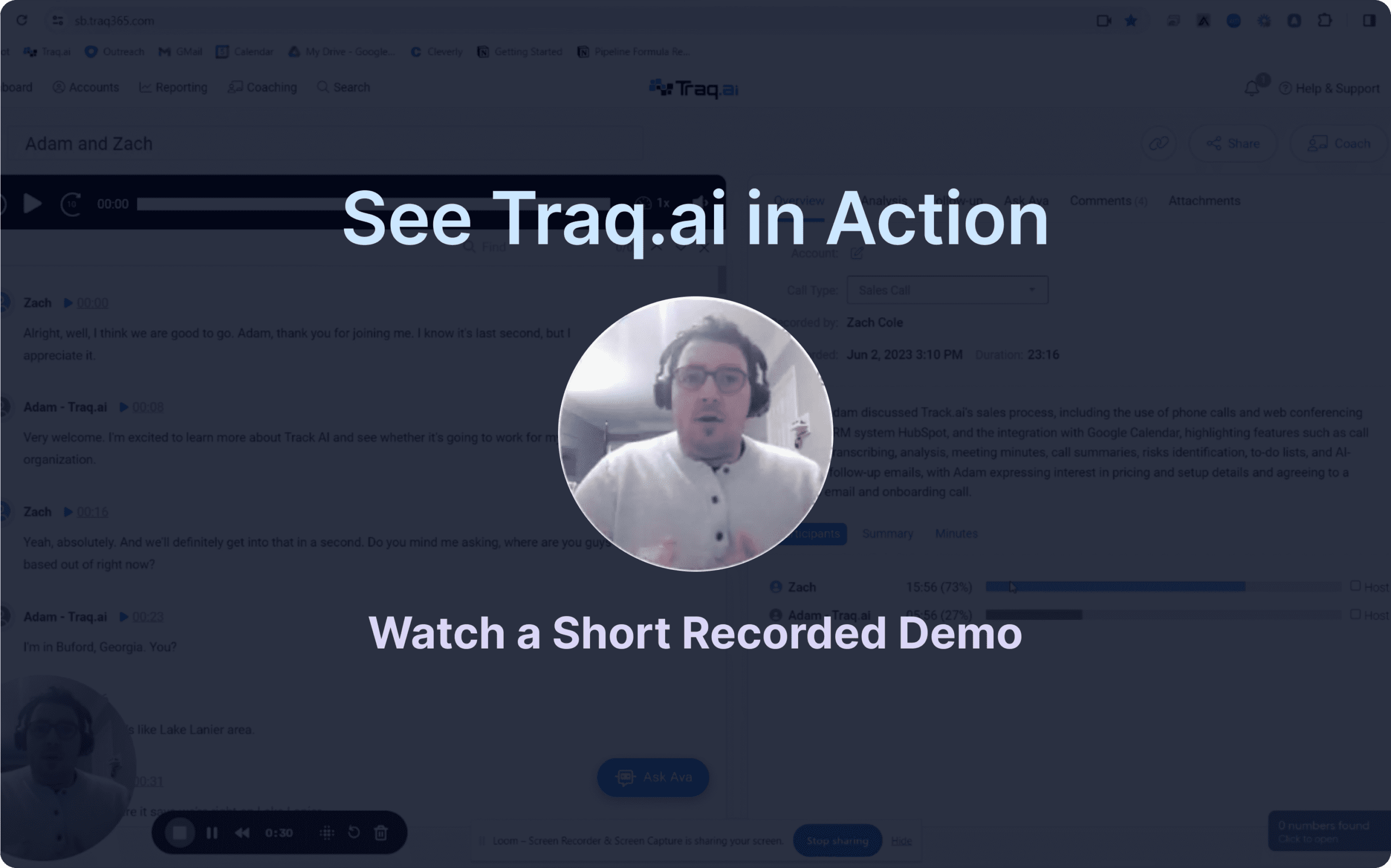
See TRAQ in action in this 5-min intro
Keep Learning

What ROI Should You Expect from Conversation Intelligence Software?

The Ultimate Guide to Conversation Intelligence: What It Is, How It Works, and Why Sales Teams Need It