What is Conversation Intelligence Software and Why Does Sales Coaching Need It?
Quick Summary:
Sales managers coach based on just 4-6% of their team’s conversations—the handful of calls they can actually join. The other 94-96% stays invisible, which means coaching defaults to surface-level observations like “talk less” or “ask more questions” instead of addressing the substantive issues that actually determine whether deals close or stall.
Conversation intelligence software uses AI to analyze 100% of sales calls and surface coaching opportunities managers would otherwise miss. Instead of guessing, managers get specific, data-driven insights:
-
- The objection that wasn’t addressed
- The discovery question that was skipped
- The buying signal that was missed
- The patterns that separate top performers from everyone else
TRAQ delivers these insights within minutes of each call ending, not weeks later. Managers review AI-generated summaries instead of listening to full recordings, cutting prep time from hours to minutes. This means coaching happens more often, more accurately, and with more impact—transforming sales coaching from educated guessing to precision.
Table of Contents
Sales managers pride themselves on knowing their reps. They can spot a weak opener, hear hesitation in a demo, and sense when a deal conversation goes sideways.
But even the best managers miss what matters most: the substantive patterns hiding in plain sight. They focus on how reps sound instead of what buyers actually say. They coach on delivery when the real issue is discovery. They address symptoms while root causes hide in conversations they never heard.
Conversation intelligence software surfaces what you can’t hear: the insights that determine whether deals close or stall, patterns that separate top performers from everyone else, and coaching opportunities that even veteran managers miss.
What Conversation Intelligence Software Actually Does
Conversation intelligence software uses AI to analyze sales conversations and extract actionable insights that help teams sell better and managers coach smarter.
At its core, the technology:
- Records and transcribes sales calls automatically
- Uses natural language processing (NLP) to identify patterns, buyer signals, and coaching moments
- Surfaces specific conversation details that would otherwise be missed
- Turns unstructured conversations into structured, searchable data
The difference between basic call recording and conversation intelligence is simple: recording captures what was said, while conversation intelligence tells you what it means.
For a comprehensive breakdown of how conversation intelligence works and its full capabilities, read our ultimate guide to conversation intelligence. The rest of this article focuses specifically on why conversation intelligence transforms sales coaching from guesswork to precision.
Why Traditional Sales Coaching Fails
Most sales coaching happens in a vacuum.
Managers join one or two calls per rep monthly if they’re lucky. They give feedback based on what they remember from those calls, which means coaching defaults to surface-level observations: “You talked too much,” “Slow down your demo,” “Ask more questions.”
This approach misses the substance. Did the rep address the buyer’s budget concern or just acknowledge it and move on? Did they ask about decision-making authority or assume the contact was the decision-maker? Did they explore the buyer’s hesitation about implementation or pivot to features?
Managers can’t coach on what they didn’t hear. And they can’t hear most of what their reps say to buyers.
The math doesn’t work. A manager with eight reps, each taking 20–30 calls weekly, means 160–240 conversations happening. The manager hears maybe 10 of them. That’s 4–6% of what’s actually happening on the front line.
Coaching based on 4% of conversations isn’t coaching; it’s educated guessing.
Worse, the calls managers do join aren’t representative. Reps perform differently when their manager listens. The difficult conversations, the ones where coaching would help most, happen when no one else is on the line.
Even exceptional managers hit a scaling wall. They can effectively coach 8 to 10 reps maximum. Beyond that, coaching quality drops because there aren’t enough hours to maintain the depth each rep needs.
Traditional coaching also happens too late. Monthly one-on-ones reviewing calls from two weeks ago don’t help. The deal already progressed (or died), the rep has already reinforced the same habits on 20 more calls, and the specific context is gone.
How Conversation Intelligence Changes Sales Coaching
Conversation intelligence makes every conversation available for coaching, not just the random sample managers happen to join.
The AI analyzes 100% of calls, identifying patterns across dozens or hundreds of conversations that no human could spot manually. It finds the moments that matter: the objection that wasn’t addressed, the discovery question that was skipped, the buying signal that was missed.
Instead of “be more consultative,” managers coach with precision: “You asked about current process but didn’t follow up when the buyer mentioned frustration with their vendor. Here’s how to dig into that.”
Instead of manager intuition about what works, teams see data on what actually correlates with wins. Top performers might not close deals because of their personality or experience. They might win because they spend 60% more time on discovery, handle objections with questions instead of statements, or consistently confirm next steps with specific dates.
Conversation intelligence shifts coaching from reactive to proactive. Managers spot coaching opportunities immediately after calls, when the conversation is fresh and the rep can actually apply feedback to the next interaction.
This changes the fundamental dynamic. Traditional coaching asks “What did you do wrong?” Conversation intelligence coaching asks “What did the buyer tell you that you might have missed?”
The Three Coaching Problems Conversation Intelligence Solves
Problem 1: Managers Don’t Know What They Don’t Know
The biggest coaching gap isn’t what managers see and ignore. It’s what they never see at all.
A rep consistently struggles with technical objections, but only on calls with IT stakeholders. The manager coaches on discovery because that’s what they observed on the two calls they joined. The real issue stays hidden.
Another rep excels at opening conversations but loses momentum in the middle. Deals stall in stage 3 for reasons the manager can’t pinpoint because they only hear the stage 1 calls.
TRAQ’s AI analyzes every recorded conversation, not just the handful a manager can join. Because it processes 100% of calls, it identifies patterns that would be invisible from a random sample—the kind of insights that only emerge when you can see across dozens or hundreds of conversations at once.
For every call, TRAQ generates a detailed summary, identifies action items, flags buyer priorities, surfaces objections, provides coaching guidance, and tracks competitor mentions. Managers don’t need to listen to full recordings to know what happened. They can review a conversation’s key moments in minutes and spot coaching opportunities that would have taken hours to find manually.
Where this gets especially powerful is with Custom AI Analysis packages. These are tailored to your specific sales process and can be configured to evaluate exactly the behaviors that matter to your team. For example, a custom analysis might flag when a rep skips budget qualification, fails to ask about decision-making authority, or introduces pricing before establishing value. When that analysis runs across every call, the patterns become undeniable and coachable.
TRAQ also generates a Buyer Sentiment Score for each conversation, so managers can see how buyers are actually responding to each rep’s approach. If a rep’s sentiment scores consistently drop during technical discussions but stay high during business conversations, that’s a specific, data-driven coaching target a manager would never spot from two ride-alongs a month.
Problem 2: Coaching Happens Too Late
Traditional coaching operates on a delay. Manager joins a call, takes notes, waits for the weekly one-on-one, discusses what happened days or weeks ago. By then, the context has faded.
By then, the rep has taken 15 more calls using the same flawed approach. The specific deal moved forward (or died) without the coaching input that could have changed the outcome.
Effective coaching happens when the conversation is fresh, when the rep still remembers the buyer’s tone, the hesitation they sensed, the objection that caught them off guard.
TRAQ delivers transcriptions, summaries, and AI-generated analysis shortly after each call ends. Managers don’t have to wait for a weekly review or schedule time to listen to recordings. The insights are available the same day, typically within minutes of the conversation wrapping up.
This speed changes the coaching dynamic entirely. A manager can review a rep’s call summary over morning coffee and send targeted feedback before the rep’s next meeting. Instead of vague advice two weeks later, the coaching is specific and timely: “In yesterday’s call with Acme Corp, the buyer raised implementation concerns twice and you pivoted to features both times. Next time, try asking what specifically worries them about implementation before moving on.”
The most effective managers build a quick daily review into their routine. They check the most recent conversation summaries, Risk Analysis, Coaching Guidance, and Buyer Sentiment Scores for their team, identify one or two coaching moments worth addressing, and deliver that feedback the same day. This turns coaching from a scheduled event into a continuous habit. Because TRAQ has already done the analysis, the manager’s prep time drops from hours of listening to minutes of reviewing summaries, which means coaching happens more often, not just more accurately.
Problem 3: Scaling High-Quality Coaching
The best sales managers can effectively coach 8 to 10 reps. Beyond that, coaching quality deteriorates because there aren’t enough hours to maintain the depth each rep needs.
New managers face an even harder challenge. They don’t have years of pattern recognition built up. They don’t instinctively know what “good discovery” sounds like or which objection patterns indicate deal risk versus buyer posturing.
Growing sales teams face a coaching capacity crisis. You can hire more reps faster than you can develop great managers, which means coaching quality drops precisely when the team needs it most.
TRAQ multiplies a manager’s coaching capacity by doing the heavy lifting that normally limits how many reps they can effectively support. Instead of spending hours listening to calls to find coaching moments, managers review AI-generated summaries and analysis that surface the moments worth coaching on. This cuts prep time dramatically. A manager who used to deeply coach 8 reps can now provide meaningful, data-backed coaching to 20 or more.
The Buyer Sentiment Score gives managers a quick triage tool. If one rep’s sentiment scores are trending down across their last several calls, that’s a clear signal to prioritize coaching attention there. Managers don’t have to guess who needs help. The data tells them.
TRAQ’s Coaching Library is a game-changer for new managers and scaling teams. Managers can save standout conversation segments—a great discovery sequence, a well-handled objection, a smooth transition from value to pricing—and make them available to the entire team. A new manager doesn’t need five years of experience to know what “good” looks like; they can point to real examples from their own team’s top performers.
Custom AI Analyses level the playing field further. When the analysis is configured to evaluate conversations against your sales methodology, every manager gets the same objective lens into rep performance. An average manager armed with TRAQ’s insights can deliver coaching that’s as specific and substantive as what your most experienced leader provides because they’re both working from the same data, not from different levels of intuition.
The net effect is that coaching quality becomes consistent across your management team, not dependent on individual manager skill. And as you grow, each new manager inherits the full coaching infrastructure from day one.
What Makes Conversation Intelligence Valuable Beyond Recording Calls
Anyone can record calls. That’s not the value.
The value is in AI identifying what matters in those conversations: the moments that determine outcomes but get lost in 30 to 60 minute calls full of small talk, logistics, and routine discussion.
Human managers naturally focus on delivery: tone, confidence, pace, talk-to-listen ratio. These matter, but they’re surface level.
Conversation intelligence with sophisticated NLP digs into substance:
Objections that weren’t addressed. The buyer says “We tried something similar before and it didn’t work.” The rep says “I understand” and pivots to features. A coach watching live might miss this. Conversation intelligence flags it: buyer expressed a past failure concern that was acknowledged but never explored.
Discovery questions that were skipped. Average reps ask about current process. Top performers ask about current process, then ask what happens when that process breaks down, who gets impacted, and what the cost of inaction is. Conversation intelligence shows which reps go deep and which stay surface-level.
Buyer concerns that signal deal risk. A champion says “I need to run this by our CFO” in week 3. Sounds routine. But conversation intelligence catches that this is the first mention of CFO involvement, the champion hasn’t described the decision process, and no executive meeting has been scheduled. That’s a coaching moment about multi-threading.
Successful techniques from top performers. Your best rep closes 40% more deals than team average. Why? Maybe they spend 60% more time on discovery. Maybe they always ask “What happens if you don’t solve this?” before presenting solutions. Conversation intelligence makes these patterns visible so you can coach every rep to adopt them.
TRAQ’s AI goes beyond simple keyword detection and talk-time metrics. It uses natural language processing to understand the context and meaning of conversations, not just the presence of specific words. A platform that flags the word “budget” can tell you the topic came up. TRAQ can tell you whether the rep actually confirmed budget authority, whether the buyer expressed concern about cost, or whether budget was mentioned in passing with no follow-up.
For example, TRAQ might identify that a rep consistently moves to demo mode whenever a buyer expresses hesitation rather than asking a follow-up question to understand the hesitation. That’s not something keyword spotting catches. It’s a behavioral pattern that only surfaces when AI understands the flow and structure of the conversation.
Similarly, TRAQ can identify when a buyer raises the same concern multiple times using different language. A buyer might say “We’ve been burned before,” then later mention “Our team is cautious about new vendors,” and later ask “What does your support look like post-implementation?” Those are three expressions of the same underlying trust concern. A keyword-based tool might catch the third one as a “support” mention. TRAQ’s NLP can recognize the pattern across all three and flag it as an unresolved buyer concern worth coaching on.
Custom AI Analyses push this even further. Because they’re built around your specific sales process and methodology, they evaluate conversations against what “good” looks like for your team, not a generic benchmark. This means the insights are immediately actionable: they tell you not just what happened, but how it compares to what should have happened according to your playbook.
Real Coaching Scenarios: Before and After
Scenario 1: The Discovery Gap
A mid-market rep had strong activity numbers and good energy on calls, but her close rate lagged behind peers by about 15%. Her manager coached her on objection handling because that’s what stood out during ride-alongs.
After implementing TRAQ, the AI Analysis revealed a different problem: the rep was averaging only 6 minutes on discovery before transitioning to a product walkthrough, while the team’s top closer averaged 14 minutes. More specifically, she rarely asked about who else was involved in the decision or what would happen if the buyer didn’t solve the problem.
The manager shifted coaching focus entirely from objection handling to discovery depth. Over the following quarter, the rep’s average discovery time increased to 12 minutes, and her close rate improved by 8 percentage points. Not a dramatic transformation, but a meaningful, sustained improvement driven by an insight the manager never would have found by joining a couple of calls.
Scenario 2: The Compliance Blind Spot
A team selling into financial services kept losing deals in the final stages. The manager assumed it was a pricing issue because reps reported “they went with a cheaper option.”
TRAQ’s conversation analysis told a different story. Across multiple lost deals, buyers consistently raised compliance and data security questions that reps answered vaguely or deflected with “Our team can address that in implementation.” The Buyer Sentiment Score dropped noticeably whenever these topics came up.
The manager worked with enablement to create a clear, conversational framework for handling security and compliance questions during the sales process rather than deferring them to implementation. Over the next two months, late-stage deal losses in that segment decreased by about 20%.
Scenario 3: The Presentation Problem
A new rep ramping onto the team was hitting activity targets but generating low-quality pipeline. His manager couldn’t figure out why. The rep sounded polished on the calls the manager joined.
TRAQ’s analysis showed the issue: the rep was spending nearly 70% of call time talking versus listening, and he almost never asked a second follow-up question after the buyer’s initial response. He was conducting calls like presentations, not conversations.
The manager used examples from the Coaching Library—segments from a top performer who excelled at follow-up questions—and coached the rep to pause after buyer responses and ask “Tell me more about that” before moving on. Within six weeks, his talk-to-listen ratio shifted from 70/30 to closer to 55/45, and the quality of opportunities entering his pipeline improved noticeably.
What to Look for in Conversation Intelligence for Coaching
Good conversation intelligence for coaching should deliver insights immediately, not after 30 to 60 days of data accumulation and AI training.
It should highlight specific moments worth coaching on, not just aggregate scores. “Your discovery score is 6.5/10” doesn’t help anyone. “You asked about current process but didn’t ask about pain points or impact when the buyer described frustration” gives a rep something to work with.
The platform should work for managers, not data analysts. If you need to build custom reports or interpret dashboards to find coaching opportunities, it won’t get used. Managers need clear, actionable insights without extensive configuration.
It should reduce coaching prep time, not increase it. The goal is more coaching, not more admin work reviewing dashboards.
Most importantly, it should surface what you didn’t know to look for. Platforms that only confirm your existing hypotheses provide limited value. The breakthrough coaching moments come from patterns you wouldn’t think to measure.
Red flags to avoid:
Platforms that require managers to listen to full calls anyway defeat the purpose. You need AI to identify the 3-minute segment worth coaching on, not a transcript of the full 45-minute call.
Tools that generate reports no one reads. If your managers aren’t opening the platform weekly (at minimum), it’s not delivering value.
Systems that need extensive configuration to be useful. If you need to spend weeks training the AI on your specific talk tracks and deal stages before it provides insights, you’re already behind.
Getting Started with Conversation Intelligence Coaching
Step 1: Choose Your Initial Coaching Focus
Pick one area where you’ll see the fastest impact:
- Discovery coaching (recommended for most teams) – If reps aren’t uncovering real pain, building urgency, and qualifying properly, everything downstream suffers. TRAQ gives you immediate visibility into how each rep handles discovery, making it easy to identify who needs help and what specifically to coach on.
- Replicating top performer techniques – Use TRAQ to identify what your best reps do differently, save those moments to the Coaching Library, and build your coaching program around concrete examples instead of abstract best practices.
- New rep ramp – Get new hires up to speed faster by showing them exactly what good looks like in real conversations from your team.
Step 2: Introduce TRAQ to Your Management Team
Frame this as a tool that makes their job easier, not one that replaces their judgment:
- TRAQ handles the time-consuming part: reviewing calls, identifying patterns, surfacing coaching moments
- Managers focus on what requires human expertise: having the coaching conversation
- Position it as giving them superpowers, not surveillance
Managers who’ve spent years developing coaching instincts will find that TRAQ validates many of their hunches and adds new insights they hadn’t considered.
Step 3: Set Realistic Expectations
First 30 days:
- Managers identify coaching opportunities they were previously missing
- Patterns across conversations become visible when AI analyzes every call
- Team builds familiarity with AI Analyses, conversation summaries, and Buyer Sentiment Scores
First 90 days:
- Measurable improvement in the specific skills being coached
- TRAQ becomes part of managers’ weekly routine
- Most managers are comfortable within two to three weeks (TRAQ’s interface is designed for sales leaders, not data analysts)
Step 4: Track Early Indicators of Success
Watch for these signals that conversation intelligence coaching is working:
- Managers spend less time preparing for one-on-ones but deliver more specific feedback
- Reps reference insights from their own conversation summaries during coaching sessions
- Improvement in targeted behaviors (measurable through TRAQ’s ongoing analysis)
- Over a full quarter: improvements in deal velocity, close rates, and pipeline quality
The Bottom Line
Conversation intelligence doesn’t replace managers. It makes their coaching exponentially more effective by surfacing what they can’t hear: the substantive patterns that determine whether deals close, teams grow, and reps develop.
Traditional coaching focuses on style because that’s what’s easy to observe. Conversation intelligence focuses on substance because that’s what drives results.
The question isn’t whether to use conversation intelligence for coaching. Your competitors are already coaching on insights you’re still missing.
The question is how quickly you can start coaching on what matters instead of what’s easy to hear.
Ready to see what your sales conversations are telling you? Start a free 14-day trial of TRAQ and discover the coaching insights hiding in your team’s calls. No credit card required, no long-term commitment. Just better coaching from day one.
Or, if you’d prefer a walkthrough first, schedule a 20-minute demo and we’ll show you how TRAQ transforms sales coaching for teams like yours.
About the Author
Adam Rubenstein is the CEO of TRAQ, a conversation intelligence platform for sales and customer-facing teams. He works with sales leaders to turn real conversations into structured insights, repeatable coaching, and measurable improvement, helping teams execute consistently and scale what works. Connect with Adam on LinkedIn or learn more at traq.ai.
Learn How TRAQ Transforms Sales Teams
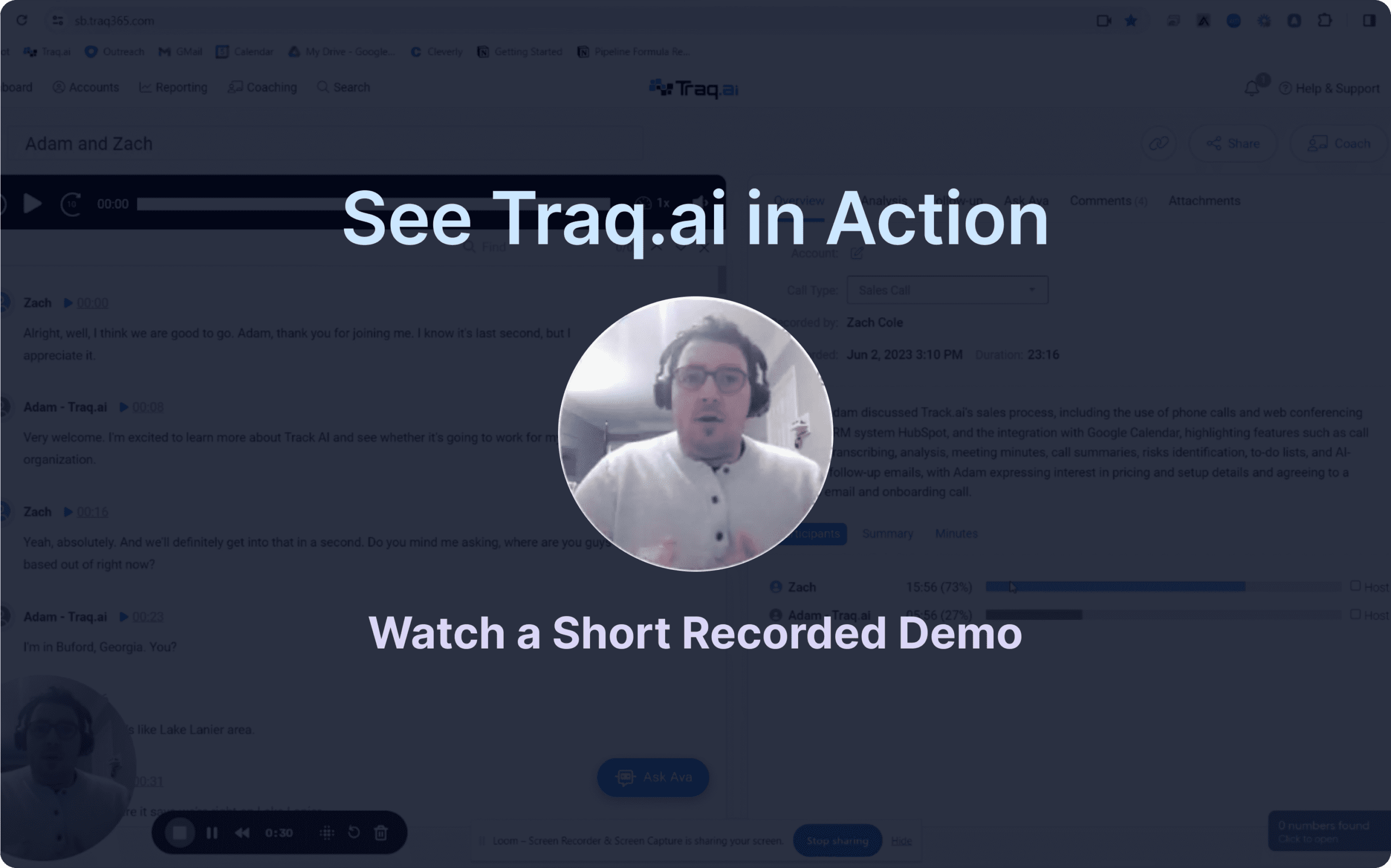
See TRAQ in action in this 5-min intro
Keep Learning

Putting Conversation Intelligence to Work: Process, Integration, and Strategy

How Can Sales Managers Leverage Conversation Intelligence Data?