
What ROI Should You Expect from Conversation Intelligence Software?
A sales leader’s guide to calculating value and avoiding expensive experiments
Quick Summary:
- Most ROI calculations fail because they focus on “revenue influenced” instead of measurable efficiency gains
- Time to value matters more than feature lists. Platforms requiring 90+ days to deliver insights cost you months of lost impact
- Four metrics actually matter: rep productivity recovery (1+ hour daily), coaching efficiency, faster ramp time (2-4 months shorter), and deal velocity improvements
- A 10-person team can expect 25:1 to 50:1 ROI based on productivity gains alone, before accounting for pipeline impact
- Immediate time-to-insight beats delayed implementation every time
Most sales leaders struggle to justify conversation intelligence investments beyond “it seems useful.” Revenue attribution is nearly impossible to isolate. Implementation timelines vary wildly. And most ROI projections rely on best-case scenarios that never materialize.
This article cuts through vendor promises to show you what realistic ROI looks like and which metrics actually matter.
Why Most ROI Calculations Miss the Mark
Vendors love talking about “revenue influenced” as an ROI metric. It’s meaningless. Did the deal close because of the conversation intelligence platform, or because your rep built a great relationship? You’ll never know, and neither will the vendor.
Better ROI measures focus on efficiency gains and velocity improvements, things you can actually track and attribute.
The bigger problem most sales leaders overlook: time to value. A platform that takes 90 days to configure and another 60 days to collect enough data for insights has already cost you five months of potential impact. That’s a real cost that never shows up in ROI calculations.
The Two ROI Timelines That Matter
Timeline 1: Time-to-First-Insight
Industry average for conversation intelligence platforms: 30 to 90 days. You need implementation, integration with your CRM, AI model training, and data accumulation before the platform tells you anything useful.
TRAQ delivers insights from your first recorded call. Click a button, connect your calendar, and the AI starts identifying coaching moments immediately. No training period. No waiting for data accumulation. No implementation project.
Timeline 2: Time-to-Measurable-Impact
Within the first 30 days, the most immediate impact is manager visibility and coaching quality. Managers go from hearing 4 to 6% of their team’s conversations to having AI-generated summaries, Buyer Sentiment Scores, and analyses for every call. Coaching shifts from guesswork to data almost immediately.
Managers typically identify coaching opportunities they were missing entirely. Patterns like reps skipping budget qualification or failing to set clear next steps only become visible when you can see across all conversations.
By 60 days, teams see measurable improvements in rep efficiency. With TRAQ automatically generating transcriptions, summaries, action items, and follow-up drafts, reps recover significant time previously spent on post-call admin. Coaching sessions become more targeted because managers prep with conversation data instead of relying on memory.
At the 90-day mark, the compounding effects start showing up in pipeline metrics. Deals move faster because reps follow up more consistently (TRAQ drafts the follow-ups), managers intervene earlier on at-risk deals (Buyer Sentiment Scores flag declining engagement), and new reps ramp more quickly because they’re learning from real conversations in the Coaching Library rather than theory alone.
The pattern is consistent: efficiency gains come first, coaching improvements come second, and pipeline impact follows.
The 4 ROI Metrics Sales Leaders Actually Care About
Metric 1: Rep Productivity Recovery
Average reps spend 2 to 3 hours daily on post-call admin: updating CRM fields, writing follow-up notes, remembering action items, logging next steps.
TRAQ saves 5 to 7 hours per week on administrative tasks, which translates to roughly 1 to 1.5 hours per day. This is consistent across clients, though the exact number depends on how much manual note-taking and CRM updating the team was doing before.
The specific tasks conversation intelligence eliminates or dramatically reduces:
- Manual note-taking during calls through AI-generated notes that capture key discussion points automatically
- Writing post-call summaries with instant AI-created recaps ready within minutes
- Drafting follow-up emails via contextual AI communication based on what was actually discussed
- Logging action items and next steps into the CRM with automatic identification and sync to HubSpot, Salesforce, Zoho, and other platforms
- Reviewing recordings to remember what was said thanks to searchable transcripts and summaries that surface specific moments instantly
Reps see the time savings almost immediately from their very first recorded call. There’s no learning curve for the core productivity features because TRAQ does the work automatically. A rep finishes a call, and within minutes they have a transcript, summary, action items, and a drafted follow-up ready to go. The only setup required is connecting their calendar, which takes a few minutes.
What this means for your team: Recovering just 1 hour per rep per day equals 5 hours weekly. For a 10-person team, that’s 50 hours back, more than one full-time employee worth of selling time recovered.
Metric 2: Coaching Efficiency
Traditional coaching: Managers join random calls, hope they catch something useful, and give generic feedback like “be more consultative.”
TRAQ’s AI identifies specific moments where reps miss opportunities, fumble objections, or skip discovery questions. Managers coach on actual behavior instead of gut feeling.
TRAQ changes coaching economics in two ways:
First, it dramatically cuts prep time. Instead of spending an hour listening to recordings to find one coaching moment, a manager reviews a conversation summary and AI analysis in five minutes and immediately knows what’s worth coaching on. That efficiency gain means managers who could previously provide deep coaching to 8 to 10 reps can extend meaningful, data-backed coaching to far more reps.
Second, coaching sessions become more focused and productive. When a manager walks into a one-on-one with specific conversation data like “In your call with Acme, the buyer raised concerns about implementation twice and you moved past it both times,” the conversation is immediately substantive. There’s no time wasted on “How do you think that call went?” or trying to reconstruct what happened from memory. Sessions can be shorter while delivering more impact because they’re built on evidence, not recollection.
The quality improvement is significant because managers are no longer limited to coaching on the small sample of calls they personally observed. TRAQ analyzes every conversation, so managers can identify patterns across all of a rep’s calls. That’s the kind of systemic coaching opportunities that are invisible from a handful of ride-alongs.
Metric 3: New Rep Ramp Time
Three things drive faster ramp with TRAQ:
First, new reps get AI-generated coaching insights on every call from day one, not just the occasional ride-along. That means every conversation becomes a learning opportunity with specific, actionable feedback, not just the handful a manager can personally observe.
Second, the Coaching Library gives new reps access to real examples of what “good” looks like in their specific selling environment. Instead of learning from role plays and theory, they can study actual conversations where top performers handled discovery, navigated objections, or closed deals. This is learning from the real thing, not a simulation.
Third, managers can coach new reps more effectively because they have conversation data for every call the new rep takes. They don’t have to guess where the rep is struggling. TRAQ’s analysis shows them. This means coaching interventions happen faster and target the right skills.
For a team with a typical six-month ramp, these factors combined can reasonably compress that timeline by two to four months. The exact improvement depends on your sales cycle complexity and baseline ramp process, but the acceleration is real because it addresses the core bottleneck: new reps learn faster when every conversation generates structured feedback, not just the ones their manager happens to join.
What this means for your team: Cutting two to four months off a six-month ramp means reps start producing pipeline earlier. For a team hiring aggressively, this compounds fast.
Metric 4: Deal Velocity & Win Rate
Conversation intelligence platforms promise better win rates and faster deal cycles. The mechanism: reps identify buyer concerns earlier, managers spot stalled deals before they die, and teams replicate what top performers do differently.
Deal velocity and win rate improvements are the hardest ROI metrics to isolate because so many variables influence outcomes. That said, the mechanisms through which TRAQ drives improvement are clear and well-documented across clients.
Better follow-up is the most immediate driver. TRAQ automatically drafts follow-up communications and identifies action items, which means commitments made during calls don’t fall through the cracks. Deals move faster when reps follow up promptly with relevant, personalized messages instead of generic check-ins two days later.
Better deal management comes next. Managers using TRAQ’s Call Scores, Opportunity Reporting, and Buyer Sentiment Scores can identify at-risk deals before they stall. A declining sentiment trend across calls is an early warning signal that gives managers time to intervene, coach the rep, adjust strategy, or escalate before the deal goes cold.
Better coaching compounds over time. When reps consistently improve their discovery, objection handling, and qualification skills through TRAQ-informed coaching, the cumulative effect shows up in win rates. It’s not a single insight that changes an outcome but rather dozens of small improvements across every conversation that add up.
Clients who fully adopt TRAQ across their team and use it consistently for coaching and deal management typically see meaningful improvements in pipeline velocity and close rates within one to two quarters. The improvement is directional and real, though the specific percentage varies by team maturity, market, and how actively managers use the data.
Calculating Your Expected ROI
Simple Formula:
(Time Saved per Rep × Hourly Value × Number of Reps) + (Incremental Revenue from Velocity/Win Rate Improvements) – Platform Cost = Annual ROI
Example Calculation for a 10-Person Team
Here’s a conservative calculation for a 10-person sales team on TRAQ’s Professional Plan.
Platform cost: 10 users at $60/month = $600/month, or $7,200 per year. No long-term contract required, no implementation fees, no setup costs.
Time savings value: Let’s be conservative and estimate each rep recovers 1 hour per day (well below the 1.5 to 2 hours clients typically report). That’s 5 hours per week per rep, or 50 hours per week across the team. Assuming an average rep fully loaded cost of $120,000/year (roughly $58/hour), that recovered time is worth approximately $150,000 annually in productivity. Even if only half of that recovered time converts to additional selling activity, that’s $75,000 in reclaimed capacity.
Coaching efficiency: Harder to quantify, but if better coaching helps even one additional rep hit quota who would have otherwise missed, the revenue impact far exceeds the platform cost. For a team with an average quota of $500K, a 5% improvement in team attainment driven by more targeted coaching represents $250,000 in additional revenue.
New rep ramp: If you hire two reps this year and each reaches productivity one month earlier, that’s two additional months of pipeline contribution. At even a conservative $30K in pipeline generated per rep per month, that’s $60,000 in accelerated revenue.
Total conservative annual value: $75,000 (productivity) + $250,000 (coaching-driven attainment) + $60,000 (faster ramp) = $385,000.
Against a platform cost of $7,200, that’s roughly a 50:1 return. Even if you cut these estimates in half to be skeptical, the ROI is still compelling at 25:1.
The key point: TRAQ doesn’t need to transform your sales results to deliver strong ROI. The productivity recovery alone covers the cost many times over. Everything else is upside.
We haven’t even discussed the “soft” benefits of improved morale and higher satisfaction among your team. Salespeople want to know that their leadership values them and their time and is willing to invest in productivity tools.
Red Flags That Kill ROI
- Some conversation intelligence platforms create more problems than they solve:
- Platforms requiring weeks of “AI training” before delivering insights mean you’re paying for a product that doesn’t work yet. You’re the unpaid data labeler.
- Tools that only work for inside sales exclude field reps, making your conversation data incomplete and your insights skewed.
- Systems that create more admin work defeat the purpose. If reps need to correct transcriptions, tag calls manually, or fill out forms the AI should handle, you’ve bought an expensive new chore.
- “Insights” that require a data analyst to interpret won’t get used. Managers need clear, actionable coaching moments, not dashboards they need training to understand.
Getting Started: Match Your ROI Timeline to Your Business Reality
If you need immediate impact:
You can’t wait 90 days for insights. Your team needs coaching opportunities now. You want setup that takes minutes, not weeks.
This is where TRAQ’s click-and-go approach makes sense. No implementation project. No AI training period. Connect your calendar, and the platform starts working.
The fastest way to evaluate TRAQ is to start a free 14-day trial. There’s no credit card required and no long-term commitment. Just connect your calendar, record a few calls, and see the AI-generated summaries, Buyer Sentiment Scores, and coaching insights for yourself. Most teams know within the first week whether the platform fits their workflow.
If you’d rather see the full picture before diving in, schedule a 20-minute demo. We’ll walk through how TRAQ works for your specific team size and sales process, and you can ask questions about the features that matter most to your situation.
If you have time for a project:
Maybe you have implementation resources available. You’re willing to wait for data accumulation. You can dedicate someone to manage configuration and training.
Other platforms might work, but understand the real cost: delayed value and team capacity tied up in setup.
For teams evaluating multiple platforms, here’s a practical test: compare time-to-first-insight. Record the same set of calls in TRAQ and any other platform you’re considering. See which one delivers actionable coaching insights faster. The difference is usually decisive.
Finally, consider the value of customized analyses designed around how you do business. Unlike other platforms that force you to use their standardized approach, TRAQ recognizes that every sales team has unique needs. Let TRAQ deploy the analyses you need to win more deals more quickly.
Here’s What Matters
- ROI for conversation intelligence isn’t about attributing revenue to a platform. It’s about time reclaimed, decisions improved, and teams ramping faster.
- The best conversation intelligence investment is the one you’ll actually use, and that means time to value matters as much as feature lists.
- Calculate your realistic ROI based on efficiency gains first. Revenue improvements compound from there, but they’re harder to isolate and take longer to materialize.
- Start with the timeline you can’t afford to waste.
Ready to see ROI from your first recorded call? Start your free 14-day TRAQ trial today. No credit card, no contracts, no implementation project. Connect your calendar in minutes and let the AI show you what your sales conversations have been telling you.
Want to run the numbers for your team first? Schedule a 20-minute demo and we’ll walk through a customized ROI projection based on your team size, sales cycle, and goals.
About the Author
Adam Rubenstein is the CEO of TRAQ, a conversation intelligence platform for sales and customer-facing teams. He works with sales leaders to turn real conversations into structured insights, repeatable coaching, and measurable improvement, helping teams execute consistently and scale what works. Connect with Adam on LinkedIn or learn more at traq.ai.
Learn How TRAQ Transforms Sales Teams
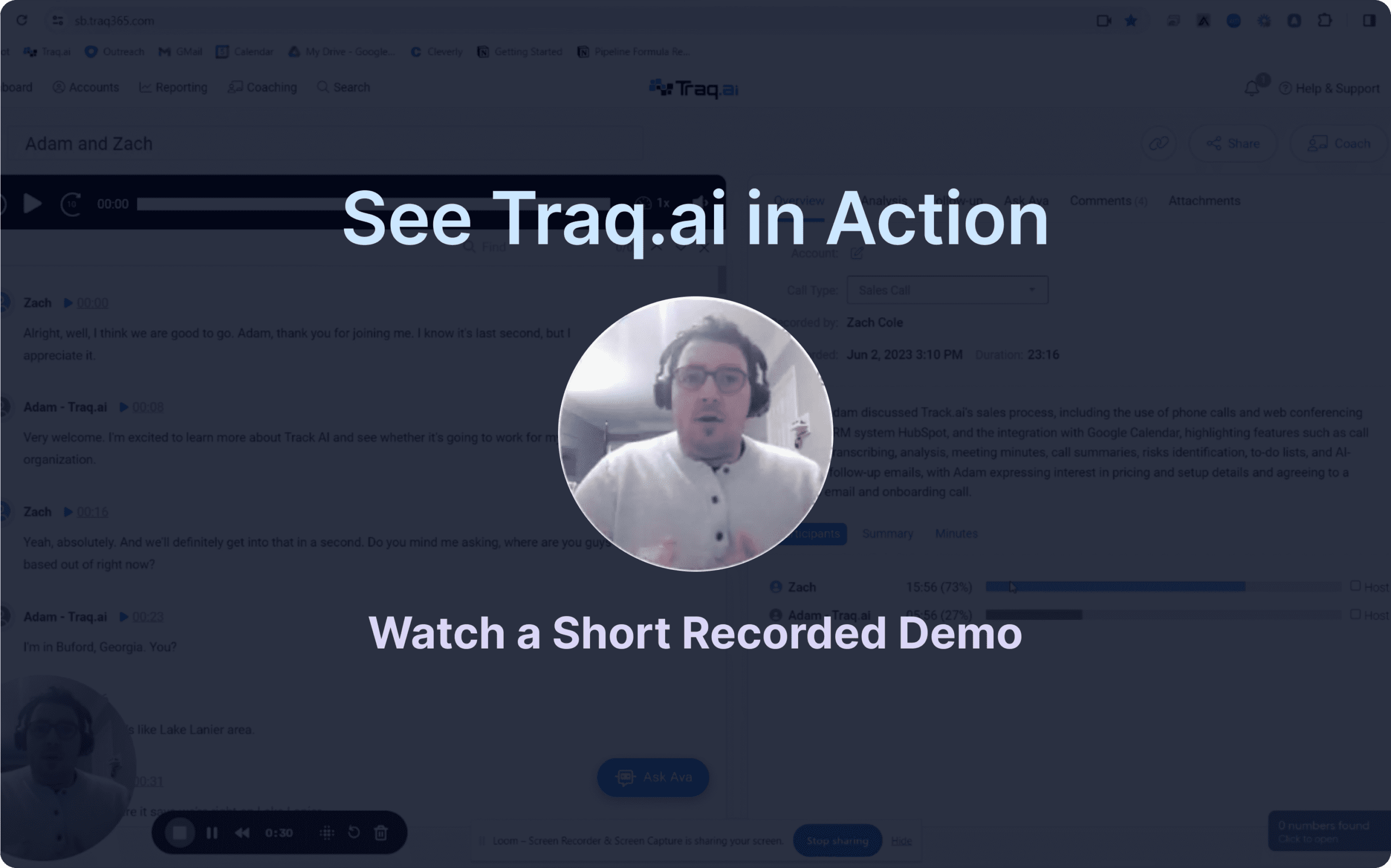
See TRAQ in action in this 5-min intro
Keep Learning
The CRM Was Never the Truth. It Was the Best We Had.

Beyond Ride-Alongs: How Conversation Intelligence With AI Turns Every Call Into a Coaching Moment. Stop Coaching the Few. Start Elevating the Entire Team.