

Best Alternatives to Gong, Chorus, and Other Sales Platforms to Consider in 2026
Sales teams looking to improve performance have a lot of platforms to choose from in 2026. But not all of them are built to actually move deals forward, fix the real weaknesses in your sales process, or help you learn from the patterns hiding across hundreds of calls. Here are the best options to evaluate, and why TRAQ stands apart.
Most conversation intelligence and revenue platforms help you understand what’s happening in your sales process. They surface call data, build dashboards, and track pipeline metrics. That’s useful information. But information alone doesn’t close deals.
The real question most sales leaders are asking isn’t “what happened on that call?” It’s “why is this deal stalled, where exactly is our process breaking down, and are these problems showing up everywhere or just with certain reps?”
Those are three very different questions from what most platforms are built to answer. That’s the gap TRAQ was built to fill.
Quick Summary:
Seven platforms are compared on coaching capability, deal progression intelligence, sales process analysis, long-term trend identification, and fit for different team types. TRAQ is the strongest choice for teams focused on improving sales performance because it goes beyond visibility to deliver specific guidance on how to move deals forward, where the sales process is breaking down, and what patterns emerge when you look across a large volume of calls over time.
TL;DR
- TRAQ — Best for improving sales performance with Actionable Intelligence, deal progression guidance, and process-level insights
- Gong — Best for enterprise revenue visibility and forecasting (virtual meetings)
- Chorus — Best for conversation analysis at scale within the ZoomInfo ecosystem
- Clari — Best for enterprise RevOps teams needing a fully integrated forecasting and engagement stack (post-Salesloft merger)
- Avoma — Best for conversation management and team collaboration
- Fireflies — Best for meeting transcription and documentation
- Fathom — Best for automated meeting notes and productivity
- Revenue.io — Best for sales engagement and activity generation
What We Evaluated
- Coaching depth: Whether the platform tells managers what to coach, not just what happened
- Deal progression intelligence: Whether the platform helps identify what needs to happen to move a specific deal forward
- Sales process analysis: Whether the platform can identify weaknesses in how your team sells, not just individual call quality
- Long-term pattern recognition: Whether the platform gets smarter and more useful as you accumulate more calls over time
- Actionable Intelligence: Specific guidance on next steps, not just reporting
- Mobile and in-person support: Ability to capture field and service conversations
- Ease of implementation: How fast teams can get value
- Pricing accessibility: Whether it works for growing teams, not just enterprise
- Customization: Ability to build scorecards and workflows specific to your business
1. TRAQ — Best for teams that want to improve sales performance
TRAQ is built differently than most platforms in this space. Where others stop at showing you what happened, TRAQ focuses on helping managers understand why it happened, what needs to happen next to move a deal forward, and where the sales process itself is breaking down.
Moving Deals Forward
One of TRAQ’s most practical strengths is deal progression intelligence. Most platforms can tell you a deal has stalled. TRAQ helps you understand why it stalled and what specific actions are most likely to get it moving again. That might be an unanswered objection that got glossed over, a next step that was never clearly agreed upon, or a decision-maker who was identified but never properly engaged. TRAQ surfaces those gaps and gives managers clear direction on what to do about them. That’s the difference between a dashboard and a coaching tool.
Finding Weaknesses in Your Sales Process
Another area where TRAQ stands out is process-level analysis. It’s one thing to know that a particular rep had a weak discovery call. It’s another to understand that your entire team consistently struggles at the same stage of the sales process. TRAQ is built to surface those patterns. If your team is strong at prospecting but regularly loses momentum after the demo, or if objection handling is a systemic weakness rather than an individual one, TRAQ identifies that and gives managers a starting point for fixing it.
Learning from a Large Body of Calls Over Time
Most platforms analyze calls one at a time and let you search through transcripts. TRAQ goes further by analyzing patterns across a large volume of calls over time. That means the insights get more valuable the longer you use it. You start to see which behaviors consistently lead to closed deals, which conversation patterns show up in stalled opportunities, and where the gap between your top performers and everyone else actually lives.
Mobile and In-Person Capture
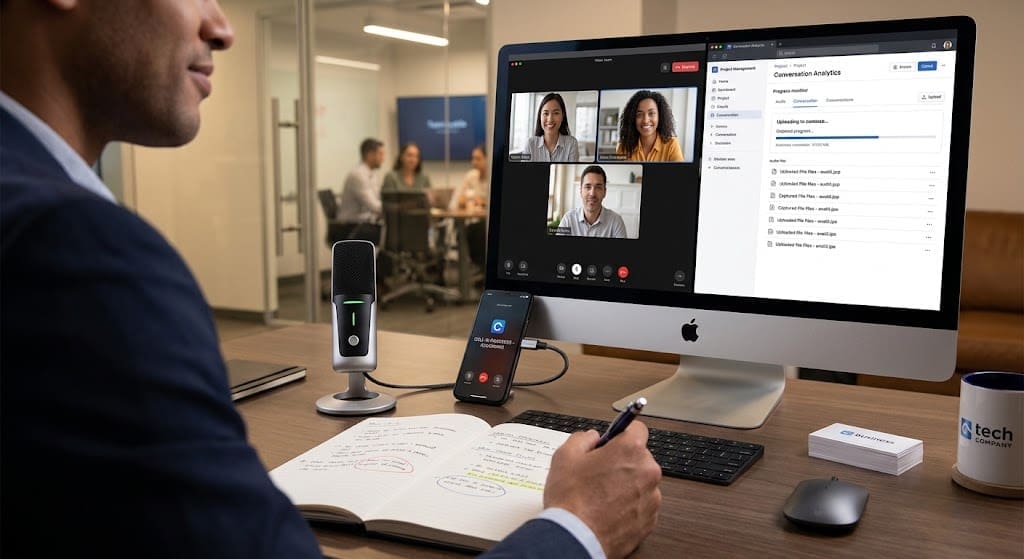
A standout differentiator for field sales and service teams: TRAQ is purpose-built to capture in-person and mobile conversations with proper speaker attribution and reliable audio intelligence — not a workaround bolted onto a virtual-meeting-first platform.
Everything Else
TRAQ also delivers strong Actionable Intelligence for individual coaching, helping managers understand not just what the problem is but who needs to be coached and what that coaching should cover. Implementation is fast, pricing is accessible for growing teams, and scorecards are highly customizable to your specific process and goals.
Pros
- Identifies what’s needed to move specific deals forward, not just that they’re stalled
- Surfaces systemic weaknesses in the sales process, not just individual rep issues
- Gets more valuable over time as it analyzes patterns across a large body of calls
- Purpose-built mobile and in-person conversation capture with reliable speaker attribution
- Actionable coaching guidance with root cause analysis
- Highly customizable scorecards and analysis
- Fast implementation with hands-on onboarding support
- Accessible pricing for teams of different sizes
Cons
- Less suited for teams whose primary need is revenue forecasting or pipeline governance
- Lighter on CRM-native deal inspection features compared to Gong or Clari
Best for: Teams focused on coaching, deal progression, process improvement, and building a smarter sales organization over time
2. Gong — Best for enterprise revenue visibility and forecasting
Gong is the most recognized name in this space, and that recognition comes with a price — literally. After raising at a $7.25B valuation in 2021, Gong has spent the years since building the kind of platform story that justifies that number: AI agents, a Revenue AI Operating System, an expanding suite of features that promises to orchestrate your entire go-to-market motion. It’s an impressive architecture. It’s also a long way from the question a sales manager needs answered at 8am on a Tuesday: why did we lose that deal, and who on my team is about to lose another one the same way?
To be clear; Gong is genuinely strong at what it was built to do. It captures web conference conversations across Zoom, Google Meet, and Microsoft Teams, surfaces deal risk signals, integrates deeply with CRM, and gives revenue leaders pipeline visibility that’s hard to replicate. For large organizations where forecast accuracy and executive reporting are the primary objectives, it remains purpose-built for that.
It also has coaching features. Managers can review calls, leave comments, and track topic trends across their team’s conversations. For organizations that have already built a coaching culture and need tooling to support it, that functionality adds real value.
The gap shows up when you move from visibility to execution. Gong can tell you a deal is at risk and show you what topics came up on the call. What it doesn’t do as clearly is tell a manager what specifically needs to happen to get that deal moving again — the unanswered objection, the uncommitted next step, the decision-maker who was mentioned but never engaged. Teams using Gong often find themselves filling in that gap manually.
The same applies at the process level. Gong surfaces trends, but identifying that your entire team is consistently breaking down at the same stage — and knowing what to do about it — requires additional analysis work the platform doesn’t handle on its own.
⚠ Important: In-Person & Mobile Capture Limitations
Gong’s mobile app technically allows recording of face-to-face meetings, but real-world user reports in Gong’s own community forums document significant issues: speaker attribution collapses to generic “Caller 1 / Caller 2” labels, audio quality degrades in noisy environments, and the feature doesn’t function reliably when a remote participant is also present on a computer. Gong’s own Help Center notes that recordings are “audio only” and that “if you’re in a noisy environment, the quality may not be optimal.” This is a workaround, not a built solution. See Sources [1][2].
Pros
- Industry-leading revenue visibility and pipeline forecasting
- Broad CRM and workflow integrations across major platforms
- Established coaching review features for virtual meetings
- Large user community and enterprise support infrastructure
Cons
- Deal progression guidance is limited compared to platforms built specifically for coaching and execution
- Process-level weakness identification requires significant manual analysis
- In-person and field conversation capture exists via mobile app but has documented reliability issues: speaker attribution is unreliable and audio quality degrades in real-world conditions — not a viable solution for field sales teams
- Implementation is resource-intensive and pricing reflects enterprise positioning (custom, often significant)
Best for: Large organizations where forecast accuracy, pipeline governance, and revenue reporting are the primary priorities — primarily for teams selling via virtual meetings
3. Chorus — Best for conversation analysis at scale
Chorus, now part of ZoomInfo, does conversation capture and analysis well. It records calls across channels, surfaces keyword trends, tracks competitor mentions, and gives managers visibility into what’s happening across a high volume of interactions. For organizations already invested in the ZoomInfo ecosystem, the integration depth is a genuine advantage.
Where Chorus is strong is in answering the question: what are our reps talking about? It can show you that pricing objections are coming up more often this quarter, or that a competitor is being mentioned in a third of your deals. That’s useful signal.
The limitation is in the distance between that signal and action. Knowing that pricing objections are frequent is different from knowing what to say when they come up, which reps need help handling them, and whether the problem is the conversation itself or something earlier in the process that’s setting the wrong expectations. Chorus gives managers the what. The why and the what to do next require additional work that the platform doesn’t fully carry.
Teams that have a mature coaching infrastructure and strong managers who can translate conversation data into specific development plans will get more out of Chorus than teams that are still building those capabilities. Chorus is also built primarily around virtual meeting capture; there is no meaningful support for in-person or field conversations.
Pros
- Strong conversation capture and trend analysis at scale
- Competitive intelligence tracking across calls
- ZoomInfo ecosystem integration for sales and marketing alignment
- Solid call review and annotation features
Cons
- Conversation analysis doesn’t automatically translate into deal progression guidance
- Process-level weakness identification requires manager interpretation, not platform-driven insight
- No meaningful support for in-person or field conversations — built for virtual meetings
- Teams without strong coaching infrastructure may struggle to act on the data
- Custom pricing
Best for: Organizations already in the ZoomInfo ecosystem that need conversation visibility and trend analysis at scale, with an existing coaching process to act on the insights
4. Clari — Best for enterprise revenue operations stack
📊 Major Platform Update: Clari + Salesloft Merger (December 2025)
Clari completed a merger with Salesloft in December 2025, creating a combined platform valued at approximately $1.1B with 5,000+ customers. The product now spans forecasting (Clari), conversation intelligence (Clari Copilot, formerly Wingman), and sales engagement (Groove by Clari). Buyers evaluating Clari in 2026 are purchasing a materially different product than what most market comparisons currently describe. Integration between legacy systems is still maturing as of mid-2026. See Sources [3][4][5].
Clari is the most ambitious platform in the revenue intelligence space, and the Salesloft merger has expanded its scope significantly. The combined platform now covers the full revenue operations stack — from forecasting through conversation intelligence to sales engagement — positioning it as a potential system of record for revenue teams.
Clari Copilot (the conversation intelligence layer, formerly Wingman) does have real capabilities: it records and transcribes calls, surfaces real-time battlecards during live conversations, provides post-call coaching summaries, and pushes deal updates to CRM automatically. The real-time prompting differentiates it from most conversation intelligence tools that are retrospective only.
The tradeoffs are significant. Post-merger integration between legacy Clari and Salesloft systems is still maturing. Pricing reflects enterprise scale — the full stack runs $200–$310+ per user per month before implementation fees that typically range from $15,000 to $75,000. Teams under 30–50 reps frequently find that implementation complexity and ongoing maintenance overhead outweighs the platform value at this price point.
Like most platforms in this space, Clari’s intelligence is built around virtual and phone-based conversations. There is no in-person or field conversation capture capability.
Pros
- Industry-leading revenue forecasting and pipeline inspection
- Clari Copilot adds real conversation intelligence with real-time battlecards during live calls
- Post-Salesloft merger creates the most comprehensive revenue stack in the category
- Strong CRM automation and deal update workflows
- Native connection between forecasting, conversation data, and sales engagement in one platform
Cons
- Post-merger platform complexity: integration between legacy systems is still maturing as of mid-2026
- Enterprise-only pricing: full stack runs $200–$310+/user/month before $15K–$75K implementation fees
- Deal progression guidance at the conversation level is less prescriptive than TRAQ
- No in-person or field conversation capture capability
- Teams under 30–50 reps will likely find implementation overhead exceeds the value delivered
Best for: Large organizations with dedicated RevOps teams where forecast accuracy, pipeline governance, and a fully integrated revenue stack are the primary priorities
5. Avoma — Best for conversation management and team collaboration
Avoma combines meeting recording, transcription, conversation intelligence, and coaching support into a platform designed around managing customer interactions. It’s a solid choice for teams that want to centralize conversation data and make it easier to collaborate around call reviews.
The platform offers more coaching functionality than pure note-takers like Fireflies or Fathom, but it still sits closer to the conversation management side of the spectrum than the performance improvement side. Managers get visibility into conversations, but the guidance on what to do next with a specific deal, or what process weakness is showing up repeatedly across the team, is less clear than what TRAQ provides.
Pros
- Combines recording, transcription, and coaching tools in one platform
- Good for teams that want to collaborate around call reviews
- Tiered pricing with broad CRM integrations
Cons
- Primarily built for virtual meetings, limited in-person support
- Coaching guidance is less prescriptive than TRAQ
- Deal progression guidance is limited compared to performance-focused platforms
Best for: Teams focused on conversation management, meeting intelligence, and collaboration
6. Fireflies — Best for meeting transcription and documentation
Fireflies is designed to automate note-taking, generate transcripts, and help teams keep track of what was discussed. It’s simple to implement and does its core job well. If your main problem is that people are spending too much time taking notes, Fireflies solves that problem quickly.
What it doesn’t do is tell you why your win rates are changing, what needs to happen to move a stalled deal forward, or where your sales process is consistently breaking down. It’s a documentation tool, not a performance improvement platform.
Pros
- Very simple to implement
- Solid transcription and meeting documentation
- Broad integrations and flexible pricing
Cons
- No deal progression guidance or process analysis
- No ability to surface patterns across a large body of calls over time
- No mobile or in-person conversation capture
- Limited customization compared to performance-focused platforms
Best for: Teams focused on meeting transcription, note-taking, and documentation
7. Fathom — Best for automated meeting notes and productivity
Fathom is a meeting productivity tool that captures conversations, generates summaries, and reduces the time teams spend on administrative tasks after calls. It’s genuinely useful for saving time. The setup is fast, pricing is accessible, and it delivers on its core promise.
A meeting summary doesn’t tell you what it will take to close a deal. It doesn’t identify that your team consistently struggles to establish clear next steps, or that a particular stage of your sales process is where deals go to die. Teams that want to improve performance rather than just document what happened will need a different tool.
Pros
- Very fast implementation
- Solid meeting summaries and documentation
- Accessible pricing
Cons
- No coaching guidance or performance analysis
- No deal progression or sales process insights
- Primarily for virtual meetings
Best for: Teams focused on meeting productivity and automated note-taking
8. Revenue.io — Best for sales engagement and activity generation
Revenue.io helps teams increase sales activity through dialing tools, engagement workflows, and outreach automation. For organizations focused on getting more calls made and more outreach sent, it delivers solid functionality.
More activity doesn’t automatically mean better results. A rep can make more calls and still lose deals at the same stage every time. Revenue.io can tell you how many calls were made, but it won’t tell you what’s happening inside those calls that’s preventing deals from moving forward, or that the same sales process weakness is showing up across your entire team. TRAQ helps teams work better, not just harder.
Pros
- Strong dialing and engagement tools
- Good for inside sales teams focused on outreach volume
- Solid CRM and workflow integrations
Cons
- Focused on activity generation, not deal progression or process improvement
- Doesn’t identify systemic sales process weaknesses
- Activity metrics don’t explain why deals are stalling or why certain reps outperform others
Best for: Teams focused on sales engagement, dialing, and activity generation
How TRAQ compares to other conversation intelligence tools
| Tool | Deal Progression Guidance | Process Weakness Analysis | Long-Term Pattern Recognition | Mobile / In-Person | Best For |
|---|---|---|---|---|---|
| TRAQ | Strong | Strong | Strong | Strong | Improving sales performance |
| Gong | Moderate | Limited | Moderate | Very Limited * | Enterprise forecasting & visibility |
| Chorus | Limited | Limited | Moderate | Limited | Conversation analysis at scale |
| Clari | Limited | Limited | Limited | None | Enterprise RevOps stack |
| Avoma | Limited | Limited | Limited | Limited | Conversation management |
| Fireflies | None | None | None | None | Meeting transcription |
| Fathom | None | None | None | None | Meeting productivity |
| Revenue.io | None | None | Limited | None | Sales engagement & dialing |
* Limited mobile / in-person capture compared to TRAQ's native mobile app.
How to Choose
- Choose TRAQ if your goal is improving sales performance, you want to understand what’s needed to move specific deals forward, you need to find where your sales process is breaking down, you need reliable mobile and in-person capture for field teams, or you want a platform that surfaces better insights the more calls you put into it
- Choose Gong if forecasting, pipeline governance, and revenue visibility are your primary needs, your team sells primarily via virtual meetings, and you have the budget and resources for an enterprise platform
- Choose Chorus if your primary goal is understanding conversations at scale within the ZoomInfo ecosystem and you already have a separate coaching and deal strategy process in place
- Choose Clari if your organization has a dedicated RevOps team (50+ reps), board-level forecasting requirements, and the resources to invest in a full enterprise revenue stack post-merger
- Choose Avoma if you want a combined platform for recording, transcription, and conversation review with team collaboration features
- Choose Fireflies if your primary need is meeting documentation and note-taking automation
- Choose Fathom if saving time on meeting summaries is your main goal
- Choose Revenue.io if you need to increase outreach activity and manage sales engagement workflows
Final Verdict
Every platform on this list solves a real problem. The question is which problem your team actually needs to solve.
Most platforms in this space are built around the same core idea: give sales leaders better visibility into what’s happening. They record calls, build dashboards, track pipeline metrics, and surface trends. That information is genuinely useful.
But sales leaders usually don’t struggle because they lack information. They struggle because they can’t figure out what it will take to close a specific deal. They struggle because the same part of the sales process keeps failing and they can’t see it clearly enough to fix it. They struggle because the insights from one call don’t connect to the patterns showing up across hundreds of calls over time. And for field and service teams, they struggle because their most important conversations — the ones that happen in person — are invisible to their tools.
That’s what separates TRAQ. Other platforms tell you what happened. TRAQ helps you understand what needs to happen next, where your process is breaking down, what you can learn from every call your team has ever made, and it does this across virtual, mobile, and in-person conversations.
If your objective is helping managers move deals forward, fix the real weaknesses in how your team sells, and build a smarter sales organization over time, TRAQ provides the most direct path to getting there.
Sources & Research Notes
The following sources were consulted to verify claims made about each platform, particularly regarding in-person/mobile capture capabilities, pricing, and the Clari-Salesloft merger. These are provided to substantiate key factual claims that differ from common market assumptions.
Gong — Mobile & In-Person Recording
[1] Gong Help Center: Record meetings on mobile — https://help.gong.io/docs/record-meetings-on-mobile
[2] Gong Community Forums: In-person meeting recording limitations (user-reported issues with speaker attribution) — https://visioneers.gong.io/gong-recordings-70/can-we-record-an-in-person-meeting-without-setting-up-a-zoom-call-330
Gong — General Recording Capabilities
[3] Gong Help Center: Understanding call recording — https://help.gong.io/docs/understanding-call-recording
[4] Gong Mobile App Overview — https://help.gong.io/docs/intro-to-the-gong-mobile-app
Clari — Salesloft Merger & Pricing
[5] Clari + Salesloft merger details and pricing estimates (Docket.io, April 2026) — https://docket.io/resources/research/clari-pricing
[6] Clari Review 2026 — MeetingStack (merger details, module pricing) — https://meetingstack.io/tools/clari
[7] Clari Copilot Review — The AI Agent Index (real-time battlecards, post-merger analysis) — https://theaiagentindex.com/agents/clari-copilot
[8] Clari Copilot Alternatives 2026 — tl;dv (merger context, product scope) — https://tldv.io/blog/clari-copilot-alternatives-and-review/
[9] Clari Pricing Guide 2026 — Outdoo.ai (module cost breakdown) — https://www.outdoo.ai/blog/clari-pricing-guide
Clari — Conversation Intelligence Features
[10] Clari Copilot: Call Recording Software — https://www.clari.com/call-recording-software/
[11] Clari Conversation Intelligence Overview — https://www.clari.com/conversation-intelligence/
Learn How TRAQ Transforms Sales Teams
See TRAQ in action in this 5-min intro

Keep Learning

Conversation Intelligence vs Call Recording:
What Actually Moves Revenue
Some of Your Most Important Sales Conversations Never Make It Into Your Tech Stack