

The Builder’s Platform: How RevOps and Technical Teams Are Unlocking Conversation Intelligence Data with TRAQ
Quick Summary
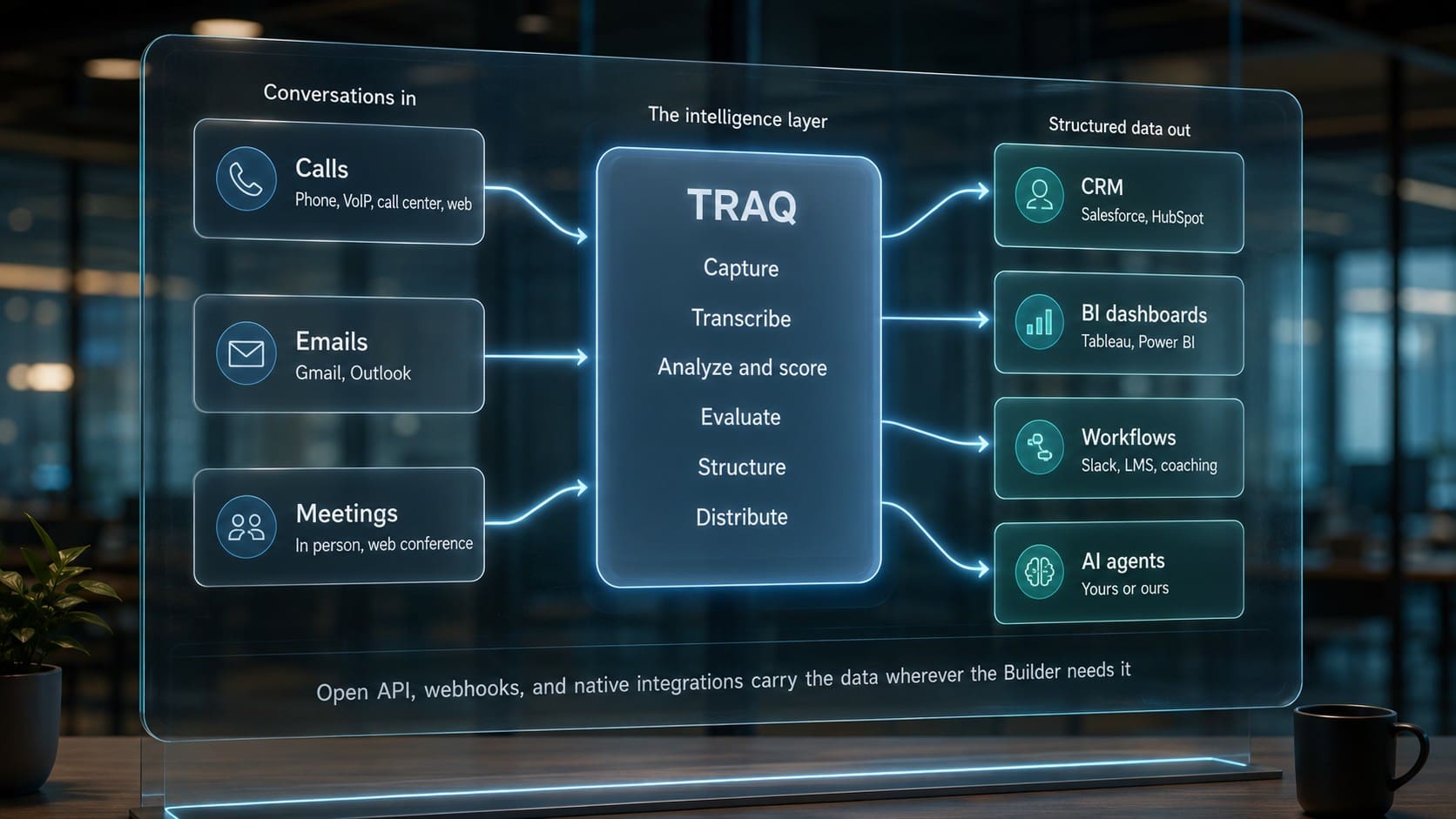
Most sales tech stacks have a critical flaw: the tools don’t talk to each other. CRMs, phone systems, and BI platforms all hold pieces of the puzzle, but the actual sales conversation, the most valuable data your business generates, stays trapped and scattered.
TRAQ fixes that by turning every call and email into structured, scored, ready-to-use data. Not raw transcripts. Not PDFs. Actual signal that BI tools, CRMs, and AI agents can consume directly.
For RevOps and technical teams, TRAQ offers three ways to move that data where it needs to go:
- Open API for pulling data into any tool on your schedule
- Webhooks for pushing data automatically when something happens
- Native integrations with Salesforce, HubSpot, Zoho, and more
The result? Teams are building better forecasting models, automated coaching workflows, compliance QA systems, CRM enrichment pipelines, and AI agents, all on a foundation of real conversation data.
TRAQ is built for the people who build the infrastructure, not just the people who read the dashboards.
Every Tool Is an Island
Your CRM has the records. Your phone system has the recordings. Your BI platform has the dashboards. And none of them talk to each other. The most important thing that happens in your business, the actual conversation between your team and your customers, is scattered across systems that were never designed to work together.
If you work in RevOps, IT, or you are the technical power user everyone comes to when something needs to be connected, you know this pain personally. You are the one they ask to make it all work. And you know the workaround graveyard by heart: spreadsheet exports, manual copy and paste, brittle scripts held together with duct tape between platforms that fight you every step of the way.
Now imagine the conversation itself was your starting point. Already captured. Already scored.
Already structured. Ready to move anywhere you need it.
That is what TRAQ was built to do. And this post is for you, the Builder.
What TRAQ Actually Gives You to Work With
recording software with a search bar on top. It is a revenue intelligence platform that turns every call and email into structured data you can actually use.
Call scoring is the engine underneath everything. Every conversation gets evaluated against a consistent framework, and the output is structured, numeric data. Not a PDF report someone has to read. Scored data that a BI tool, a CRM, or an AI agent can consume directly.
And the score is just the start. TRAQ produces sales conversation analytics across the board:
AI conversation sentiment analysis, compliance flags, coaching triggers, objection tracking, rep performance trends, and deal signals.
Here is why that structure matters so much. A raw transcript is noise to a dashboard or an agent. A structured TRAQ score is signal. If you have ever tried to build anything useful on top of raw call recordings, you already know the difference.
Build the Analysis First, Then Move It Anywhere
TRAQ gives you yours.
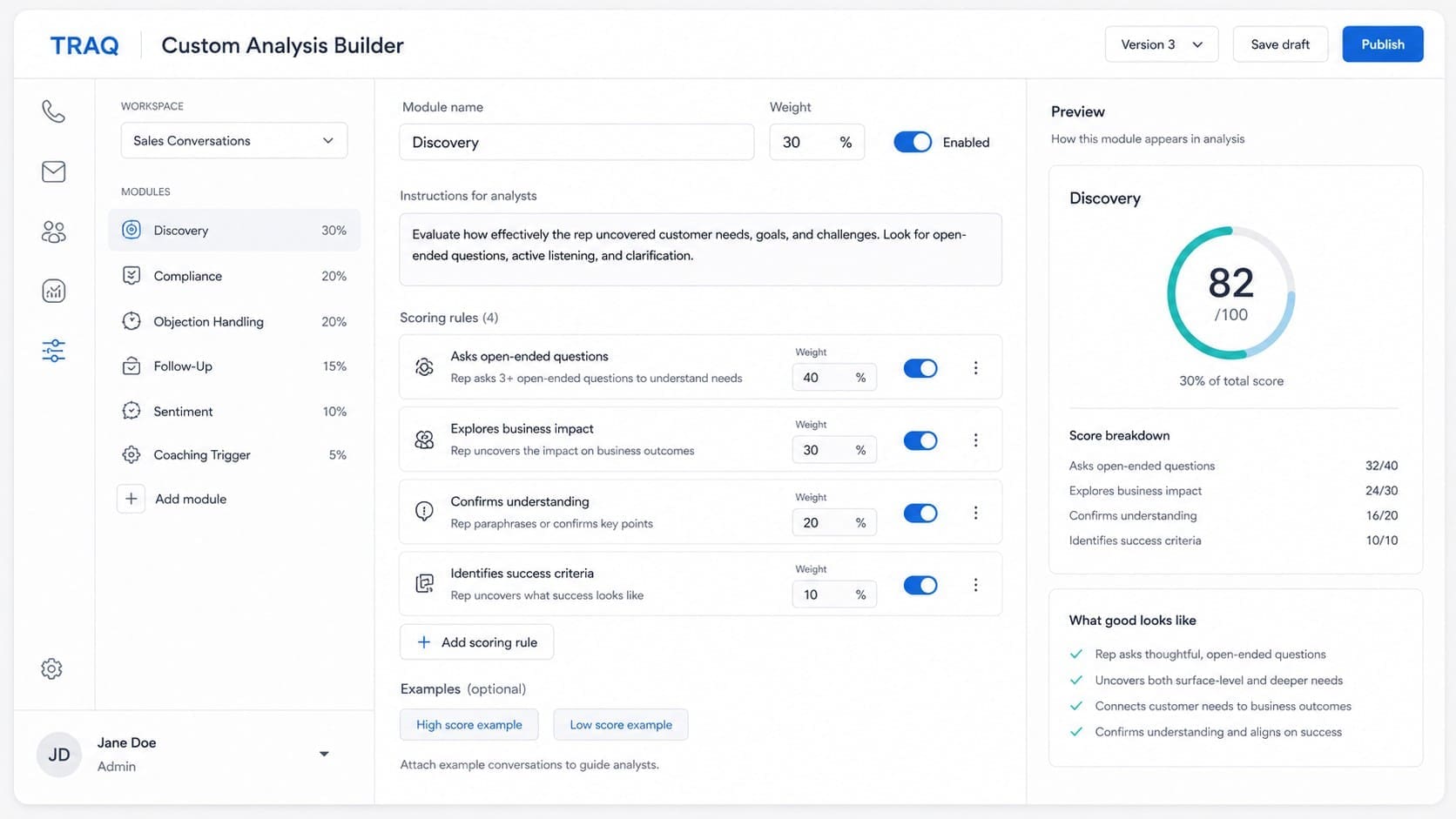
With TRAQ’s custom analysis builder, you define what good looks like for your team, your market, and your methodology. Builders are using this to score things no off-the-shelf tool would think to capture:
- Custom discovery call quality rubrics built around how your team actually sells
- Call compliance checklists that verify required disclosures and regulatory language on every single call, with exceptions flagged automatically
- Methodology adherence, whether your team runs MEDDIC, Challenger, or your own playbook
- Email follow-through and response quality, scored with the same rigor as calls
Here is the payoff. Once you define the analysis, every output is structured data. And structured data can go anywhere.
Cross Call Analysis: Intelligence Across the Whole Relationship
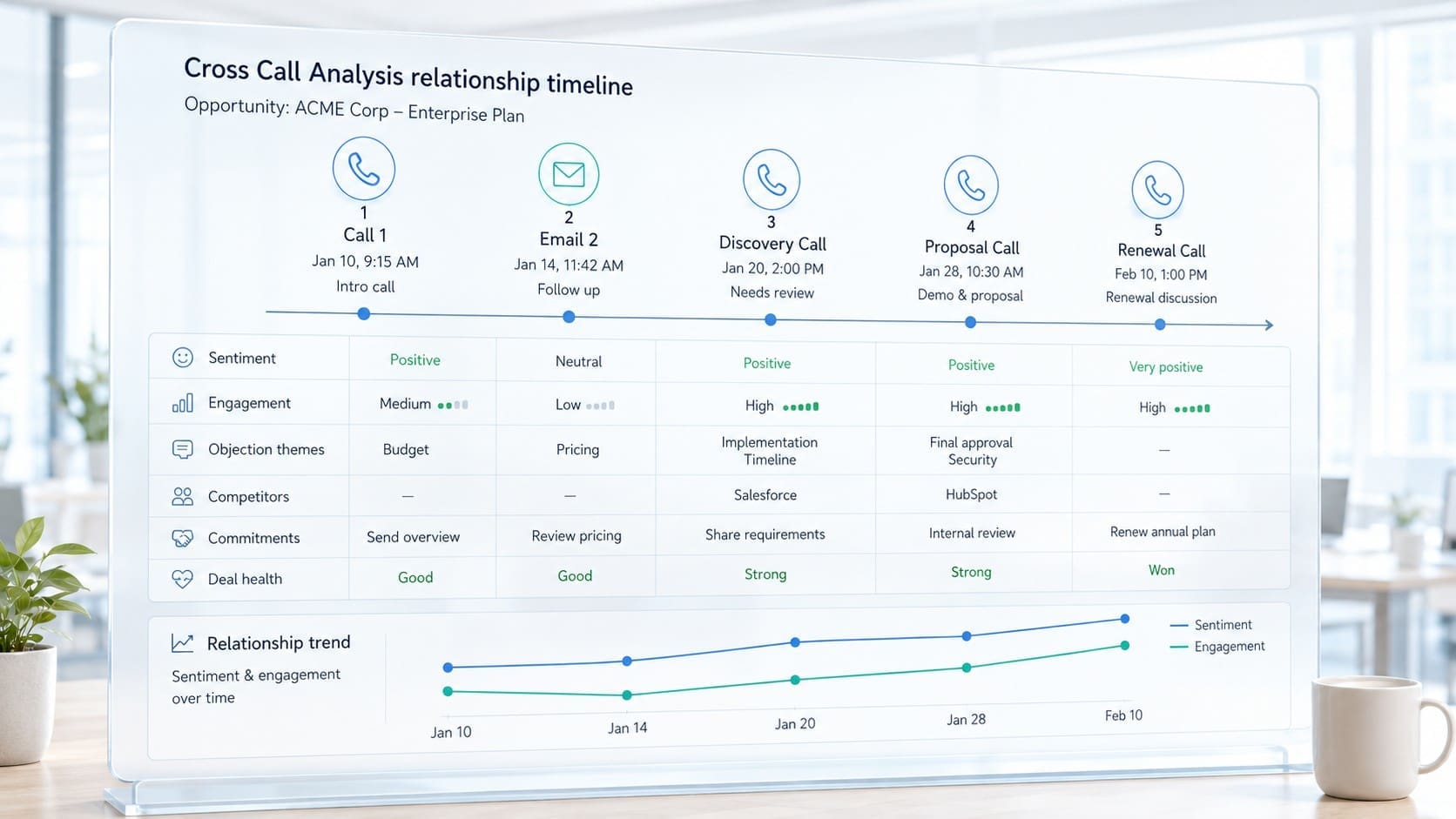
This is the data your leadership dashboards actually need. Not point-in-time snapshots, but longitudinal signal. It is the layer that turns TRAQ from a coaching tool into a true business intelligence source.
Getting It Out: Three Paths for Builders
This is the part you came for. TRAQ gives you three ways to move data wherever you need it.
Path 1: The Open API
TRAQ publishes documented, RESTful API covering every major data object: calls, scores, transcripts, coaching flags, rep performance, and deal signals. Pull it on your own schedule into any tool you want. Your BI platform. Your data warehouse. Your custom dashboard.
Rate limiting, versioning, and a developer portal mean you are not building on shifting ground. And every connection you make inherits TRAQ’s security posture, with encrypted data in transit and role-based access controls, so you are not creating a new risk surface with every integration.
You own your data. The API is how you exercise that ownership.
Path 2: Webhooks and Triggers
Sometimes you do not want to pull data. You want TRAQ to push it the moment something happens.
Here is a real example. A call ends. The score drops below your threshold. TRAQ automatically creates a CRM follow-up task, fires a Slack alert, and kicks off a coaching workflow. No one had to check a report. The data moved because something happened that mattered.
This is the bridge between conversation intelligence and real action in your downstream tools.
Path 3: Native Integrations
For the connections you want done without writing a line of code, TRAQ offers pre-built connectors for Salesforce, HubSpot, Zoho, and many other platforms. Use native integrations for the common stuff. Use the API for everything else.
Bring Your Own AI: TRAQ as the Foundation for Your Agents
Here is where things get interesting. TRAQ does not have to be the only AI in your stack. It is designed to be the best data source for whatever AI you are running.
Think about what your agents can do with structured TRAQ data that they could never do with raw transcripts:
- Make escalation decisions based on deal health signals
- Draft follow-up emails that reflect what was actually said on the call
- Update CRM fields from conversation content instead of rep memory
- Feed sales pipeline forecasting models with language patterns instead of gut feel
And it is secure and efficient by design. AI inference runs inside TRAQ’s managed infrastructure. There are no external credentials to manage, no third-party exposure, and a full audit trail is maintained automatically. If you are the person who has to defend your architecture to InfoSec, that is not a small thing.
There is an efficiency payoff too. TRAQ data is ready for an agent to consume the moment it is created. You are not cleaning transcripts, normalizing fields, or building a preprocessing pipeline before your agent can do anything useful. That work is already done.
TRAQ wins either way. Build on our native tools or route your own agents through the API. In both cases, TRAQ’s structured data is what the agent depends on.
What You Can Build
Here is what Builders are actually creating with TRAQ data.
Forecasting accuracy and pipeline reliability. CRM-based forecasting is built on what reps type into fields, which is optimistic by definition. TRAQ-based forecasting is built on what was actually said: tone shifts across the deal cycle, commitment language, objection frequency, and engagement patterns. Route deal health scores and sentiment trends into your forecasting model and you get a forecast your VP of Sales can defend to the board. TRAQ tells you whether a deal is real based on the conversation, not the rep’s confidence level.
A revenue intelligence dashboard. Pull real-time rep scorecards, call quality trends, and deal signals from TRAQ into Tableau, Power BI, or Looker. Cross Call Analysis becomes your primary feed, giving leadership longitudinal signal instead of snapshots.
CRM enrichment at scale. Post-call summaries, objection flags, and next-step commitments written automatically into Salesforce or HubSpot from what was actually said. Not what the rep remembered to type at 6pm on a Friday.
Sales coaching without the manual review. TRAQ works like an automated sales coaching tool, surfacing coaching opportunities directly from scored calls. No manager has to listen to hours of recordings to find the teachable moment. Wire score output into a coaching workflow, a Slack alert, or a live dashboard. Managers coach on what the data surfaces, not on whoever they happen to check in on.
Sales training and role play that builds itself. TRAQ automatically identifies high-performing calls that match specific patterns, like the best discovery calls or the strongest objection handling, and surfaces them as training candidates. Route them into any LMS through the API. TRAQ also generates role play scenarios drawn from real conversations in your vertical, built on the actual objections and buyer language your team hears every day. Trigger them automatically when a rep’s score drops in a specific area, so training is targeted instead of one-size-fits-all. Then connect role play scores to real call performance over time and prove the training is working.
Automated QA and compliance workflows. Every call scored against a compliance checklist. Exceptions routed to your compliance officer with a timestamp, call reference, and the specific flag. A full audit trail maintained without anyone doing manual review. This is automated QA the way contact centers and regulated industries like insurance, legal, and financial services actually need it.
Why TRAQ for Builders, Specifically
Most conversation intelligence software is built for the sales leader, not for you. Those tools optimize for the dashboard experience and lock down the data layer underneath it. Limited APIs. Locked export formats. No webhook framework. No custom scoring.
TRAQ is built on a different assumption: technically sophisticated clients will outgrow any pre-built dashboard, and that is a feature, not a problem.
Security that passes the IT review. Enterprise-grade encryption at rest and in transit. Role-based access controls, SSO support, and immutable audit logs on every data access event. SOC 2 Type II compliance as the baseline. When you connect TRAQ to your CRM, your BI platform, or an internal agent, a clean security posture means your integration project does not die in the security review queue.
Efficiency that compounds. TRAQ produces structured, schema-consistent data on every call and email. No transformation layer. No preprocessing pipeline. No manual export process to babysit. Every integration you build runs on the same data model, so adding a new downstream tool never means rebuilding the foundation.
And here is the honest truth about stickiness. The more you build on TRAQ data, the more valuable TRAQ becomes to your team. Not because switching is painful, but because your own workflows and agents now depend on it. That is what open architecture actually delivers.
Getting Started
Want to see it in action? Reach out to the TRAQ team for a technical walkthrough. Bring your hardest integration problem. We like those.
The Bottom Line
Where it goes next is entirely up to you.
Learn How TRAQ Transforms Sales Teams
See TRAQ in action in this 5-min intro

Keep Learning

Are You Training Reps on How to Sell, or on How Your Best Reps Actually Sell?

Coaching From 6% of the Picture